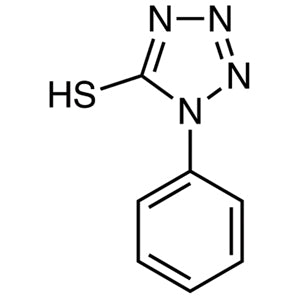
TCI C2011, 1-(4-Carboxyphenyl)-5-mercapto-1H-tetrazole, is a heterocyclic compound that combines a tetrazole ring bearing a thiol group at the five position with a phenyl ring carrying a carboxylic acid group at the para position. In the laboratory, this compound serves as a bifunctional building block and a versatile ligand, because it provides two reactive ends of markedly different character within a single molecule. The combination of a nitrogen-rich tetrazole ring, a thiol group with strong affinity for soft metals, and a readily coupled carboxylate group makes it an attractive material for both coordination chemistry and surface chemistry.
The principal characteristic that drives its selection is the dual-pole nature of its functionality. The mercapto group on the tetrazole ring can exist in a thiol–thione equilibrium and shows strong affinity for noble metal surfaces such as gold, silver, and copper, so the compound is frequently used to form self-assembled monolayers. At the same time, the carboxylic acid group at the opposite end of the molecule remains available for conjugation with amines, for use as a binding site within coordination frameworks, or simply to present a surface with defined polar character to the surrounding medium.
In Indonesian laboratories, this building block is typically encountered in university research groups and institutional laboratories working on coordination compounds, functionalised surfaces, and organic synthesis. It is normally ordered as a research-scale reagent in small unit packs rather than in bulk, held in a general chemical store alongside other heterocyclic intermediates, and drawn on as needed for ligand preparation, surface modification steps, and multi-step synthetic routes where a bifunctional linker is required.
Related TCI products
- TCI P0640 86-93-1 5-Mercapto-1-phenyl-1H-tetrazole
- TCI H0896 52431-78-4 1-(4-Hydroxyphenyl)-5-mercapto-1H-tetrazole
- TCI E0668 15182-68-0 1-(4-Ethoxyphenyl)-5-mercapto-1H-tetrazole
- TCI A0425 2349-67-9 2-Amino-5-mercapto-1,3,4-thiadiazole
- TCI A0427 4418-61-5 5-Amino-1H-tetrazole
- TCI T2737 21743-75-9 1H-Tetrazole-5-acetic Acid
- Self-assembled monolayer preparation: the mercapto group anchors strongly to gold, silver, and copper surfaces while the carboxylic acid end remains exposed to define the interfacial character of the resulting film.
- Coordination chemistry and ligand synthesis: the nitrogen-rich tetrazole ring and the carboxylate group both offer binding sites, allowing the molecule to act as a linker between metal centres in framework construction.
- Bifunctional linker chemistry: having two chemically distinct reactive ends in one molecule allows stepwise, selective coupling strategies that would require protecting groups with a symmetric linker.
- Amide coupling and conjugation work: the free carboxylic acid group is readily activated and coupled with amines, making the compound a convenient handle for attaching molecular fragments to a tetrazole-thiol scaffold.
- Surface modification of metal substrates: the compound is applied where a metal surface must be given a defined polar, carboxylate-terminated character for subsequent chemistry or further functionalisation steps.
| Brand | TCI |
|---|---|
| CAS number | 23249-95-8 |
| Molecular formula | — |
| Purity | — |
| Category | Chemistry > Building Blocks > Heterocyclic Building Blocks |
| Pack sizes | supplied in standard research-scale unit packs; please confirm the available pack size when ordering |
| Physical form | — |
| Storage | keep in the closed original container under the conditions stated on the manufacturer's label |
- Chemical name: 1-(4-Carboxyphenyl)-5-mercapto-1H-tetrazole
Store the container tightly closed in a cool, dry, well-ventilated place away from direct sunlight, moisture, and sources of ignition, following the conditions given on the manufacturer's label and safety data sheet. Keep the material in its original supplier container, or in a clean, chemically compatible and clearly labelled container if it must be transferred. Because the compound carries a thiol group that is sensitive to oxidation, minimise unnecessary exposure to air and close the container promptly after use. Handle the solid in a fume hood, using gloves, safety glasses, and a laboratory coat, and avoid raising dust during weighing. Store separately from strong oxidising agents and strong bases, and dispose of residues and contaminated materials in accordance with your institution's chemical waste procedures.
—
Produk Terkait
-
5-Mercapto-1-phenyl-1H-tetrazole TCI P0640
Regular price From Rp 875.700,00Regular price -
1-(4-Hydroxyphenyl)-5-mercapto-1H-tetrazole TCI H0896
Regular price From Rp 717.150,00Regular price -
1-(4-Ethoxyphenyl)-5-mercapto-1H-tetrazole TCI E0668
Regular price Rp 2.862.300,00Regular price -
2-Amino-5-mercapto-1,3,4-thiadiazole TCI A0425
Regular price From Rp 769.650,00Regular price -
5-Amino-1H-tetrazole TCI A0427
Regular price From Rp 1.776.600,00Regular price -
1H-Tetrazole-5-aceticAcid TCI T2737
Regular price From Rp 5.619.600,00Regular price -
5-(p-Tolyl)-1H-tetrazole TCI T2486
Regular price From Rp 1.538.250,00Regular price -
5-(4-Bromophenyl)-1H-tetrazole TCI B5308
Regular price From Rp 2.411.850,00Regular price