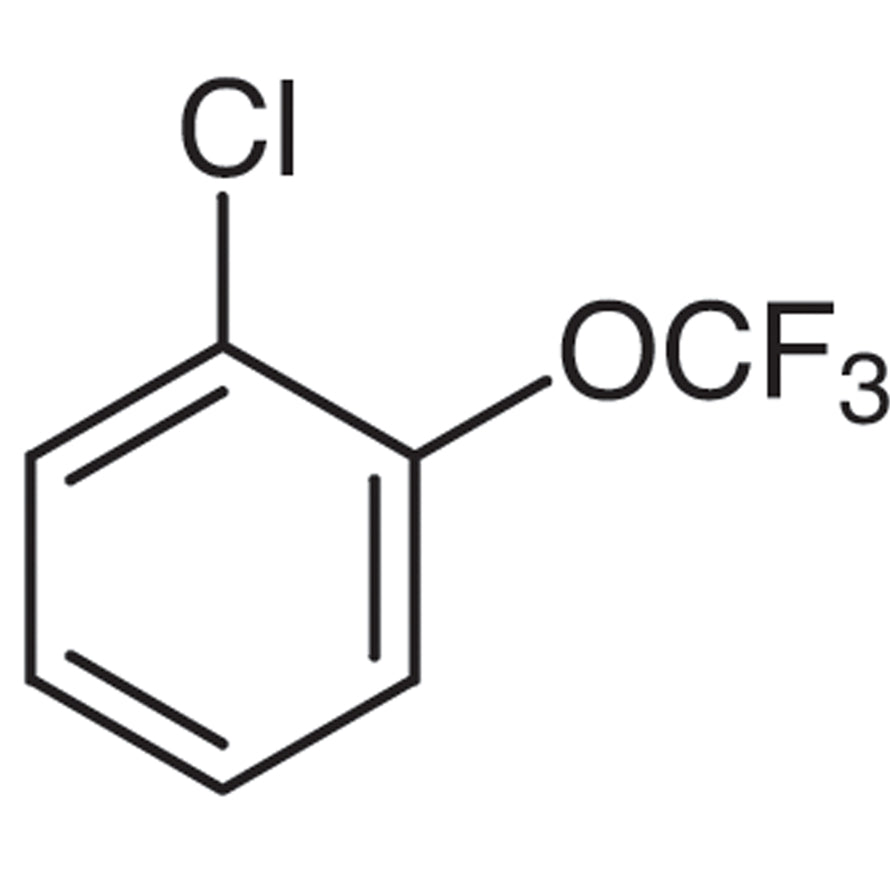
TCI C2091 1-Chloro-2-(trifluoromethoxy)benzene is an aromatic compound carrying a chlorine atom and a trifluoromethoxy group at adjacent positions on the benzene ring. The trifluoromethoxy group is one of the most sought-after substituents in modern medicinal chemistry and agrochemical research because of properties that other groups struggle to reproduce. As a fluorinated building block, this material supplies that group in ready-to-use form, so researchers do not need to work through the carbon–oxygen–trifluoromethyl bond-forming steps that normally demand specialised reagents and reaction conditions that are difficult to control.
The characteristics that make it a preferred choice centre on the trifluoromethoxy group itself, which is strongly lipophilic while remaining resistant to metabolic degradation. These properties are frequently exploited to improve a molecule's ability to cross membranes and to extend its stability within biological systems. In addition, the group is electron-withdrawing, so it influences the electron density of the aromatic ring and directs subsequent reactions. The chlorine atom at the ortho position acts as a reactive handle for transition-metal-catalysed cross-coupling reactions and for related substitution chemistry, giving a defined point at which the scaffold can be elaborated further.
In Indonesian laboratories, this building block is typically used in synthetic and medicinal chemistry research groups at universities and research institutes, as well as in agrochemical and pharmaceutical development work. It is normally handled at bench scale on a Schlenk line or in a fume hood, where the ortho-substituted scaffold is carried forward into coupling or substitution sequences. Because the fluorinated fragment is already installed, laboratories can shorten their route and concentrate on the steps that define the target structure.
Related TCI products
- TCI T2155 713-65-5 1-Nitro-4-(trifluoromethoxy)benzene
- TCI T2153 103962-05-6 1-Iodo-4-(trifluoromethoxy)benzene
- TCI T2152 175278-00-9 1-Iodo-2-(trifluoromethoxy)benzene
- TCI T2149 461-81-4 1-Chloro-4-(trifluoromethoxy)benzene
- TCI T2147 64115-88-4 1-Bromo-2-(trifluoromethoxy)benzene
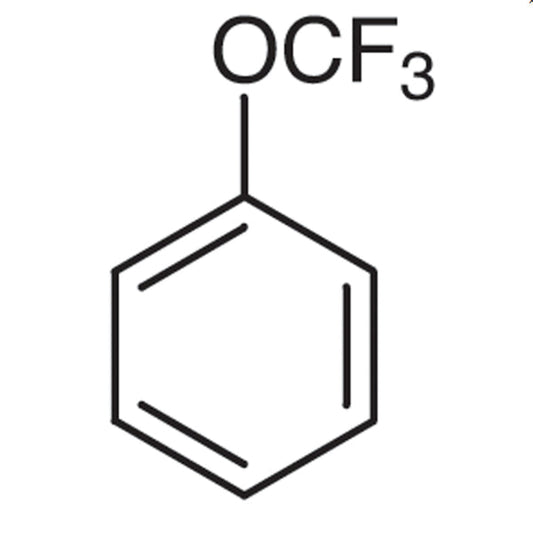
- TCI T1617 456-55-3 (Trifluoromethoxy)benzene
- Medicinal chemistry scaffold synthesis — the ready-installed trifluoromethoxy group lets chemists introduce a lipophilic, metabolically resistant fragment without running difficult trifluoromethoxylation steps in-house.
- Transition-metal-catalysed cross-coupling — the ortho chlorine atom serves as a defined reactive handle for palladium- or nickel-mediated bond formation onto the fluorinated aromatic ring.
- Agrochemical research and development — the compound supplies a fluorinated aromatic fragment of the type widely pursued in modern agrochemical discovery programmes and structure–activity studies.
- Nucleophilic aromatic substitution studies — the electron-withdrawing trifluoromethoxy group modifies ring electron density, making the adjacent chlorine a useful site for substitution chemistry.
- Structure–activity relationship work — incorporating this fragment allows researchers to probe how lipophilicity and metabolic stability change when a trifluoromethoxy group is added to a candidate molecule.
| Brand | TCI (Tokyo Chemical Industry) |
|---|---|
| CAS number | 450-96-4 |
| Molecular formula | — |
| Purity | — |
| Category | Chemistry > Building Blocks > Fluorinated Building Blocks |
| Pack sizes | available in standard TCI research-scale packaging; please confirm the size required when ordering |
| Physical form | — |
| Storage | keep the container tightly closed in a cool, well-ventilated place |
- Product code: C2091
Store the container tightly closed in a cool, dry and well-ventilated area, away from direct sunlight, heat sources and ignition sources. Keep the material in its original manufacturer packaging or in a compatible tightly sealed glass container, and label it clearly. Handle only in a fume hood with adequate ventilation, wearing safety goggles, chemical-resistant gloves and a laboratory coat. Avoid inhalation of vapours and contact with skin and eyes. Keep away from strong oxidising agents and other incompatible chemicals. Always consult the manufacturer's Safety Data Sheet before use, and follow your institution's procedures for the handling and disposal of halogenated organic waste.
—
Produk Terkait
-
1-Nitro-4-(trifluoromethoxy)benzene TCI T2155
Regular price From Rp 769.650,00Regular price -
1-Iodo-4-(trifluoromethoxy)benzene TCI T2153
Regular price From Rp 1.167.600,00Regular price -
1-Iodo-2-(trifluoromethoxy)benzene TCI T2152
Regular price Rp 1.405.950,00Regular price -
1-Chloro-4-(trifluoromethoxy)benzene TCI T2149
Regular price Rp 848.400,00Regular price -
1-Bromo-2-(trifluoromethoxy)benzene TCI T2147
Regular price From Rp 637.350,00Regular price -
(Trifluoromethoxy)benzene TCI T1617
Regular price Rp 1.220.100,00Regular price -
5-Bromo-1,3-difluoro-2-(trifluoromethoxy)benzene TCI B5057
Regular price From Rp 1.087.800,00Regular price -
1-Bromo-3-fluoro-4-(trifluoromethoxy)benzene TCI B3808
Regular price From Rp 689.850,00Regular price