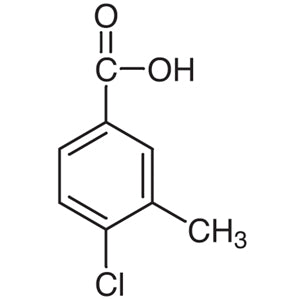
TCI C2115 4-Chloro-3-methylbenzoic Acid is an organic synthesis chemical belonging to the substituted benzoic acid family, carrying chloro and methyl groups at adjacent positions on the aromatic ring. In the laboratory, this compound serves as a non-heterocyclic building block — a starting scaffold that is reacted onward into amides, esters, acid chlorides, or heterocyclic cores. Medicinal chemistry, materials chemistry, and synthetic organic chemistry researchers turn to it whenever they need an aromatic fragment that already carries a defined substitution pattern, sparing them from building it up from scratch through long halogenation routes that are often poorly selective.
The characteristic that makes this material a frequent choice is its combination of complementary functional groups. The carboxylic acid group provides a highly versatile reaction point for activation and coupling, while the chlorine atom plays a dual role: it withdraws electron density, thereby modulating the acidity of the acid and the reactivity of the ring, and at the same time serves as a handle for metal-catalysed cross-coupling reactions in a subsequent step. The methyl group adds measurable lipophilic character and steric bulk, a parameter that synthetic chemists frequently explore when tuning a molecular series.
In Indonesian laboratories, this building block is typically used in university research groups, government research institutes, and industrial R&D units working on organic synthesis. It suits work programmes in which a defined aromatic fragment must be elaborated reproducibly across several derivatives, and it is generally ordered as part of a broader building-block collection so that a research team can run structure–activity or structure–property comparisons without waiting for a lengthy in-house preparation of each intermediate.
Related TCI products
- Amide coupling and derivative synthesis: the carboxylic acid group can be activated and coupled directly with amines, making this compound a convenient entry point into substituted benzamide libraries.
- Esterification studies: researchers convert the acid function into a range of esters when they need modified solubility, protecting-group strategies, or intermediates for further transformation in a multi-step route.
- Acid chloride preparation: the carboxyl group is readily converted into the corresponding acid chloride, giving a more reactive acylating agent for downstream reactions with nucleophiles.
- Metal-catalysed cross-coupling: the aryl chlorine atom acts as a synthetic handle for cross-coupling chemistry, allowing a new carbon substituent to be installed on the aromatic ring later.
- Heterocycle construction: the substituted benzoic acid core is elaborated into heterocyclic systems, supporting medicinal chemistry and materials chemistry programmes that require defined aromatic substitution patterns.
| Brand | TCI (Tokyo Chemical Industry) |
|---|---|
| CAS number | 7697-29-2 |
| Molecular formula | — |
| Purity | — |
| Category | Chemistry > Building Blocks > Non-Heterocyclic Building Blocks |
| Pack sizes | available in the standard research pack sizes offered by the manufacturer; storage in a cool, dry place as indicated on the product label |
| Physical form | — |
| Storage | — |
- Product code: C2115
- Chemical name: 4-Chloro-3-methylbenzoic Acid
Store the container tightly closed in a cool, dry, well-ventilated area away from direct sunlight, heat sources, moisture, and incompatible materials such as strong bases and strong oxidising agents. Keep the material in its original manufacturer container, or in a clean, chemically resistant, clearly labelled vessel if transferred. Handle the solid in a fume hood to limit dust formation and inhalation, and wear a laboratory coat, safety goggles, and suitable chemical-resistant gloves. Avoid contact with skin and eyes, and wash hands thoroughly after handling. Always consult the manufacturer's Safety Data Sheet before use and follow your institution's chemical waste procedures for disposal.
—
Produk Terkait
-
2-Chloro-6-methylbenzoicAcid TCI C2776
Regular price From Rp 664.650,00Regular price -
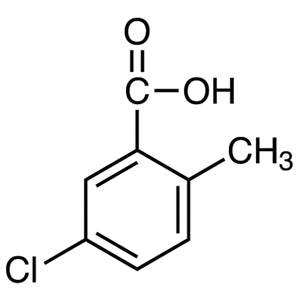
5-Chloro-2-methylbenzoicAcid TCI C2509
Regular price From Rp 795.900,00Regular price -
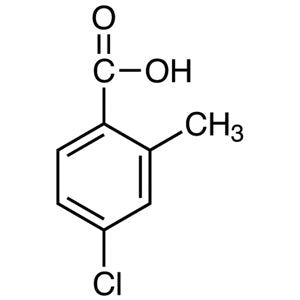
4-Chloro-2-methylbenzoicAcid TCI C2508
Regular price From Rp 1.140.300,00Regular price -
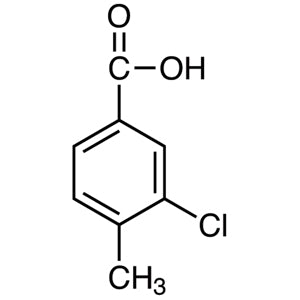
3-Chloro-4-methylbenzoicAcid TCI C2462
Regular price From Rp 955.500,00Regular price -
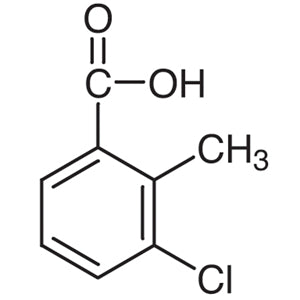
3-Chloro-2-methylbenzoicAcid TCI C2057
Regular price From Rp 505.050,00Regular price -
2-Bromo-5-methylbenzoicAcid TCI B4145
Regular price From Rp 1.510.950,00Regular price -
2-Bromo-6-methylbenzoicAcid TCI B4097
Regular price From Rp 1.431.150,00Regular price -
2-Bromo-4-methylbenzoicAcid TCI B3879
Regular price From Rp 795.900,00Regular price