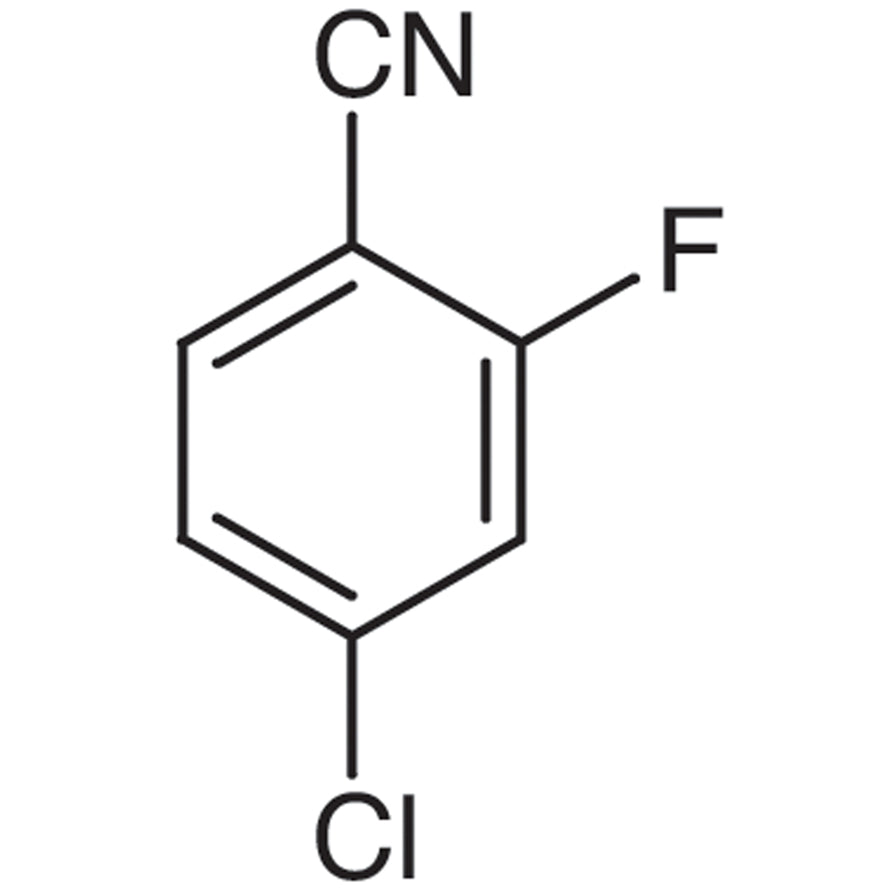
4-Chloro-2-fluorobenzonitrile is an aromatic organic compound belonging to the fluorinated building blocks group—synthetic starting materials that carry a nitrile functional group (-C≡N) along with two halogen substituents: chlorine at position 4 and fluorine at position 2 on the benzene ring. In an organic chemistry laboratory, this compound serves as a highly valuable intermediate for constructing more complex molecules. The nitrile group can be transformed into amines, carboxylic acids, amides, or heterocyclic rings, while the halogen atoms act as reactive sites for various substitution and coupling reactions. It is therefore a key foundation in the design and synthesis of target compounds, supporting both academic research and the development of fine chemical products in laboratory settings.
The main advantage of this compound lies in the combination of fluorine and chlorine substituents, which together produce a distinctive reactivity profile. The fluorine atom—small yet highly electronegative—modulates the electronic properties of the benzene ring and enhances the metabolic stability and lipophilicity of its derivatives, an attractive feature when designing drug-like molecules and agrochemical intermediates. The chlorine atom, in contrast, provides a versatile reactive position that is readily exploited in substitution and coupling chemistry. Because both substituents occupy defined positions on the ring, the compound offers predictable regiochemistry, making it a preferred choice for chemists who need reliable and reproducible results when building substituted aromatic frameworks in the laboratory.
In Indonesian laboratories, this building block is typically employed in academic research groups and fine chemical R&D facilities working on the synthesis of pharmaceutical intermediates, bioactive compounds, and functional aromatic molecules. Researchers commonly use it as a starting material in multi-step syntheses where the nitrile handle is converted into primary amines, amides, or carboxylic acids, or where the halogens are engaged in coupling steps to extend the aromatic system. It also serves as a practical substrate for undergraduate and postgraduate organic synthesis coursework, where its well-defined reactivity and clear substitution pattern make it an instructive and dependable material for hands-on training and method development.
- Pharmaceutical intermediate synthesis: The nitrile group can be converted into amines, amides, and carboxylic acids, making this compound a dependable starting point for building drug-like scaffolds in medicinal chemistry projects.
- Cross-coupling reactions: The chlorine and fluorine substituents serve as reactive handles for substitution and coupling steps, allowing chemists to extend the aromatic framework into more complex target molecules.
- Heterocycle construction: The nitrile functionality participates in cyclization routes toward heterocyclic rings, enabling the preparation of nitrogen-containing ring systems that are common in bioactive compounds.
- Academic organic synthesis training: Its well-defined substitution pattern and predictable reactivity make it an instructive substrate for teaching multi-step synthesis and functional group transformations in university laboratories.
- Agrochemical and fine chemical development: The fluorine atom imparts enhanced metabolic stability and lipophilicity, supporting the design of stable derivatives for agrochemical and specialty chemical research programs.
| Brand | TCI (product code C2121) |
|---|---|
| CAS number | 57381-51-8 |
| Molecular formula | — |
| Purity | — |
| Category | Chemistry > Building Blocks > Fluorinated Building Blocks |
| Pack sizes | — |
| Physical form | — |
| Storage | — |
- Chemical identity: 4-Chloro-2-fluorobenzonitrile
Store the compound in its original, tightly sealed container in a cool, dry, and well-ventilated area, protected from direct light and excessive moisture. Keep the container clearly labeled with the product name and CAS number to prevent mix-ups. When handling, wear appropriate personal protective equipment such as a laboratory coat, nitrile gloves, and safety goggles, and work in a fume hood to avoid inhaling dust or vapors. Avoid skin and eye contact, and do not eat, drink, or smoke in the work area. Keep the material away from strong oxidizing agents and incompatible chemicals, and dispose of any waste in accordance with local laboratory regulations. Always consult the manufacturer's label and safety data sheet for specific hazard information before first use.
*Assumption: where specific pack sizes, physical form, and storage details were not provided in the source data, these were marked as "not specified" rather than invented.*
—
Produk Terkait
-
4-Chloro-3-fluorobenzonitrile TCI C3103
Regular price From Rp 769.650,00Regular price -
3-Chloro-2-fluorobenzonitrile TCI C2562
Regular price Rp 2.439.150,00Regular price -
2-Chloro-4-fluorobenzonitrile TCI C2129
Regular price From Rp 1.035.300,00Regular price -
3-Chloro-4-fluorobenzonitrile TCI C2081
Regular price From Rp 823.200,00Regular price -
2-Chloro-5-fluorobenzonitrile TCI C2080
Regular price From Rp 769.650,00Regular price -
2-Chloro-6-fluorobenzonitrile TCI C1002
Regular price From Rp 823.200,00Regular price -
2-(Bromomethyl)-4-fluorobenzonitrile TCI B4988
Regular price From Rp 980.700,00Regular price -
3-Bromo-5-fluorobenzonitrile TCI B4600
Regular price From Rp 769.650,00Regular price