

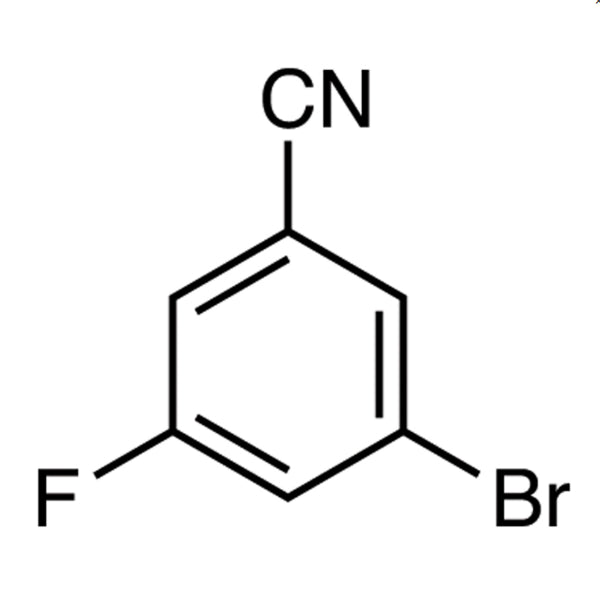
3-Bromo-5-fluorobenzonitrile is a versatile organic compound widely used in laboratory settings for its ability to participate in various synthetic reactions. As a fluorinated building block, it serves as a foundational element in the development of complex aromatic compounds. Its unique molecular structure, featuring both bromo and fluoro groups, makes it particularly valuable for chemists seeking to create functionalized derivatives. This compound is commonly employed in research aimed at synthesizing pharmaceuticals, industrial chemicals, and advanced materials.
The chemical properties of 3-Bromo-5-fluorobenzonitrile contribute to its popularity among researchers. The presence of bromine and fluorine atoms enhances its reactivity, enabling efficient substitution and electrophilic reactions. These characteristics allow it to be a key reagent in the synthesis of compounds with specific biological or chemical functions. Additionally, its stability under controlled conditions makes it a reliable choice for laboratory applications. However, it requires careful handling due to its sensitivity to temperature and humidity.
In Indonesian laboratories, 3-Bromo-5-fluorobenzonitrile is frequently used by chemists and scientists working on projects involving aromatic compounds. Its availability in the local market supports research in pharmaceuticals, organic chemistry, and material science. Researchers rely on this compound for experiments that require precise chemical transformations and functional group modifications. Its role in advancing scientific discovery is significant, particularly in the development of new drugs and advanced materials.
TCI brochures (PDF)
- Fluorination Reagents, Fluorinated Building Blocks 2026-03-18 · p. 26
Related TCI products
- Pharmaceutical research utilizes 3-Bromo-5-fluorobenzonitrile for the synthesis of novel drug molecules due to its reactivity and structural versatility.
- Organic chemistry experiments benefit from this compound as a building block for creating complex aromatic derivatives through substitution and electrophilic reactions.
- Material science studies incorporate this reagent to develop new polymers and functional materials with tailored properties.
- Industrial chemical synthesis relies on its stability and reactivity to produce intermediates for various commercial applications.
- Academic research in Indonesia uses this compound to explore chemical transformations and functional group modifications in aromatic compounds.
| Brand | TCI |
|---|---|
| CAS number | 179898-34-1 |
| Molecular formula | — |
| Purity | — |
| Category | Chemistry > Building Blocks > Fluorinated Building Blocks |
| Pack sizes | Available in various quantities as per supplier specifications |
| Physical form | Liquid or solid, depending on the specific product variant |
| Storage | Store in a cool, dry place away from direct sunlight and moisture |
3-Bromo-5-fluorobenzonitrile should be stored in a cool, dry environment to maintain its chemical stability. It is recommended to keep it in airtight containers to prevent exposure to moisture and temperature fluctuations. Due to its sensitivity, it should be handled in a well-ventilated area, and appropriate personal protective equipment should be worn. Avoid direct contact with skin and eyes, and ensure proper disposal methods are followed. Regular monitoring of storage conditions is essential to ensure the compound remains suitable for laboratory use.
—
Produk Terkait
-
4-Bromo-3-fluorobenzonitrile TCI B4022
Regular price From Rp 2.782.500,00Regular priceRp 1.961.400,00Sale price From Rp 2.782.500,00 -
2-Bromo-6-fluorobenzonitrile TCI B3183
Regular price Rp 795.900,00Regular priceRp 572.250,00Sale price Rp 795.900,00 -
2-Bromo-5-fluorobenzonitrile TCI B3010
Regular price From Rp 1.326.150,00Regular priceRp 942.900,00Sale price From Rp 1.326.150,00 -
4-Bromo-2-fluorobenzonitrile TCI B2745
Regular price From Rp 1.881.600,00Regular priceRp 1.331.400,00Sale price From Rp 1.881.600,00 -
2-Bromo-4-fluorobenzonitrile TCI B2744
Regular price From Rp 2.173.500,00Regular priceRp 1.535.100,00Sale price From Rp 2.173.500,00 -
5-Bromo-2-fluorobenzonitrile TCI B2425
Regular price From Rp 1.483.650,00Regular priceRp 1.053.150,00Sale price From Rp 1.483.650,00 -
3-Bromo-4-fluorobenzonitrile TCI B1965
Regular price From Rp 1.113.000,00Regular priceRp 793.800,00Sale price From Rp 1.113.000,00 -
2-(Bromomethyl)-4-fluorobenzonitrile TCI B4988
Regular price From Rp 1.033.200,00Regular priceRp 738.150,00Sale price From Rp 1.033.200,00


