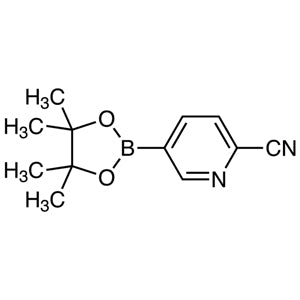
TCI 2-Cyano-5-(4,4,5,5-tetramethyl-1,3,2-dioxaborolan-2-yl)pyridine, supplied under catalogue code C3126, is an organoboron compound consisting of a pinacol boronate ester attached to a cyano-substituted pyridine ring. It functions as a key reagent in carbon–carbon bond forming reactions, most notably the Suzuki–Miyaura cross-coupling, which stands as one of the most important methods available in modern synthetic chemistry. Within the laboratory, its role is to deliver the cyanopyridine fragment onto a target molecule through a palladium-catalysed reaction with a partnering aryl halide or triflate, allowing chemists to construct biaryl and heterobiaryl frameworks under reliable, well-documented conditions.
The pinacol ester form is chosen because it offers considerably better stability than the corresponding free boronic acid, an advantage that matters especially for heteroaromatic derivatives such as pyridines, which are well known to be prone to protodeboronation. The pinacol ester exists as a solid that is easier to weigh accurately, to store, and to purify, while still providing adequate reactivity under standard coupling conditions. The cyano group at the two position not only influences the electronic character of the ring but also serves as a synthetic handle that can later be converted into an amide, a carboxylic acid, a primary amine, or a tetrazole, so that a single reagent opens several downstream routes from one coupling step.
In Indonesian laboratories, this reagent is typically used in medicinal chemistry and organic synthesis research groups at universities and research institutes, as well as in pharmaceutical development laboratories building heterocyclic scaffolds. It suits work where a pyridine-containing fragment must be introduced into a larger structure, including analogue synthesis programmes, materials chemistry projects, and postgraduate research on cross-coupling methodology. The solid, stable ester form is convenient for laboratories that need a reagent tolerant of routine handling and ordinary storage practice.
TCI brochures (PDF)
- Suzuki-Miyaura Cross Coupling Reaction 2025-12-01 · p. 18
- Boron Compounds 2025-10-07 · p. 19
Related TCI products
- TCI T4400 942919-26-8 4-(4,4,5,5-Tetramethyl-1,3,2-dioxaborolan-2-yl)-1H-pyrrolo[2,3-b]pyridine
- TCI T3400 1009033-87-7 4-[4-(4,4,5,5-Tetramethyl-1,3,2-dioxaborolan-2-yl)phenyl]pyridine
- TCI T3399 1009033-83-3 4-[3-(4,4,5,5-Tetramethyl-1,3,2-dioxaborolan-2-yl)phenyl]pyridine
- TCI T3313 939430-30-5 3-[3-(4,4,5,5-Tetramethyl-1,3,2-dioxaborolan-2-yl)phenyl]pyridine
- TCI T2345 329214-79-1 3-(4,4,5,5-Tetramethyl-1,3,2-dioxaborolan-2-yl)pyridine
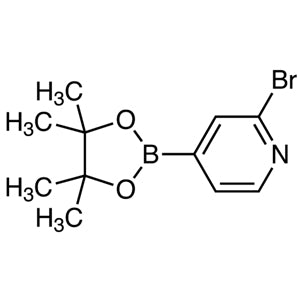
- TCI B5238 458532-82-6 2-Bromo-4-(4,4,5,5-tetramethyl-1,3,2-dioxaborolan-2-yl)pyridine
- Suzuki–Miyaura cross-coupling: the pinacol boronate transmetalates efficiently to palladium, transferring the cyanopyridyl group to aryl halides or triflates under standard base and catalyst conditions.
- Medicinal chemistry analogue synthesis: introduces a cyanopyridine motif into candidate scaffolds, giving structure–activity relationship work a reliable route to heterobiaryl variants from common halide intermediates.
- Heterobiaryl scaffold construction: joins pyridine rings to other aromatic partners in one catalytic step, avoiding lengthy ring-building sequences that would otherwise be required for these frameworks.
- Downstream nitrile functionalisation: the two-position cyano group is converted after coupling into amides, carboxylic acids, primary amines, or tetrazoles, extending one reagent across several synthetic routes.
- Cross-coupling methodology research: serves as a stable heteroaryl boron substrate for studying ligand, base, and catalyst effects where free boronic acids would suffer protodeboronation.
| Brand | TCI (Tokyo Chemical Industry) |
|---|---|
| CAS number | 741709-63-7 |
| Molecular formula | — |
| Purity | — |
| Category | Chemistry > Organometallic Reagents > Organoboron [Organometallic Reagents] |
| Pack sizes | available in the standard research-scale pack sizes offered for this catalogue item |
| Physical form | solid pinacol boronate ester |
| Storage | keep in a cool, dry place in the tightly closed original container |
- Catalogue code: C3126
Store the container tightly closed in a cool, dry, well-ventilated area away from moisture, strong oxidising agents, and direct sunlight, and keep the material in its original supplier packaging or an equivalent tightly sealed glass or amber container. Because boronate esters are sensitive to prolonged moisture exposure, allow cold-stored material to reach room temperature before opening to prevent condensation, and reseal promptly after weighing. Handle in a fume hood using safety goggles, chemical-resistant gloves, and a laboratory coat, weigh the solid carefully to limit dust generation, and consult the manufacturer's safety data sheet before use and for disposal guidance.
—
Produk Terkait
-
4-(4,4,5,5-Tetramethyl-1,3,2-dioxaborolan-2-yl)-1H-pyrrolo[2,3-b]pyridine TCI T4400
Regular price From Rp 3.630.900,00Regular price -
4-[4-(4,4,5,5-Tetramethyl-1,3,2-dioxaborolan-2-yl)phenyl]pyridine TCI T3400
Regular price From Rp 1.565.550,00Regular price -
4-[3-(4,4,5,5-Tetramethyl-1,3,2-dioxaborolan-2-yl)phenyl]pyridine TCI T3399
Regular price From Rp 1.908.900,00Regular price -
3-[3-(4,4,5,5-Tetramethyl-1,3,2-dioxaborolan-2-yl)phenyl]pyridine TCI T3313
Regular price From Rp 4.982.250,00Regular price -
3-(4,4,5,5-Tetramethyl-1,3,2-dioxaborolan-2-yl)pyridine TCI T2345
Regular price From Rp 1.485.750,00Regular price -
2-Bromo-4-(4,4,5,5-tetramethyl-1,3,2-dioxaborolan-2-yl)pyridine TCI B5238
Regular price Rp 2.411.850,00Regular price -
2-Bromo-6-(4,4,5,5-tetramethyl-1,3,2-dioxaborolan-2-yl)pyridine TCI B5077
Regular price From Rp 2.306.850,00Regular price -
1-(tert-Butoxycarbonyl)-1,2,3,6-tetrahydro-4-(4,4,5,5-tetramethyl-1,3,2-dioxaborolan-2-yl)pyridine TCI B4051
Regular price Rp 2.279.550,00Regular price
![942919-26-8 4-(4,4,5,5-Tetramethyl-1,3,2-dioxaborolan-2-yl)-1H-pyrrolo[2,3-b]pyridine - AMI Scientific](http://amiscientific.com/cdn/shop/files/TCI2510T4400.jpg?v=1767145178&width=533)
![1009033-87-7 4-[4-(4,4,5,5-Tetramethyl-1,3,2-dioxaborolan-2-yl)phenyl]pyridine - AMI Scientific](http://amiscientific.com/cdn/shop/files/TCI2510T3400.jpg?v=1769143727&width=533)
![1009033-83-3 4-[3-(4,4,5,5-Tetramethyl-1,3,2-dioxaborolan-2-yl)phenyl]pyridine - AMI Scientific](http://amiscientific.com/cdn/shop/files/TCI2510T3399.jpg?v=1769058221&width=533)
![939430-30-5 3-[3-(4,4,5,5-Tetramethyl-1,3,2-dioxaborolan-2-yl)phenyl]pyridine - AMI Scientific](http://amiscientific.com/cdn/shop/files/TCI2510T3313.jpg?v=1769058203&width=533)