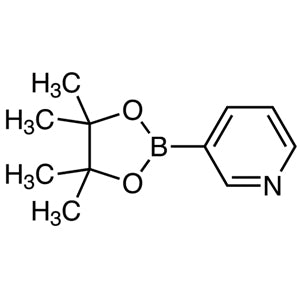
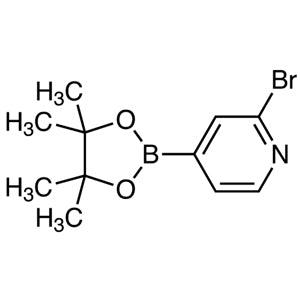
This compound, TCI B4051, is an organoboron reagent with a complex molecular structure containing both a tert-butoxycarbonyl group and a boron-containing group. It plays a crucial role in organic chemistry laboratories, particularly in the synthesis of heterocyclic compounds and coupling reactions. Its unique chemical structure enables it to participate in various organoboron reactions, making it a valuable tool for chemists working on complex molecular transformations. The compound's versatility allows it to be used in multiple synthetic pathways, contributing to the development of new chemical entities with specific functional properties.
The compound's properties, including its reactivity and selectivity, make it a preferred choice for advanced synthetic applications. It is known for its stability under controlled conditions and its ability to undergo reactions such as Suzuki-Miyaura and Kumada-Corriu. These characteristics make it suitable for applications requiring high precision and controlled chemical environments. Its ability to act as a reagent in organoboron chemistry also supports the synthesis of aromatic and heterocyclic compounds, which are essential in pharmaceutical and materials science research.
In Indonesian laboratories, this compound is widely used in organic chemistry research, especially in the fields of pharmacology and the synthesis of bioactive compounds. It is an essential component of the laboratory toolkit, supporting scientific innovation and technological advancement in educational and research institutions. Its presence in these settings underscores its importance in the development of new chemical methodologies and applications.
TCI brochures (PDF)
- Suzuki-Miyaura Cross Coupling Reaction 2025-12-01 · p. 17
- Boron Compounds 2025-10-07 · p. 15
Related TCI products
- TCI T4400 942919-26-8 4-(4,4,5,5-Tetramethyl-1,3,2-dioxaborolan-2-yl)-1H-pyrrolo[2,3-b]pyridine
- TCI T3668 1040377-03-4 1-(Tetrahydro-2H-pyran-4-yl)-4-(4,4,5,5-tetramethyl-1,3,2-dioxaborolan-2-yl)-1H-pyrazole
- TCI T3468 889865-38-7 4,4,5,5-Tetramethyl-2-[4-[(tetrahydro-2H-pyran-2-yl)oxy]phenyl]-1,3,2-dioxaborolane
- TCI T3400 1009033-87-7 4-[4-(4,4,5,5-Tetramethyl-1,3,2-dioxaborolan-2-yl)phenyl]pyridine
- TCI T3399 1009033-83-3 4-[3-(4,4,5,5-Tetramethyl-1,3,2-dioxaborolan-2-yl)phenyl]pyridine
- TCI T3313 939430-30-5 3-[3-(4,4,5,5-Tetramethyl-1,3,2-dioxaborolan-2-yl)phenyl]pyridine
- Organic synthesis of heterocyclic compounds due to its reactivity and selectivity in coupling reactions.
- Pharmaceutical research for the development of bioactive molecules through complex synthetic pathways.
- Advanced chemical reactions such as Suzuki-Miyaura and Kumada-Corriu in organic chemistry laboratories.
- Synthesis of aromatic compounds where organoboron reagents are required for high precision and control.
- Supporting research in bioactive compound development by enabling the creation of structurally complex molecules.
| Brand | TCI |
|---|---|
| CAS number | 286961-14-6 |
| Molecular formula | — |
| Purity | — |
| Category | Chemistry > Organometallic Reagents > Organoboron [Organometallic Reagents] |
| Pack sizes | — |
| Physical form | — |
| Storage | Store in a cool, dry place away from moisture and direct sunlight |
This compound should be stored in a cool, dry environment to maintain its stability and reactivity. It is recommended to keep it in a sealed container to prevent exposure to moisture and air, which could affect its chemical integrity. Proper ventilation is essential when handling the material to minimize inhalation risks. Laboratory personnel should wear appropriate personal protective equipment, such as gloves and safety goggles, to ensure safe handling. The compound should be stored away from incompatible substances to prevent any potential chemical interactions. Regular monitoring of storage conditions is advised to ensure optimal performance and safety in laboratory settings.
—
Produk Terkait
-
4-(4,4,5,5-Tetramethyl-1,3,2-dioxaborolan-2-yl)-1H-pyrrolo[2,3-b]pyridine TCI T4400
Regular price From Rp 3.683.400,00Regular priceRp 2.591.400,00Sale price From Rp 3.683.400,00 -
1-(Tetrahydro-2H-pyran-4-yl)-4-(4,4,5,5-tetramethyl-1,3,2-dioxaborolan-2-yl)-1H-pyrazole TCI T3668
Regular price From Rp 822.150,00Regular priceRp 590.100,00Sale price From Rp 822.150,00 -
4,4,5,5-Tetramethyl-2-[4-[(tetrahydro-2H-pyran-2-yl)oxy]phenyl]-1,3,2-dioxaborolane TCI T3468
Regular price From Rp 1.934.100,00Regular priceRp 1.368.150,00Sale price From Rp 1.934.100,00 -
4-[4-(4,4,5,5-Tetramethyl-1,3,2-dioxaborolan-2-yl)phenyl]pyridine TCI T3400
Regular price From Rp 1.618.050,00Regular priceRp 1.146.600,00Sale price From Rp 1.618.050,00 -
4-[3-(4,4,5,5-Tetramethyl-1,3,2-dioxaborolan-2-yl)phenyl]pyridine TCI T3399
Regular price From Rp 1.961.400,00Regular priceRp 1.387.050,00Sale price From Rp 1.961.400,00 -
3-[3-(4,4,5,5-Tetramethyl-1,3,2-dioxaborolan-2-yl)phenyl]pyridine TCI T3313
Regular price From Rp 5.034.750,00Regular priceRp 3.536.400,00Sale price From Rp 5.034.750,00 -
3-(4,4,5,5-Tetramethyl-1,3,2-dioxaborolan-2-yl)pyridine TCI T2345
Regular price From Rp 1.538.250,00Regular priceRp 1.090.950,00Sale price From Rp 1.538.250,00 -
2-Bromo-4-(4,4,5,5-tetramethyl-1,3,2-dioxaborolan-2-yl)pyridine TCI B5238
Regular price Rp 2.464.350,00Regular priceRp 1.738.800,00Sale price Rp 2.464.350,00