

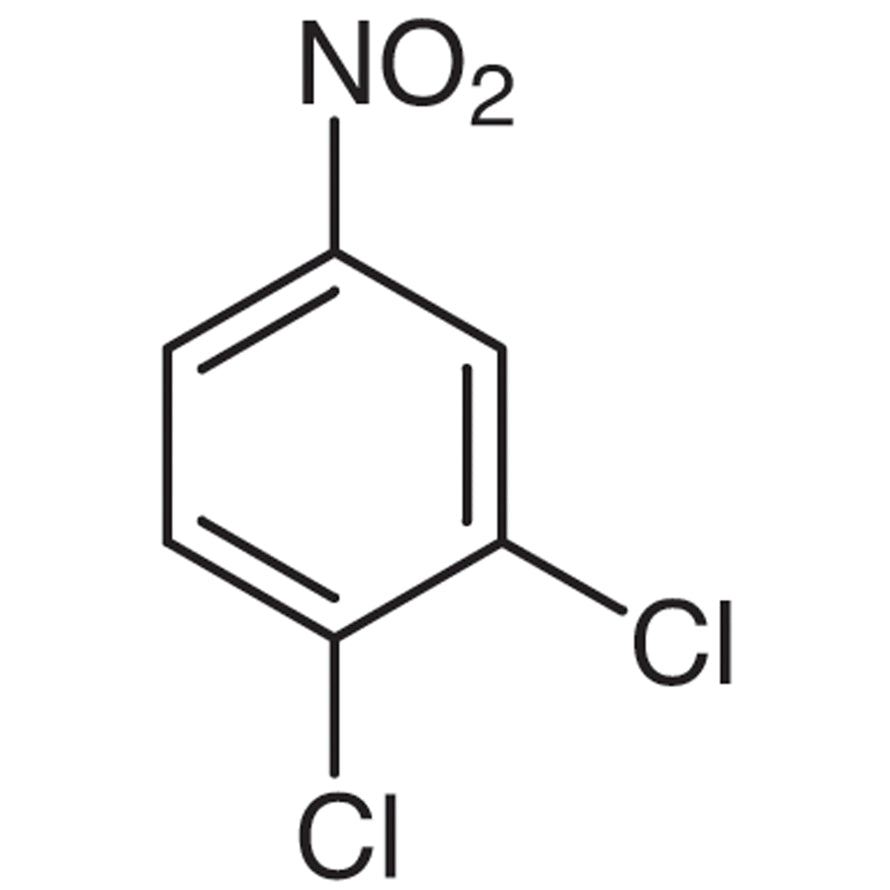
3,4-Dichloronitrobenzene is a chemical compound widely used as a foundational building block in the synthesis of complex organic compounds. It plays a crucial role in laboratory settings where organic chemistry reactions require precise structural modifications. This compound is particularly valuable in reactions involving aromatic rings, where its functional groups contribute to the formation of nitrogen and chlorine-containing derivatives. Its presence in various chemical reactions makes it a versatile reagent for researchers working on synthetic pathways.
The chemical properties of 3,4-Dichloronitrobenzene, including its stability and controlled reactivity, make it a preferred choice for laboratory applications. The positioning of chlorine atoms at the 3 and 4 positions significantly influences the compound’s reactivity and substitution capabilities within aromatic rings. This structural feature allows for targeted chemical modifications, making it ideal for specific synthetic strategies. Its predictable behavior under different reaction conditions ensures reliable results in experimental setups.
In Indonesian laboratories, 3,4-Dichloronitrobenzene is commonly used in organic chemistry research, especially in studies focused on the synthesis of heterocyclic and aromatic compounds. Its availability in the local market supports scientific experimentation by providing researchers with access to essential reagents. This compound is a key component in the development of new chemical structures and is frequently utilized in academic and industrial research settings.
- Aromatic Compound Synthesis: This compound is ideal for creating substituted aromatic structures due to its stable nitro and chloro groups.
- Electrophilic Substitution Reactions: Its reactivity allows for controlled substitution on aromatic rings, making it suitable for such reactions.
- Nitration Reactions: The nitro group facilitates the formation of nitroaromatic compounds, which is essential in organic synthesis.
- Heterocyclic Compound Development: The compound’s functional groups support the synthesis of nitrogen-containing ring structures.
- Research in Organic Chemistry: It is widely used in academic and industrial research for its versatility and reliability in synthetic pathways.
| Brand | TCI |
|---|---|
| CAS number | 99-54-7 |
| Molecular formula | — |
| Purity | — |
| Category | Chemistry > Building Blocks > Non-Heterocyclic Building Blocks |
| Pack sizes | Available in various quantities as per standard laboratory requirements |
| Physical form | Solid |
| Storage | Store in a cool, dry place away from direct sunlight and incompatible materials |
3,4-Dichloronitrobenzene should be stored in a cool, dry environment to maintain its chemical integrity. It is recommended to keep it in a sealed container to prevent exposure to moisture and air. Due to its chemical nature, it should be stored away from incompatible substances such as strong acids or bases. Proper ventilation is essential when handling this compound to minimize inhalation risks. Laboratory personnel should wear appropriate personal protective equipment, including gloves and safety goggles, to ensure safe handling. Regular inspection of storage conditions is advised to ensure the compound remains stable and safe for use in experiments.
—
Produk Terkait
-
3,5-Dichloronitrobenzene TCI D0983
Regular price Rp 1.298.850,00Regular price -
2,4-Dichloronitrobenzene TCI D0982
Regular price From Rp 477.750,00Regular price -
2,3-Dichloronitrobenzene TCI D0386
Regular price From Rp 769.650,00Regular price -
3,4,5-Trichloronitrobenzene TCI T1580
Regular price From Rp 743.400,00Regular price -
2,3,4-Trichloronitrobenzene TCI T1197
Regular price Rp 1.353.450,00Regular price -
3-Bromo-4-chloronitrobenzene TCI B1624
Regular price From Rp 769.650,00Regular price -
2,4,6-Trichloronitrobenzene TCI T0388
Regular price From Rp 1.035.300,00Regular price -
2,4,5-Trichloronitrobenzene TCI T0387
Regular price Rp 769.650,00Regular price


