

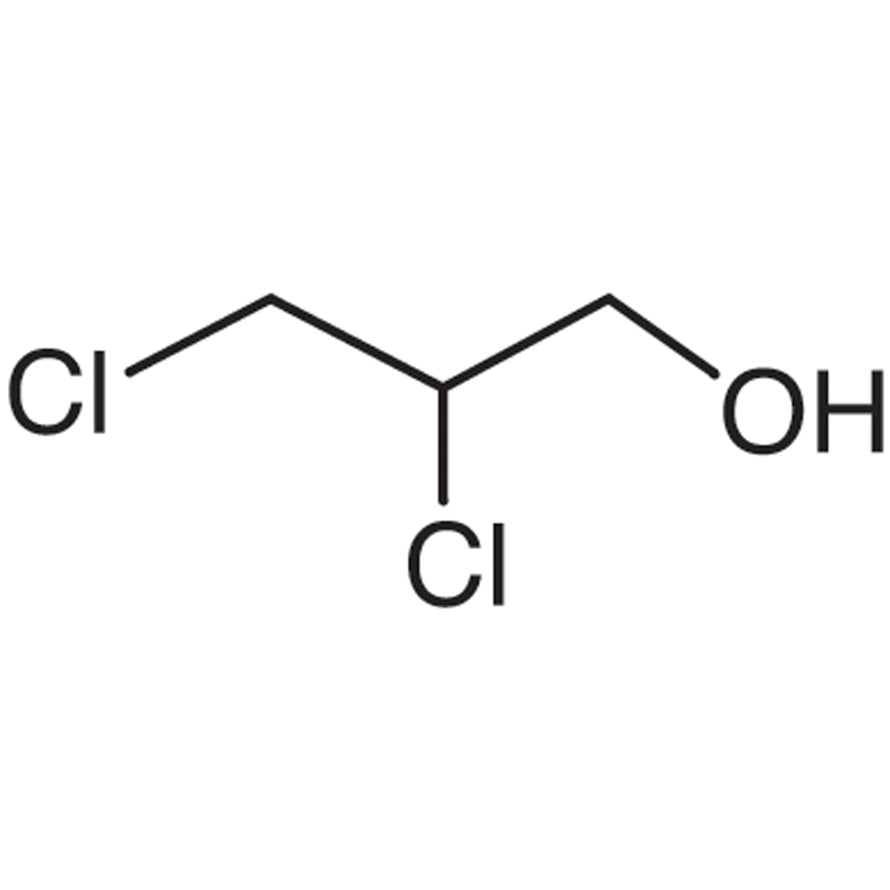
2,3-Dichloro-1-propanol is a chemical compound widely used in laboratory settings for various synthetic reactions, particularly in the development of complex organic molecules. As a building block in organic chemistry, it serves as a versatile intermediate that can undergo substitution, reduction, or oxidation reactions to form a range of derivatives. Its role is critical in the synthesis of heterocyclic compounds and functionalized molecules, making it an essential tool for researchers working on molecular structure modification. This compound is commonly found in chemical synthesis protocols where precise control over reactivity and selectivity is required.
The compound's high reactivity and polarity are attributed to the presence of two chlorine atoms at positions 2 and 3, which influence its chemical behavior and stability. These chlorine atoms enhance the molecule's ability to participate in nucleophilic and electrophilic reactions, making it a preferred choice for synthetic chemists. Additionally, its solubility in organic solvents facilitates ease of handling and integration into reaction mixtures, which is crucial for efficient chemical processes. The combination of reactivity and solubility makes it a valuable reagent in both academic and industrial research environments.
In Indonesian laboratories, 2,3-Dichloro-1-propanol is frequently used in organic chemistry research projects involving the synthesis of new compounds or the modification of molecular structures. It is a key component in studies focused on functional group transformations and heterocyclic ring formation. Its availability and chemical properties make it a reliable choice for researchers aiming to explore the potential of this compound in various synthetic pathways.
Related TCI products
- TCI D0402 96-23-1 1,3-Dichloro-2-propanol
- TCI B5274 2077-19-2 2-(4-Bromophenyl)-2-propanol
- TCI B4657 25574-11-2 3-(4-Bromophenyl)-1-propanol
- TCI B3905 847682-00-2 1,3-Bis[(2,2-dimethyl-1,3-dioxan-5-yl)oxy]-2-propanol
- TCI B3277 4799-68-2 3-(Benzyloxy)-1-propanol
- TCI B2110 6972-79-8 1,3-Bis(benzyloxy)-2-propanol
- Organic synthesis of heterocyclic compounds due to its reactivity and ability to undergo substitution reactions.
- Functional group modification in complex molecule construction, supporting the development of new chemical entities.
- Nucleophilic and electrophilic reaction studies, offering a versatile platform for reaction mechanism investigations.
- Molecular structure modification in research projects aimed at creating novel compounds with specific properties.
- Chemical process development where controlled reactivity and solubility in organic solvents are essential.
| Brand | TCI |
|---|---|
| CAS number | 616-23-9 |
| Molecular formula | — |
| Purity | — |
| Category | Chemistry > Building Blocks > Non-Heterocyclic Building Blocks |
| Pack sizes | Available in various quantities as per standard laboratory supply practices |
| Physical form | Liquid |
| Storage | Store in a cool, dry place away from light and incompatible materials |
This compound should be stored in a cool, dry place, away from direct sunlight and sources of heat. It is recommended to use sealed containers made of materials compatible with its chemical properties, such as glass or high-density polyethylene. Due to its reactivity, it should be kept away from strong oxidizing agents and incompatible substances. In laboratory settings, proper ventilation is essential to minimize exposure during handling. Always use appropriate personal protective equipment, including gloves and safety goggles, when working with this material. Ensure that spill containment and emergency response procedures are in place to handle any accidental release.
—
Produk Terkait
-
1,3-Dichloro-2-propanol TCI D0402
Regular price Rp 530.250,00Regular price -
2-(4-Bromophenyl)-2-propanol TCI B5274
Regular price From Rp 1.353.450,00Regular price -
3-(4-Bromophenyl)-1-propanol TCI B4657
Regular price From Rp 848.400,00Regular price -
1,3-Bis[(2,2-dimethyl-1,3-dioxan-5-yl)oxy]-2-propanol TCI B3905
Regular price Rp 3.340.050,00Regular price -
3-(Benzyloxy)-1-propanol TCI B3277
Regular price Rp 1.881.600,00Regular price -
1,3-Bis(benzyloxy)-2-propanol TCI B2110
Regular price From Rp 1.881.600,00Regular price -
1-Butoxy-2-propanol TCI B0864
Regular price From Rp 477.750,00Regular price -
3-Bromo-1-propanol TCI B0641
Regular price From Rp 2.491.650,00Regular price


![847682-00-2 1,3-Bis[(2,2-dimethyl-1,3-dioxan-5-yl)oxy]-2-propanol - AMI Scientific](http://amiscientific.com/cdn/shop/files/TCI2510B3905.jpg?v=1768815545&width=533)


