

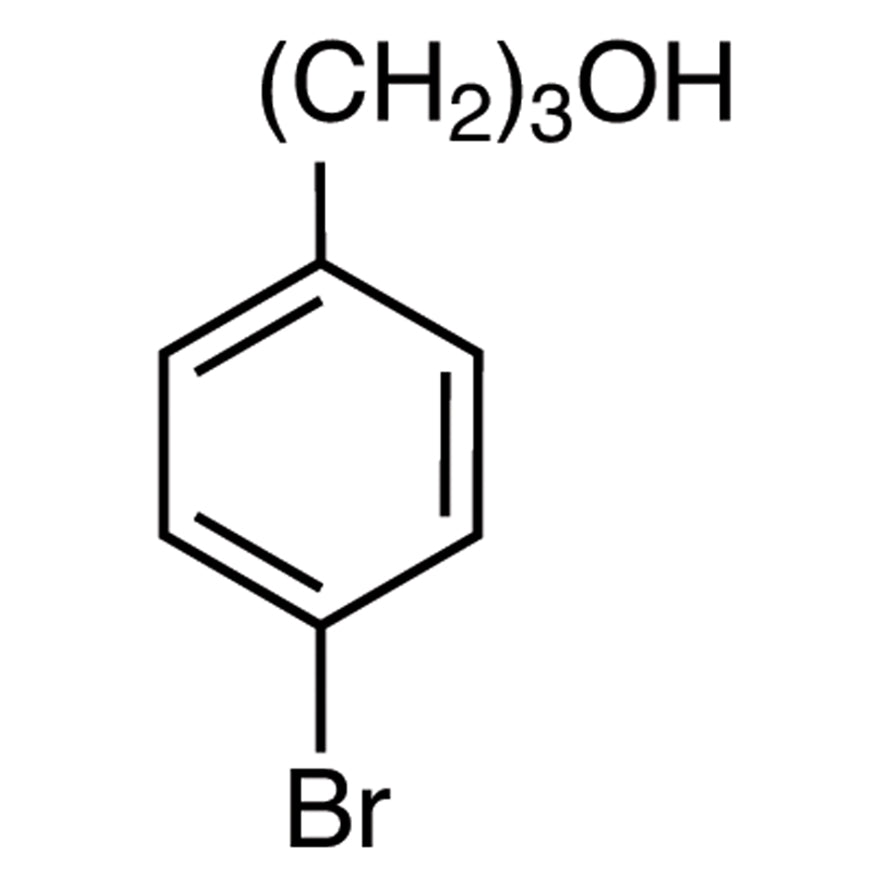
3-(4-Bromophenyl)-1-propanol is a chemical compound widely used as a building block in organic synthesis. It plays a crucial role in the development of complex organic molecules, particularly in the creation of heterocyclic compounds and other structurally intricate substances. This compound is a key component in various chemical reactions, making it indispensable for researchers and chemists working in synthetic chemistry. Its versatility allows it to be employed in multiple stages of chemical synthesis, from initial functional group introduction to final compound formation.
The compound's unique molecular structure, featuring a bromo group on the phenyl ring and a hydroxyl group on the propanol chain, contributes to its high reactivity. These characteristics make it ideal for substitution, reduction, and electrophilic reactions. Its reactivity and functional group diversity make it a preferred choice for chemists seeking to modify molecular structures efficiently. The ability to participate in a wide range of chemical transformations enhances its utility in both academic and industrial research settings.
In Indonesian laboratories, 3-(4-Bromophenyl)-1-propanol is commonly used by organic chemists, students, and pharmaceutical researchers. Its availability supports the development of new drugs, industrial chemicals, and advanced materials. The compound's role in laboratory processes is essential for those working on projects requiring specific molecular structures. Its presence in the local market ensures accessibility for researchers, facilitating continued innovation and experimentation in chemical synthesis.
Related TCI products
- TCI B5274 2077-19-2 2-(4-Bromophenyl)-2-propanol
- TCI B3277 4799-68-2 3-(Benzyloxy)-1-propanol
- TCI B2110 6972-79-8 1,3-Bis(benzyloxy)-2-propanol
- TCI B0864 5131-66-8 1-Butoxy-2-propanol
- TCI B0641 627-18-9 3-Bromo-1-propanol
- TCI B0640 19686-73-8 1-Bromo-2-propanol (contains ca. 20% 2-Bromo-1-propanol) (stabilized with MgO)
- Organic synthesis of heterocyclic compounds due to its reactive functional groups and structural versatility.
- Development of pharmaceuticals through its use in the synthesis of complex drug molecules.
- Research in material science for the creation of new polymers and functional materials.
- Educational purposes in teaching synthetic chemistry techniques and molecular manipulation.
- Industrial applications in the production of specialty chemicals and chemical intermediates.
| Brand | TCI |
|---|---|
| CAS number | 25574-11-2 |
| Molecular formula | — |
| Purity | — |
| Category | Chemistry > Building Blocks > Non-Heterocyclic Building Blocks |
| Pack sizes | Available in various quantities as per standard chemical supply practices |
| Physical form | Liquid or crystalline, depending on purity and storage conditions |
| Storage | Store in a cool, dry place away from light and incompatible substances |
3-(4-Bromophenyl)-1-propanol should be stored in a cool, dry environment, away from direct sunlight and sources of heat. It is recommended to use airtight containers to prevent moisture absorption and contamination. The compound should be kept in a well-ventilated area to minimize exposure to vapors. It is important to avoid contact with incompatible materials such as strong oxidizing agents. Always use appropriate personal protective equipment, including gloves and safety goggles, when handling this compound. Proper labeling of containers is essential to ensure safe handling and storage in a laboratory setting.
—
Produk Terkait
-
2-(4-Bromophenyl)-2-propanol TCI B5274
Regular price From Rp 1.353.450,00Regular priceRp 946.050,00Sale price From Rp 1.353.450,00 -
3-(Benzyloxy)-1-propanol TCI B3277
Regular price Rp 1.934.100,00Regular priceRp 1.368.150,00Sale price Rp 1.934.100,00 -
1,3-Bis(benzyloxy)-2-propanol TCI B2110
Regular price From Rp 1.934.100,00Regular priceRp 1.368.150,00Sale price From Rp 1.934.100,00 -
1-Butoxy-2-propanol TCI B0864
Regular price From Rp 530.250,00Regular priceRp 386.400,00Sale price From Rp 530.250,00 -
3-Bromo-1-propanol TCI B0641
Regular price From Rp 2.491.650,00Regular priceRp 1.741.950,00Sale price From Rp 2.491.650,00 -
1-Bromo-2-propanol(containsca.20%2-Bromo-1-propanol)(stabilizedwithMgO) TCI B0640
Regular price Rp 2.306.850,00Regular priceRp 1.612.800,00Sale price Rp 2.306.850,00 -
1,1,1-Trichloro-2-methyl-2-propanolHemihydrate TCI T0386
Regular price From Rp 664.650,00Regular priceRp 464.100,00Sale price From Rp 664.650,00


