

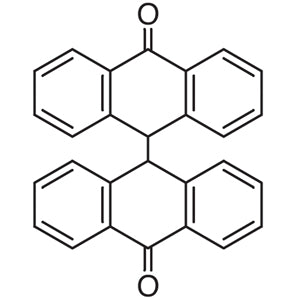
Bianthronyl, listed under CAS number 434-84-4, is a polycyclic aromatic compound formed from two anthrone units joined to one another through a carbon-carbon bond at the bridging position of each ring. This dimeric structure produces a large, rigid, pi-electron-rich molecular framework that holds considerable interest for researchers working in organic chemistry and materials chemistry alike. In the laboratory, the compound serves as a non-heterocyclic building block for constructing more extensive condensed aromatic systems, and equally as a model compound in studies of carbon-carbon bond behaviour under substantial steric strain between two polycyclic units.
The principal appeal of Bianthronyl lies in the combination of an extended conjugated system with a non-planar geometry arising from steric repulsion between the two anthrone units. This condition gives rise to electronic and optical properties that are rewarding to investigate, including the behaviour of its derivatives, which remain a classic point of reference in discussions of molecules that respond to heat and light. The carbonyl group on each unit provides a reactive site for reduction, condensation, and transformation into anthracene derivatives, making the molecule a versatile starting point rather than a single-purpose reagent.
In Indonesian laboratories, Bianthronyl is typically encountered in university research groups and institutional facilities engaged in synthetic organic chemistry and materials studies. It is handled in its crystalline solid form on the standard synthetic bench, weighed out for small-scale reactions, and used where a well-defined polycyclic scaffold is required. Its role as both a synthetic intermediate and a reference structure makes it suitable for postgraduate research projects, method development work, and structural investigations of strained aromatic systems.
Related TCI products
- Synthesis of extended condensed aromatic systems: the rigid dimeric polycyclic framework serves as a non-heterocyclic building block from which larger fused aromatic architectures can be constructed in successive synthetic steps.
- Study of sterically strained carbon-carbon bonds: the bond linking the two anthrone units carries substantial steric strain, making the compound a well-suited model for investigating bond behaviour under such conditions.
- Investigation of electronic and optical behaviour: the extended conjugated system combined with a non-planar geometry produces electronic and optical characteristics that are informative subjects for spectroscopic and photophysical study.
- Preparation of anthracene derivatives: the carbonyl group present on each anthrone unit offers a defined reactive handle for reduction and onward transformation into anthracene-type products.
- Reference material in stimuli-responsive molecule studies: derivatives of Bianthronyl are a classic reference point in discussions of molecules that respond to heat and light, supporting comparative research work.
| Brand | TCI |
|---|---|
| CAS number | 434-84-4 |
| Molecular formula | — |
| Purity | — |
| Category | Chemistry > Building Blocks > Non-Heterocyclic Building Blocks |
| Pack sizes | available in laboratory research pack sizes; please refer to the current catalogue listing for the sizes offered |
| Physical form | crystalline solid |
| Storage | store in a closed container under the conditions stated on the manufacturer's label |
- Product code: D1389
Store Bianthronyl in a tightly closed original container in a cool, dry, and well-ventilated area, kept away from direct sunlight, sources of heat, and ignition. Amber glass or the manufacturer's supplied packaging is suitable for protecting the crystalline solid from light and moisture, and containers should be resealed promptly after each use to limit exposure to air. Handle the material in a fume hood using standard laboratory personal protective equipment, including safety glasses, a laboratory coat, and chemical-resistant gloves. Avoid generating or inhaling dust during weighing and transfer, keep the compound separated from strong oxidising agents, and consult the manufacturer's safety data sheet before use and for disposal guidance.
—
Produk Terkait
-
Bianthrone TCI B0827
Regular price From Rp 823.200,00Regular price
