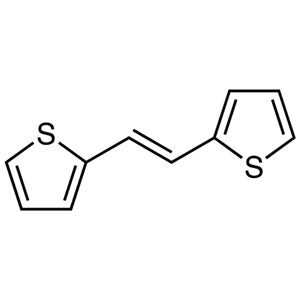
TCI D2074 trans-1,2-Di(2-thienyl)ethylene is a heterocyclic building block consisting of a conjugated molecule built from two thiophene rings joined by an ethylene bridge in the trans configuration. The structure can be regarded as a stilbene analogue in which the benzene rings have been replaced by thiophene rings, giving the molecule richer electron density and making it more readily oxidised. In the laboratory it serves as a starting material and as a model compound for research on conjugated organic materials, photochemistry, and the synthesis of larger thiophene-containing compounds that form the backbone of much present-day organic electronics research.
The property that makes this compound a preferred choice lies in its π-conjugated system, which runs continuously from one thiophene ring to the other through the central double bond. This conjugation produces a characteristic ultraviolet–visible absorption together with fluorescence and photoisomerisation behaviour that is attractive to study. The well-defined trans configuration gives the molecule a planar geometry, so it stacks readily in an ordered fashion and is well suited to investigations of thin-film ordering. The sulfur atoms of the thiophene rings enhance the electron-donating character of the molecule and support polymerisation-type and other reactions typical of electron-rich heteroaromatics.
In Indonesian laboratories, this material is typically used in university and institutional research groups working on organic materials, photochemistry, and synthetic heterocyclic chemistry. It is normally handled on a small preparative or analytical scale, weighed out for reactions, spectroscopic measurement, or thin-film preparation, and stored alongside other light- and air-sensitive organic building blocks. Its role is usually that of a defined reference structure or an intermediate en route to larger conjugated thiophene systems.
TCI brochures (PDF)
- Thiophenes 2026-06-29 · p. 9
Related TCI products
- Conjugated organic materials research: the continuous π system across both thiophene rings makes this a convenient starting structure for building larger conjugated frameworks used in organic electronics studies.
- Photochemistry and photoisomerisation studies: the central trans double bond within a conjugated framework allows researchers to follow light-induced configurational change as a well-defined model system.
- Ultraviolet–visible and fluorescence spectroscopy: the characteristic absorption and fluorescence arising from the extended conjugation make the compound a useful reference and model chromophore for optical measurements.
- Synthesis of larger thiophene compounds: the electron-rich thiophene rings and reactive positions allow the molecule to serve as an intermediate toward extended thiophene-based structures.
- Thin-film ordering investigations: the defined trans configuration provides a planar geometry that stacks in an ordered way, supporting studies of molecular arrangement in deposited layers.
| Brand | TCI (Tokyo Chemical Industry) |
|---|---|
| CAS number | 13640-78-3 |
| Molecular formula | — |
| Purity | — |
| Category | Chemistry > Building Blocks > Heterocyclic Building Blocks |
| Pack sizes | as listed in the current TCI catalogue entry for this product code; storage should follow the conditions stated on the manufacturer's label and safety data sheet. |
| Physical form | — |
| Storage | — |
- Chemical name: trans-1,2-Di(2-thienyl)ethylene
- Catalogue code: D2074
Store the compound in its original tightly closed container in a cool, dry, and well-ventilated place, away from direct sunlight, heat, and ignition sources. As a conjugated and electron-rich organic material, it is best protected from prolonged light exposure and from air, so amber glass or otherwise light-protected containers, kept tightly sealed and where appropriate under an inert atmosphere, are preferred. Handle in a fume hood using safety glasses, gloves, and a laboratory coat, avoid generating dust, and keep it separate from strong oxidising agents. Always consult the manufacturer's safety data sheet before use and dispose of residues as chemical waste in accordance with institutional procedures.
—
Produk Terkait
-
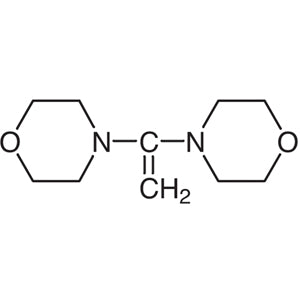
1,1-Bis(morpholino)ethylene TCI B1180
Regular price Rp 4.399.500,00Regular price -
2-(2-Thienyl)ethylp-Toluenesulfonate TCI T3064
Regular price From Rp 477.750,00Regular price -
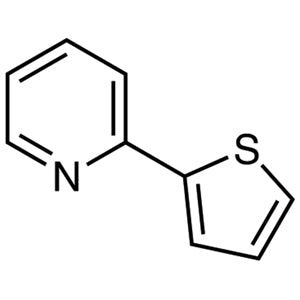
2-(2-Thienyl)pyridine TCI T2936
Regular price From Rp 2.227.050,00Regular price -
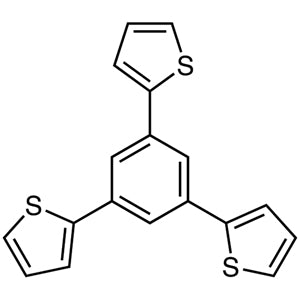
1,3,5-Tri(2-thienyl)benzene TCI T2866
Regular price From Rp 2.650.200,00Regular price -
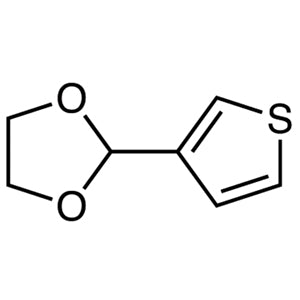
2-(3-Thienyl)-1,3-dioxolane TCI T2623
Regular price Rp 2.625.000,00Regular price -
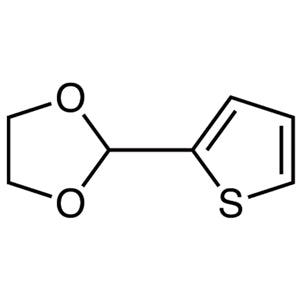
2-(2-Thienyl)-1,3-dioxolane TCI T2049
Regular price From Rp 3.260.250,00Regular price -
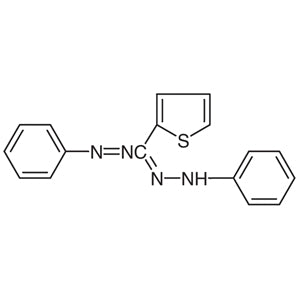
1,5-Diphenyl-3-(2-thienyl)formazan TCI B0326
Regular price Rp 1.273.650,00Regular price -
2,3-Diphenyl-5-(2-thienyl)tetrazoliumChloride TCI B0325
Regular price From Rp 1.696.800,00Regular price