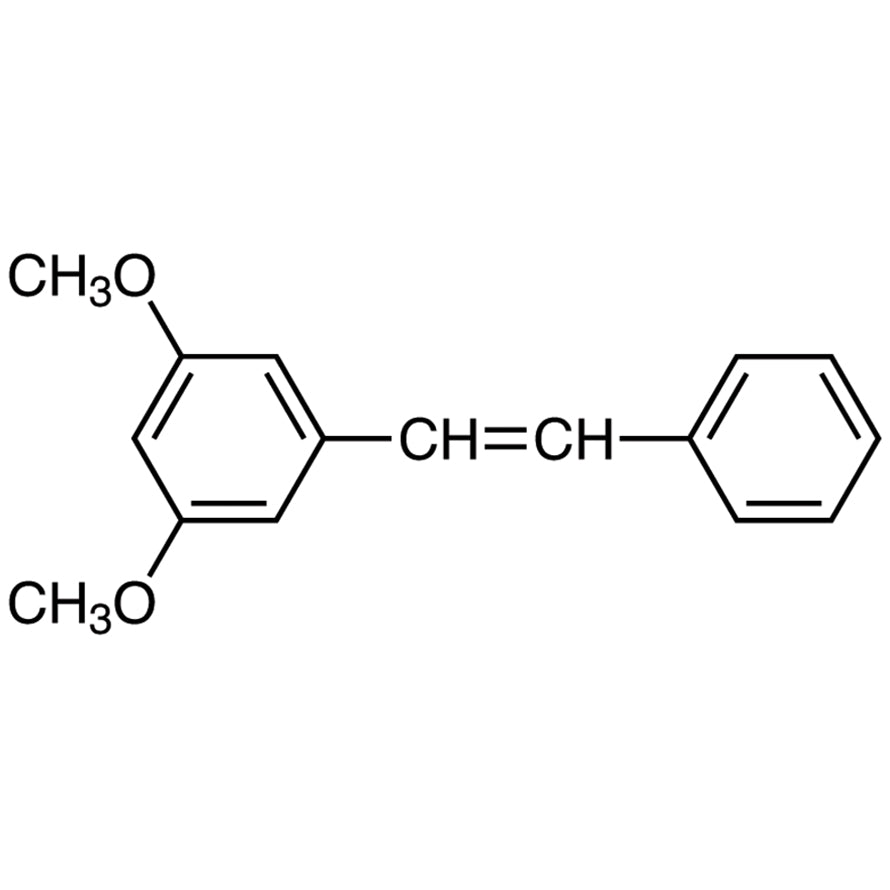
TCI D2592 3,5-Dimethoxystilbene is a stilbene compound bearing two methoxy groups at the 3 and 5 positions of one of its aromatic rings. The stilbene framework consists of two benzene rings joined by a carbon-carbon double bond, a motif that is very well known in both natural product chemistry and materials science. In the laboratory, this compound serves as a building block and as a structural reference compound for research around the stilbenoid family, a group that includes the plant phenolic compounds widely studied for their biological properties and their interesting optical behaviour.
The property that makes it a preferred choice is the long conjugated system that extends across both aromatic rings and the connecting double bond. This conjugation produces light absorption in the ultraviolet region and is often accompanied by fluorescence, which is why stilbene compounds are so widely used in photochemical studies and in optical materials work. The double bond can also undergo cis-trans isomerisation upon irradiation, providing a clean model system for studying photoisomerisation. The methoxy groups add electron density to the ring and provide sites that can be demethylated when a researcher wants to prepare derivatives.
In Indonesian laboratories, material of this kind is typically used in university and institutional research settings where synthetic organic chemistry, natural product chemistry, and photochemistry are studied. It is ordered as a defined starting material or comparison standard for work on stilbenoid analogues, for method development, and for teaching-level and postgraduate research projects. Because it is supplied as a catalogue reagent from an established brand, it fits routine research procurement rather than bulk production use.
- Stilbenoid analogue synthesis — the methoxy-substituted stilbene core provides a defined starting framework from which researchers can build related plant phenolic structures through further functionalisation.
- Structural reference compound — its known stilbene substitution pattern makes it useful as a comparison sample when identifying or characterising stilbenoid compounds isolated from plant material.
- Photochemistry and photoisomerisation studies — the central carbon-carbon double bond isomerises cleanly between cis and trans forms under irradiation, giving a straightforward and well behaved model system.
- Ultraviolet absorption and fluorescence work — the extended conjugation across both rings and the double bond gives absorption in the ultraviolet region, often with accompanying fluorescence useful in optical measurements.
- Demethylation and derivative preparation — the two methoxy groups act as protected phenolic sites that can be demethylated when a research group wishes to access the corresponding hydroxylated analogues.
| Brand | TCI |
|---|---|
| CAS number | 78916-49-1 |
| Molecular formula | — |
| Purity | — |
| Category | Chemistry > Building Blocks > Non-Heterocyclic Building Blocks |
| Pack sizes | available in standard TCI catalogue research pack sizes; please confirm the size required when enquiring |
| Physical form | — |
| Storage | store in the closed original container under the conditions stated on the manufacturer label and safety data sheet |
- Chemical class: substituted stilbene (non-heterocyclic building block)
Keep the material in its original tightly closed container, stored in a cool, dry, well ventilated place away from direct sunlight, heat sources, and incompatible chemicals. Because conjugated stilbene compounds can be light sensitive, an amber container or protection from light is advisable, and containers should be reclosed promptly after weighing to limit exposure to air and moisture. Handle in a fume hood using safety glasses, gloves, and a laboratory coat, and avoid generating or inhaling dust. Always consult the manufacturer safety data sheet before use, and dispose of residues and contaminated materials through the laboratory chemical waste route in line with institutional procedures.
—
Produk Terkait
-
3-Chloro-3'-methoxystilbene TCI C1593
Regular price Rp 1.458.450,00Regular price -
4,4'-Bis[(E)-2-methoxystyryl]biphenyl TCI B2730
Regular price Rp 1.803.900,00Regular price -
5-Allyl-3-methoxysalicylaldehyde TCI A2104
Regular price From Rp 928.200,00Regular price -
2,3,5,4'-Tetrahydroxystilbene2-O-beta-D-Glucoside TCI T3513
Regular price From Rp 3.260.250,00Regular price

![79448-61-6 4,4'-Bis[(E)-2-methoxystyryl]biphenyl - AMI Scientific](http://amiscientific.com/cdn/shop/files/TCI2510B2730.jpg?v=1768815387&width=533)