

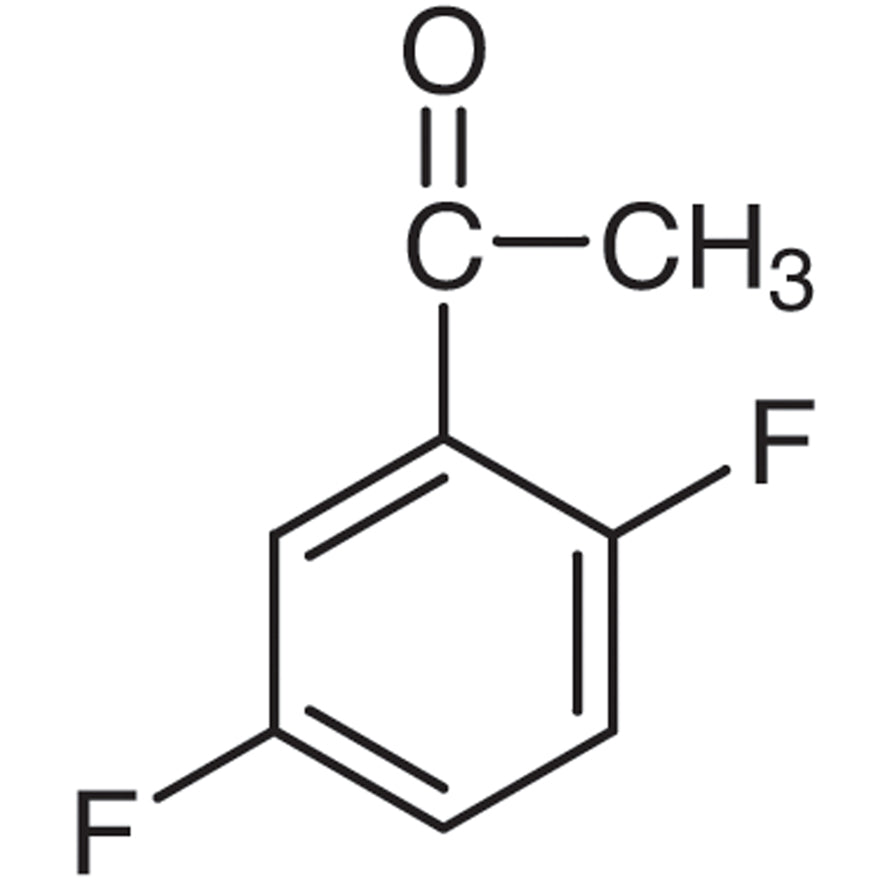
TCI D2607 2',5'-Difluoroacetophenone is a fluorinated aromatic ketone that carries an acetyl group on a benzene ring bearing two fluorine atoms at the 2' and 5' positions. The compound belongs to the family of fluorinated starting materials that are widely used in organic chemistry and medicinal chemistry laboratories, particularly when researchers need an aromatic methyl ketone that already carries fluorine substituents from the very beginning of a synthetic sequence. The acetyl group provides a highly versatile reaction site, while the difluoro substitution pattern on the ring imparts a distinctive electronic character that influences both the course of reactions and the properties of derived molecules.
The reason this compound is so frequently selected lies in the rich reactivity of the methyl ketone moiety. The alpha hydrogens of the acetyl group can be deprotonated for aldol condensation reactions, chalcone formation, alkylation, and alpha-halogenation, the latter serving as a gateway to a broad range of heterocycles. The carbonyl itself is ready to be reduced to a secondary alcohol or converted through reductive amination into an amine. Meanwhile, the two fluorine atoms lower the electron density of the ring, influence polarity and lipophilicity, and are often exploited to tune the properties of candidate molecules in structure–activity relationship studies.
In Indonesian laboratories, this fluorinated building block is typically used in university research groups, medicinal chemistry programs, and industrial R&D units that build small molecules step by step. It is generally ordered as a defined building block for a planned synthetic route rather than as a bulk consumable, so it is commonly handled in modest quantities, weighed out on an analytical balance, and stored alongside other fluorinated intermediates in a dedicated reagent cabinet for the duration of a project.
TCI brochures (PDF)
- Fluorination Reagents, Fluorinated Building Blocks 2026-03-18 · p. 32
Related TCI products
- Aldol condensation and chalcone synthesis: the acidic alpha hydrogens of the acetyl group are readily deprotonated, allowing condensation with aromatic aldehydes to give fluorinated enone scaffolds.
- Heterocycle construction: alpha-halogenation of the methyl ketone opens direct access to a wide range of heterocyclic ring systems that retain the difluorinated aromatic core intact.
- Reduction to secondary alcohols: the carbonyl group can be reduced cleanly, giving fluorinated benzylic alcohols useful as intermediates for further functionalisation in multi-step routes.
- Reductive amination toward amines: converting the ketone into an amine provides fluorinated amine building blocks that are frequently required in medicinal chemistry synthesis programmes.
- Structure–activity relationship studies: the fixed 2',5'-difluoro pattern lets researchers adjust electron density, polarity, and lipophilicity while keeping the rest of the molecular framework unchanged.
| Brand | TCI (Tokyo Chemical Industry) |
|---|---|
| CAS number | 1979-36-8 |
| Molecular formula | — |
| Purity | — |
| Category | Chemistry > Building Blocks > Fluorinated Building Blocks |
| Pack sizes | available in standard research-scale laboratory pack sizes; please confirm the currently available packaging option when ordering. |
| Physical form | — |
| Storage | keep the container tightly closed in a cool, dry, well-ventilated place, away from ignition sources and incompatible chemicals. |
- Product code: D2607
Store 2',5'-Difluoroacetophenone in its original tightly closed container in a cool, dry, and well-ventilated area, kept away from heat, open flames, and strong oxidising agents. Chemically resistant glass bottles with well-sealing caps are suitable, and the container should be returned to its designated cabinet promptly after each use so that the material is not left exposed to air and moisture. All handling, weighing, and transfer operations should be carried out inside a fume hood while wearing safety glasses, chemically resistant gloves, and a laboratory coat, and the container label should be checked before use. Consult the manufacturer's safety data sheet before first use, and dispose of residues and contaminated materials in accordance with the laboratory's chemical waste procedures and applicable local regulations.
—
Produk Terkait
-
2-Bromo-2',4'-difluoroacetophenone TCI B4020
Regular price Rp 2.386.650,00Regular price -
2',6'-Difluoroacetophenone TCI D3559
Regular price From Rp 1.510.950,00Regular price -
3',5'-Difluoroacetophenone TCI D3425
Regular price From Rp 1.087.800,00Regular price -
3',4'-Difluoroacetophenone TCI D1906
Regular price From Rp 928.200,00Regular price -
2',4'-Difluoroacetophenone TCI D1885
Regular price Rp 875.700,00Regular price -
2-Chloro-2',4'-difluoroacetophenone TCI C2030
Regular price From Rp 795.900,00Regular price -
2-(1H-1,2,4-Triazol-1-yl)-2',4'-difluoroacetophenone TCI T2722
Regular price From Rp 1.724.100,00Regular price


