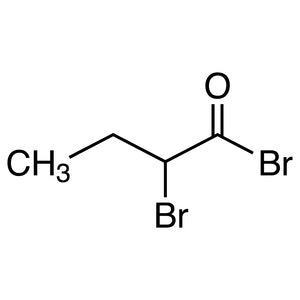
TCI D2612 Ethyl 2,3-Dibromobutyrate is an aliphatic ester that carries two bromine atoms at the 2- and 3-positions of the butyrate chain. This arrangement presents three functional groups at once within a single small molecule: the ethyl ester group, one bromine atom at the alpha position adjacent to the carbonyl, and one bromine atom at the beta position. In the organic synthesis laboratory, this combination makes the compound a highly versatile starting material, particularly as an alkylating agent and as a precursor toward a range of heterocyclic compounds as well as unsaturated ester derivatives.
The property that makes it a frequent choice is the differing reactivity of the two bromine atoms. The bromine at the alpha position is activated by the neighbouring carbonyl group, so it is more readily displaced by nucleophiles such as amines, thiols, or heterocyclic nitrogen anions. The bromine at the beta position, meanwhile, opens the way to elimination reactions that form alpha,beta-unsaturated esters. This distinction allows researchers to design stepwise transformations with reasonably good selectivity. The ester group can also be hydrolysed to the corresponding carboxylic acid, transesterified, or reduced, so the compound offers many synthetic directions from one single starting material.
In Indonesian laboratories, this building block is typically used in organic synthesis research at universities and research institutes, as well as in industrial and pharmaceutical research and development groups that prepare heterocyclic intermediates or unsaturated ester derivatives on a laboratory scale. It suits method development work, teaching laboratories covering substitution and elimination chemistry, and small-scale route-scouting where a single reagent that offers several reaction pathways reduces the number of separate starting materials that must be kept on hand.
- Alkylation of nitrogen and sulfur nucleophiles: the carbonyl-activated alpha bromine is readily displaced by amines, thiols, or heterocyclic nitrogen anions under standard laboratory conditions.
- Synthesis of heterocyclic compounds: the two adjacent bromine atoms together with the ester group provide the connection points needed to build ring systems from a small precursor.
- Preparation of alpha,beta-unsaturated esters: elimination at the beta bromine position gives access to unsaturated ester derivatives useful as onward synthetic intermediates.
- Stepwise selective transformations: the different reactivity of the alpha and beta bromine atoms lets researchers sequence two substitution or elimination steps with reasonable selectivity.
- Ester group derivatisation studies: the ethyl ester can be hydrolysed to the carboxylic acid, transesterified, or reduced, supporting route-scouting from a single starting material.
| Brand | TCI |
|---|---|
| CAS number | 609-11-0 |
| Molecular formula | — |
| Purity | — |
| Category | Chemistry > Building Blocks > Non-Heterocyclic Building Blocks |
| Pack sizes | available in the standard catalogue pack sizes offered by TCI for this item; please confirm the required pack size when ordering |
| Physical form | — |
| Storage | store according to the conditions stated on the manufacturer's label and safety data sheet |
- Product code: D2612
- Chemical name: Ethyl 2,3-Dibromobutyrate
Store the container tightly closed in a cool, dry, well-ventilated area away from heat, direct sunlight, and incompatible materials, following the conditions given on the manufacturer's label and safety data sheet. Keep the material in its original supplier packaging or in a chemically compatible, clearly labelled glass container with a secure closure. As an organobromine ester, it should be handled in a fume hood using safety glasses, gloves, and a laboratory coat, avoiding contact with skin and eyes and avoiding inhalation of vapours. Transfer with clean, dry equipment, close the container promptly after use, and collect residues and contaminated materials as halogenated organic waste for disposal in line with institutional procedures. Consult the current safety data sheet before first use.
—
Produk Terkait
-
Methyl4-Bromobutyrate TCI B2308
Regular price From Rp 2.094.750,00Regular price -
Methyl2-Bromobutyrate TCI B1462
Regular price From Rp 637.350,00Regular price -
Ethyl4-Bromobutyrate TCI B0999
Regular price From Rp 848.400,00Regular price -
Ethyl2-Bromobutyrate TCI B0800
Regular price From Rp 610.050,00Regular price -
4-BromobutylAcetate TCI B4958
Regular price From Rp 769.650,00Regular price -
2-BromobutyrylChloride TCI B4105
Regular price From Rp 2.916.900,00Regular price -
4-BromobutyricAcid TCI B1279
Regular price Rp 2.147.250,00Regular price -
2-BromobutyrylBromide TCI B0566
Regular price Rp 2.466.450,00Regular price