

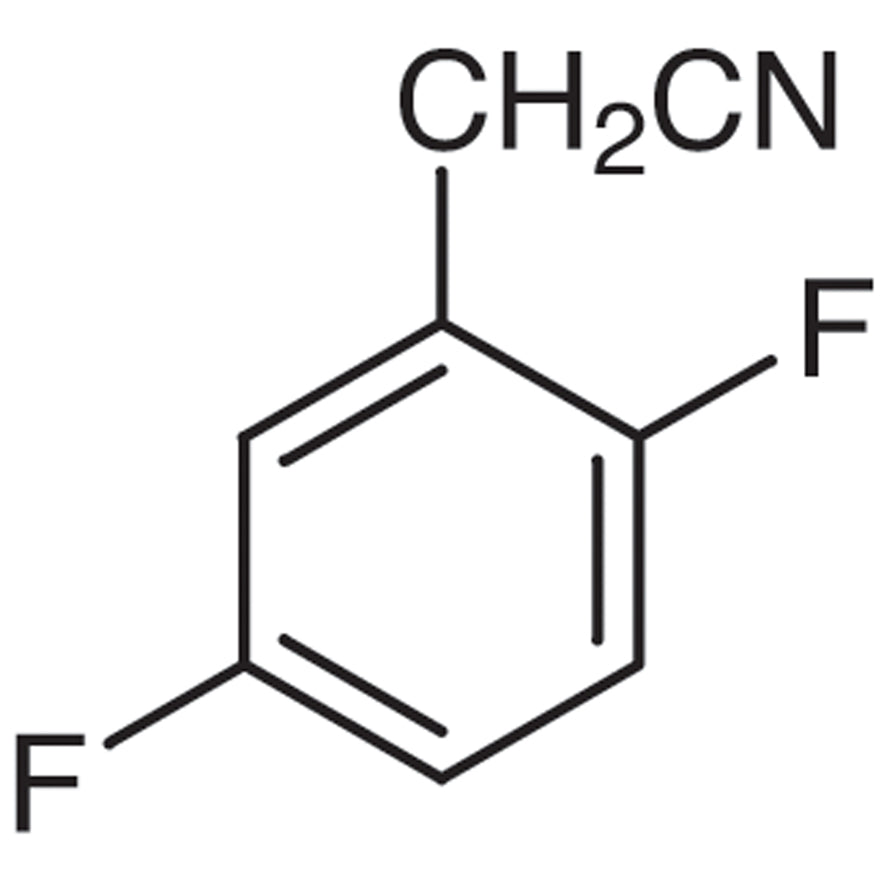
TCI D3442 2,5-Difluorobenzyl Cyanide is a positional isomer of fluorinated phenylacetonitrile that carries fluorine atoms at the 2- and 5-positions of the aromatic ring. The compound serves as a versatile building block in organic synthesis laboratories because it provides a readily transformable nitrile group together with an aromatic ring that is already functionalized. Researchers use it to construct aryl-ethylamine side chains, arylacetic acids, or heterocyclic frameworks, particularly when a specific fluorine substitution pattern is required to tune the physicochemical properties of the target molecule under development.
The distinguishing feature that separates the 2,5-isomer from other isomers is the placement of one fluorine atom at the ortho position and another at the meta position relative to the acetonitrile side chain. This pattern produces a different electron distribution and dipole moment, which in turn influences the acidity of the benzylic protons, the conformational orientation of the side chain, and the interaction profile of the molecule with biological targets. In medicinal chemistry programmes, subtle differences of this kind are frequently decisive for activity, so the availability of several difluorobenzyl cyanide isomers allows researchers to assemble analogue series systematically.
In Indonesian laboratories, this building block is typically used in synthetic organic chemistry and medicinal chemistry research groups at universities and research institutes, as well as in development laboratories that prepare intermediates for active compound candidates. It supports work where a defined fluorine substitution pattern must be carried through a multi-step route, and where the nitrile handle is later converted into amine, carboxylic acid, or heterocyclic functionality. Supplied under the TCI brand, it fits routine bench-scale synthesis and analogue exploration campaigns.
TCI brochures (PDF)
- Fluorination Reagents, Fluorinated Building Blocks 2026-03-18 · p. 32
Related TCI products
- TCI D4510 654-01-3 2,6-Difluorobenzyl Cyanide
- TCI D3443 122376-76-5 3,5-Difluorobenzyl Cyanide
- TCI D3441 656-35-9 2,4-Difluorobenzyl Cyanide
- TCI T1884 4084-38-2 2,3,5,6-Tetrafluorobenzyl Alcohol
- TCI T1883 53072-18-7 2,3,4,5-Tetrafluorobenzyl Alcohol
- TCI T1204 32974-36-0 Pentafluorobenzyl p-Toluenesulfonate [Derivatizing Reagent for GC of Inorganic Anions]
- Aryl-ethylamine synthesis — the nitrile group can be reduced to a primary amine, giving direct access to fluorinated aryl-ethylamine side chains needed in bioactive molecule design.
- Arylacetic acid preparation — hydrolysis of the nitrile function delivers the corresponding 2,5-difluorophenylacetic acid, a useful acid intermediate for amide coupling and further elaboration.
- Heterocycle construction — the reactive nitrile carbon participates in cyclization chemistry, allowing researchers to build heterocyclic frameworks that already carry the 2,5-difluoroaryl motif.
- Medicinal chemistry analogue series — the defined ortho/meta fluorine placement lets teams compare isomers systematically and identify which substitution pattern best supports target activity.
- Benzylic functionalization — the acidity of the benzylic protons adjacent to the nitrile enables alkylation and related carbon-carbon bond forming steps on the side chain.
| Brand | TCI (Tokyo Chemical Industry) |
|---|---|
| CAS number | 69584-87-8 |
| Molecular formula | — |
| Purity | — |
| Category | Chemistry > Building Blocks > Fluorinated Building Blocks |
| Pack sizes | available in standard TCI research-scale packaging; please confirm the currently offered pack size when ordering. |
| Physical form | — |
| Storage | keep in the tightly closed original container in a cool, dry, well-ventilated place, following the manufacturer's stated storage conditions on the label and safety data sheet. |
- Catalogue number: D3442
Store the material in its original tightly closed container in a cool, dry, and well-ventilated area, away from heat, ignition sources, moisture, and incompatible substances such as strong oxidizing agents, strong acids, and strong bases. Amber glass or the supplier's original packaging is suitable for protecting the contents; transfer only into clean, chemically compatible, clearly labelled vessels. Handle in a functioning fume hood using safety glasses, chemically resistant gloves, and a laboratory coat, and avoid inhalation of vapours or contact with skin and eyes. As with all nitrile compounds, avoid contact with acids that could liberate hazardous decomposition products, and collect waste separately for disposal in accordance with institutional chemical waste procedures. Always consult the manufacturer's safety data sheet before use.
—
Produk Terkait
-
2,6-DifluorobenzylCyanide TCI D4510
Regular price From Rp 3.392.550,00Regular price -
3,5-DifluorobenzylCyanide TCI D3443
Regular price Rp 1.670.550,00Regular price -
2,4-DifluorobenzylCyanide TCI D3441
Regular price Rp 2.518.950,00Regular price -
2,3,5,6-TetrafluorobenzylAlcohol TCI T1884
Regular price From Rp 610.050,00Regular price -
2,3,4,5-TetrafluorobenzylAlcohol TCI T1883
Regular price Rp 903.000,00Regular price -
Pentafluorobenzylp-Toluenesulfonate[DerivatizingReagentforGCofInorganicAnions] TCI T1204
Regular price Rp 6.042.750,00Regular price -
3-Bromo-2-fluorobenzylAlcohol TCI B5143
Regular price From Rp 875.700,00Regular price -
4-Bromo-2,6-difluorobenzylAlcohol TCI B5090
Regular price From Rp 1.035.300,00Regular price


![32974-36-0 Pentafluorobenzyl p-Toluenesulfonate [Derivatizing Reagent for GC of Inorganic Anions] - AMI Scientific](http://amiscientific.com/cdn/shop/files/TCI2510T1204.jpg?v=1769057856&width=533)

