

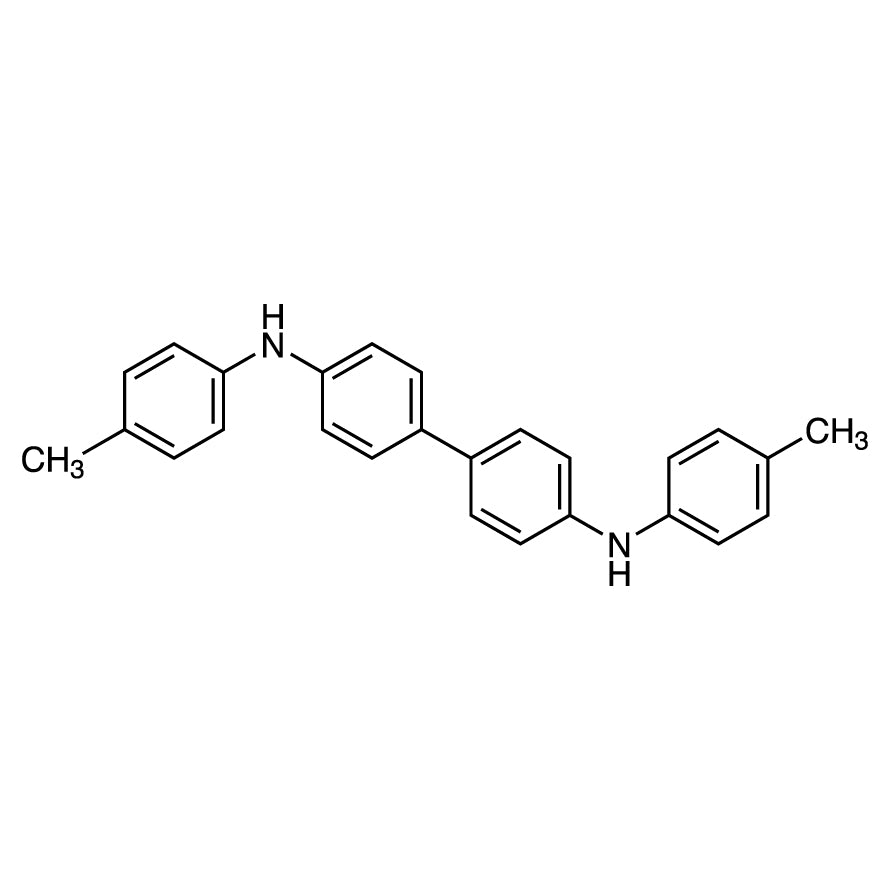
TCI D3567 N,N'-Di-p-tolylbenzidine is an organic compound supplied by TCI and classified within materials science as a small molecule semiconductor building block. Its structure consists of a biphenyl (benzidine) core in which both nitrogen atoms are substituted with p-tolyl groups, forming a conjugated diarylamine framework. In materials research laboratories, this compound serves as a base scaffold for constructing hole transport materials and active layers for organic electronic devices, because the triarylamine framework is widely recognised as an efficient motif for positive charge carrier transport.
The property that makes this compound attractive is the extended conjugation system linking the two nitrogen centres through the biphenyl core, which allows the molecule to be oxidised readily into a stable radical cation — the fundamental basis of its hole transport capability. In addition, both secondary nitrogen atoms still carry hydrogen atoms that can be reacted further through Buchwald–Hartwig amination or Ullmann coupling to install additional aryl groups. This reactivity makes the compound a direct precursor toward tetraaryl derivatives such as the TPD and NPB families. Its solid form and thermal stability further support its practical use in synthetic and device fabrication work.
In Indonesian laboratories, this building block is typically used within university and institutional research groups working on organic electronics and functional materials. It is handled as a starting material for the multi-step synthesis of charge transporting derivatives, or kept as a reference scaffold in materials chemistry programmes. Because it is a solid with good thermal stability, it is convenient to store, weigh and transport under ordinary laboratory conditions commonly available in Indonesian research facilities.
TCI brochures (PDF)
- Building Blocks for Organic Semiconductor 2026-03-24 · p. 30
Related TCI products
- TCI T2891 167218-30-6 N,N,N'-Triphenylbenzidine
- TCI D0878 531-91-9 N,N'-Diphenylbenzidine
- TCI T2573 54827-17-7 3,3',5,5'-Tetramethylbenzidine [for Biochemical Research]
- TCI T1023 54827-17-7 3,3',5,5'-Tetramethylbenzidine
- TCI T0141 366-29-0 N,N,N',N'-Tetramethylbenzidine
- TCI T3367 19606-98-5 N,N,N'-Triphenyl-1,4-phenylenediamine
- Hole transport material development — the conjugated diarylamine framework supports efficient positive charge carrier movement, making it a suitable starting scaffold for charge transporting layer design.
- Synthesis of TPD and NPB family derivatives — the two secondary nitrogen atoms retain reactive hydrogens, allowing direct conversion into well known tetraaryl transport compounds.
- Buchwald–Hartwig amination studies — the compound provides two accessible N–H sites, making it a practical substrate for palladium catalysed carbon–nitrogen bond formation research.
- Ullmann coupling research — the same secondary amine positions allow copper mediated arylation, giving laboratories a route to install additional aryl groups onto the benzidine core.
- Organic electronic device material research — as a small molecule semiconductor building block, it supports the preparation of active materials investigated in organic electronic device studies.
| Brand | TCI |
|---|---|
| CAS number | 10311-61-2 |
| Molecular formula | — |
| Purity | — |
| Category | Materials Science > Material Building Blocks > Small Molecule Semiconductor Building Blocks |
| Pack sizes | available in the standard research pack sizes offered by TCI for this catalogue item |
| Physical form | solid |
| Storage | keep in a tightly closed container in a cool, dry and well ventilated place |
- Catalogue code: D3567
Store TCI D3567 N,N'-Di-p-tolylbenzidine in its original tightly closed container, kept in a cool, dry and well ventilated area away from direct sunlight, moisture and sources of ignition. Amber glass or the manufacturer's supplied container is suitable for maintaining material quality, and the container should be reclosed promptly after each use. Handle the solid in a fume hood using standard personal protective equipment, including safety glasses, a laboratory coat and chemical resistant gloves, and avoid generating or inhaling dust during weighing and transfer. Use clean, dry spatulas to prevent contamination, keep the material separated from strong oxidising agents, and always consult the manufacturer's safety data sheet before handling. Dispose of residues and contaminated materials in accordance with applicable laboratory chemical waste procedures.
—
Produk Terkait
-
N,N,N'-Triphenylbenzidine TCI T2891
Regular price From Rp 2.386.650,00Regular price -
N,N'-Diphenylbenzidine TCI D0878
Regular price From Rp 1.326.150,00Regular price -
3,3',5,5'-Tetramethylbenzidine[forBiochemicalResearch] TCI T2573
Regular price From Rp 1.510.950,00Regular price -
3,3',5,5'-Tetramethylbenzidine TCI T1023
Regular price From Rp 1.298.850,00Regular price -
N,N,N',N'-Tetramethylbenzidine TCI T0141
Regular price From Rp 1.298.850,00Regular price -
N,N,N'-Triphenyl-1,4-phenylenediamine TCI T3367
Regular price From Rp 1.724.100,00Regular price -
N-(p-Tolyl)-1-naphthylamine TCI T2201
Regular price Rp 4.426.800,00Regular price -
N-(p-Tolyl)-2-naphthylamine TCI T2065
Regular price Rp 2.359.350,00Regular price


![54827-17-7 3,3',5,5'-Tetramethylbenzidine [for Biochemical Research] - AMI Scientific](http://amiscientific.com/cdn/shop/files/TCI2510T2573.jpg?v=1767143058&width=533)


