

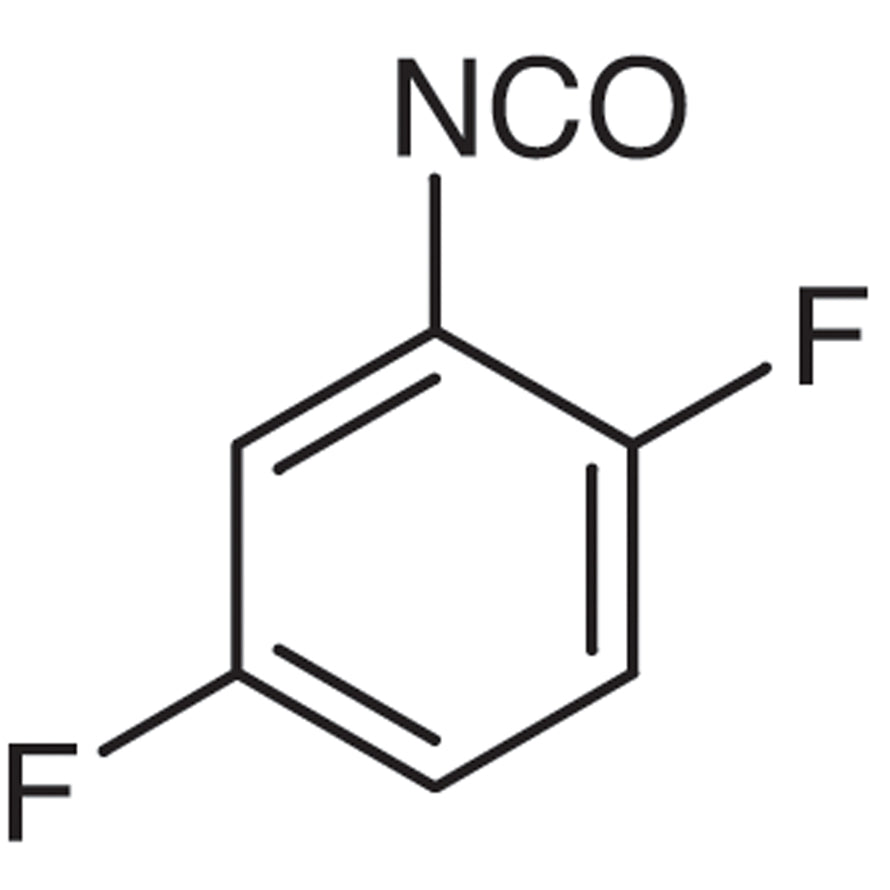
TCI D3695 2,5-Difluorophenyl Isocyanate (CAS 39718-32-6) is a fluorinated building block belonging to the aryl isocyanate family, carrying two fluorine atoms at positions 2 and 5 of the benzene ring. The compound is designed to introduce a difluorinated aryl fragment into a target molecule while simultaneously forming a urea or carbamate linkage in a single reaction step. In medicinal chemistry and agrochemical laboratories, reagents of this type are highly valued because fluorine incorporation is a common strategy for tuning the physicochemical properties of a molecule, while the isocyanate group offers a clean and rapid bond-forming pathway with no significant by-products.
The characteristic that makes this reagent a preferred choice is the strong influence exerted by the two fluorine atoms on the electronic character of the aromatic ring. Fluorine is strongly electron-withdrawing, which increases the reactivity of the isocyanate group toward nucleophiles and at the same time affects the acidity of the NH group in the resulting urea product, with a direct impact on hydrogen-bonding strength. The unsymmetrical ortho and meta placement provides a distinctive substitution pattern that is useful in exploring structure-activity relationships, while the strong carbon-fluorine bond makes the substituent stable toward metabolic degradation.
In Indonesian laboratories, this building block is typically used in synthetic organic chemistry groups at universities and research institutes, as well as in pharmaceutical and agrochemical research units engaged in analogue preparation and library synthesis. It suits work in which small quantities of a defined, ready-to-use reagent are needed to assemble urea and carbamate derivatives quickly, without the additional steps that would be required to prepare the difluorinated aryl fragment in-house.
TCI brochures (PDF)
- Fluorination Reagents, Fluorinated Building Blocks 2026-03-18 · p. 32
Related TCI products
- TCI D3696 42601-04-7 3,4-Difluorophenyl Isocyanate
- TCI D3086 59025-55-7 2,4-Difluorophenyl Isocyanate
- TCI T3756 132123-45-6 3,4,5-Trifluorophenyl trans,trans-4'-Propylbicyclohexyl-4-carboxylate
- TCI T3129 113798-74-6 2,3,6-Trifluorophenol
- TCI T2407 209995-38-0 2,4,5-Trifluorophenylacetic Acid
- TCI T2299 99627-05-1 3,4,5-Trifluorophenol
- Urea derivative synthesis — direct reaction with primary or secondary amines forms substituted ureas in one step, with the difluorinated aryl fragment already installed and no significant by-products to remove.
- Carbamate formation — reaction with alcohols or phenols delivers carbamate linkages cleanly, making this reagent convenient for building protected intermediates and for attaching the difluoroaryl group to hydroxyl-bearing scaffolds.
- Medicinal chemistry analogue preparation — the unsymmetrical 2,5-difluoro substitution pattern gives medicinal chemists a distinctive aryl variant for probing structure-activity relationships across a series of related target molecules.
- Agrochemical research — fluorine incorporation is a standard strategy for tuning physicochemical properties of candidate actives, and the strong carbon-fluorine bond confers stability of the substituent toward metabolic degradation.
- Hydrogen-bonding studies in molecular design — the electron-withdrawing fluorines modulate the acidity of the urea NH group, allowing researchers to adjust hydrogen-bond strength in the products they construct.
| Brand | TCI (Tokyo Chemical Industry) |
|---|---|
| CAS number | 39718-32-6 |
| Molecular formula | — |
| Purity | — |
| Category | Chemistry > Building Blocks > Fluorinated Building Blocks |
| Pack sizes | available in the pack sizes listed by the manufacturer for this catalogue number |
| Physical form | — |
| Storage | follow the storage conditions stated on the manufacturer label and Safety Data Sheet |
- Catalogue number: D3695
Aryl isocyanates react readily with nucleophiles, including water and alcohols, so this reagent should be stored in a tightly closed original container, kept dry, and protected from moisture and atmospheric humidity. Transfers are best performed under an inert atmosphere using dry glassware and dry solvents to preserve reagent quality between uses. All handling should take place in a functioning fume hood, with gloves, safety glasses, and a laboratory coat worn at all times, since isocyanates are respiratory and skin sensitisers. Avoid inhalation of vapours and any contact with skin or eyes, keep the material away from incompatible materials such as amines, water, and strong bases, and collect waste separately for appropriate chemical disposal. Always consult the manufacturer's Safety Data Sheet before use.
—
Produk Terkait
-
3,4-DifluorophenylIsocyanate TCI D3696
Regular price Rp 2.730.000,00Regular price -
2,4-DifluorophenylIsocyanate TCI D3086
Regular price Rp 1.405.950,00Regular price -
3,4,5-Trifluorophenyltrans,trans-4'-Propylbicyclohexyl-4-carboxylate TCI T3756
Regular price From Rp 1.431.150,00Regular price -
2,3,6-Trifluorophenol TCI T3129
Regular price From Rp 955.500,00Regular price -
2,4,5-TrifluorophenylaceticAcid TCI T2407
Regular price Rp 1.193.850,00Regular price -
3,4,5-Trifluorophenol TCI T2299
Regular price From Rp 1.220.100,00Regular price -
MethylTrifluoropyruvate TCI T1785
Regular price From Rp 584.850,00Regular price -
3,3,3-TrifluoropropionicAcid TCI T1713
Regular price From Rp 1.115.100,00Regular price


