

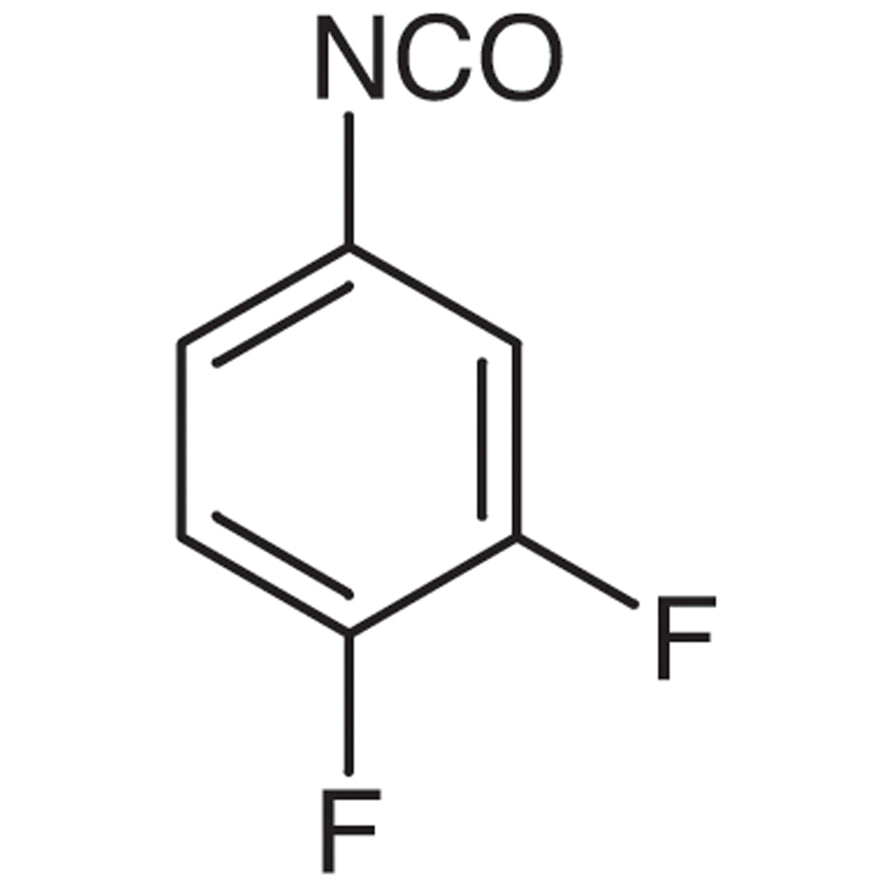
TCI D3696 3,4-Difluorophenyl Isocyanate is a fluorinated building block belonging to the aryl isocyanate family, featuring two adjacent fluorine atoms at positions 3 and 4 of the benzene ring. The 3,4-difluorophenyl motif is one of the most frequently encountered substitution patterns in modern medicinal chemistry and agrochemical research, and this reagent allows chemists to install that motif while simultaneously forming a urea or carbamate linkage in a single step. In the laboratory it serves as a direct entry point to fluorinated nitrogen-containing scaffolds without multi-step preparation.
The properties that make this reagent a preferred choice are its combination of high reactivity and distinctive electronic influence. The two neighbouring fluorine atoms withdraw electron density strongly, activating the isocyanate group and shaping the polarity, solubility, and hydrogen-bonding strength of the resulting derivatives. Unlike the 2,5-substitution pattern, positions 3 and 4 place no steric hindrance near the reactive group, so reactions generally proceed smoothly and the resulting urea products often crystallise readily. The strong carbon–fluorine bonds additionally confer stability toward oxidation and hydrolysis.
In Indonesian laboratories, this building block is typically applied in the efficient construction of urea and carbamate libraries, since the isocyanate group reacts directly with amines, alcohols, and phenols without requiring any additional coupling reagent. This makes it well suited to university research groups, pharmaceutical discovery laboratories, and agrochemical development programmes where fluorinated intermediates must be prepared reliably and where a straightforward, reagent-economical route to fluorinated derivatives is valued.
TCI brochures (PDF)
- Fluorination Reagents, Fluorinated Building Blocks 2026-03-18 · p. 28
Related TCI products
- TCI D3695 39718-32-6 2,5-Difluorophenyl Isocyanate
- TCI D3086 59025-55-7 2,4-Difluorophenyl Isocyanate
- TCI T3756 132123-45-6 3,4,5-Trifluorophenyl trans,trans-4'-Propylbicyclohexyl-4-carboxylate
- TCI T3129 113798-74-6 2,3,6-Trifluorophenol
- TCI T2407 209995-38-0 2,4,5-Trifluorophenylacetic Acid
- TCI T2299 99627-05-1 3,4,5-Trifluorophenol
- Urea library synthesis — the isocyanate group reacts directly with a wide range of amines, allowing rapid parallel preparation of fluorinated urea derivatives without additional coupling reagents.
- Carbamate preparation — reaction with alcohols and phenols proceeds cleanly, giving fluorinated carbamates in a single step and simplifying route design for downstream chemistry.
- Medicinal chemistry scaffold building — the 3,4-difluorophenyl motif is a very common substitution pattern in drug discovery, so this reagent installs a directly relevant pharmacophore fragment.
- Agrochemical intermediate synthesis — the same difluorophenyl pattern appears widely in modern agrochemical research, making this building block useful for preparing candidate active-ingredient intermediates.
- Structure–property studies — the strongly electron-withdrawing fluorine pair lets researchers systematically modify polarity, solubility, and hydrogen-bonding strength across a series of related derivatives.
| Brand | TCI (Tokyo Chemical Industry) |
|---|---|
| CAS number | 42601-04-7 |
| Molecular formula | — |
| Purity | — |
| Category | Chemistry > Building Blocks > Fluorinated Building Blocks |
| Pack sizes | available in standard TCI research-scale packaging; please confirm the required size when ordering |
| Physical form | — |
| Storage | keep tightly closed and protected from moisture; refer to the manufacturer's label and Safety Data Sheet for the specified storage condition |
- Catalogue Number: D3696
Store the container tightly closed in a cool, dry, well-ventilated area, away from moisture, amines, alcohols, and other protic substances, since the isocyanate group reacts readily with these. Keep the material in its original manufacturer container or in a suitable tightly sealed glass container, and consider handling under an inert atmosphere when transferring. All manipulation should take place in a functioning fume hood using nitrile gloves, safety glasses, and a laboratory coat, as isocyanates are irritating to the eyes, skin, and respiratory tract. Avoid inhaling vapours, allow cold containers to warm before opening to prevent moisture condensation, and always consult the manufacturer's Safety Data Sheet before use.
—
Produk Terkait
-
2,5-DifluorophenylIsocyanate TCI D3695
Regular price From Rp 1.115.100,00Regular price -
2,4-DifluorophenylIsocyanate TCI D3086
Regular price Rp 1.405.950,00Regular price -
3,4,5-Trifluorophenyltrans,trans-4'-Propylbicyclohexyl-4-carboxylate TCI T3756
Regular price From Rp 1.431.150,00Regular price -
2,3,6-Trifluorophenol TCI T3129
Regular price From Rp 955.500,00Regular price -
2,4,5-TrifluorophenylaceticAcid TCI T2407
Regular price Rp 1.193.850,00Regular price -
3,4,5-Trifluorophenol TCI T2299
Regular price From Rp 1.220.100,00Regular price -
MethylTrifluoropyruvate TCI T1785
Regular price From Rp 584.850,00Regular price -
3,3,3-TrifluoropropionicAcid TCI T1713
Regular price From Rp 1.115.100,00Regular price


