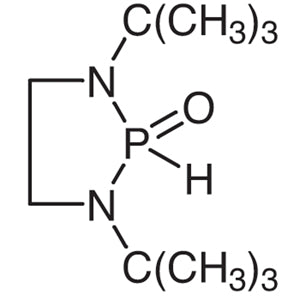
The 1,3-Di-tert-butyl-1,3,2-diazaphospholidine 2-Oxide supplied by TCI under CAS number 854929-38-7 is a five-membered cyclic phosphorus compound containing two tert-butyl-substituted nitrogen atoms and one phosphorus atom in an oxidised state. It belongs to the family of cyclic phosphonamides and is catalogued under phosphorus compounds for catalysis and inorganic chemistry. In the laboratory its role is that of a reagent and phosphorus precursor: it delivers a ready-made P–N framework, allowing researchers to build organophosphorus compounds, ligands and catalysts without having to assemble the diazaphospholidine ring from basic starting materials.
The property that makes this compound attractive is its rigid ring framework carrying two bulky tert-butyl groups on the nitrogen atoms. This steric hindrance lends structural stability to the phosphorus centre while simultaneously controlling how reactants approach it, which matters greatly when the compound is used to construct a directed coordination environment. The phosphorus–nitrogen bonds within the ring give the molecule electronic characteristics that differ from those of ordinary alkyl phosphines, so compounds of this class are frequently explored for reactions demanding a particular balance between basicity and stability. The oxidised state of the phosphorus centre further defines its handling behaviour and its reactivity profile relative to the corresponding non-oxidised species.
In Indonesian laboratories, a specialised reagent of this type is typically used in university and institutional research groups working on organic synthesis, homogeneous catalysis and coordination chemistry. Because it is an imported research chemical rather than a bulk commodity, it is generally ordered in small quantities for defined synthetic routes, method development or thesis-level projects, and is kept as part of a controlled inventory of phosphorus reagents alongside other catalysis chemicals.
TCI brochures (PDF)
- Ligands 2025-12-01 · p. 6
Related TCI products
- TCI D2300 22429-12-5 1,3-Dimethyl-2-phenyl-1,3,2-diazaphospholidine
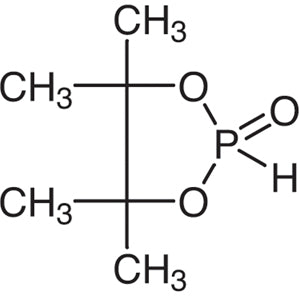
- TCI T2645 16352-18-4 4,4,5,5-Tetramethyl-1,3,2-dioxaphospholane 2-Oxide
- TCI P1746 1314-56-3 Phosphorus(V) Oxide
- TCI M0705 707-61-9 3-Methyl-1-phenyl-2-phospholene 1-Oxide
- TCI H1766 33530-51-7 anti-1,2,2,3,4,4-Hexamethylphosphetane 1-Oxide
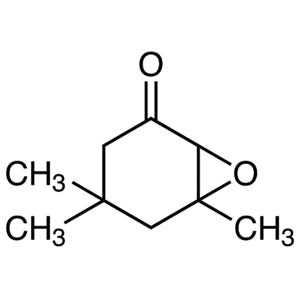
- TCI I0805 10276-21-8 Isophorone Oxide
- Organophosphorus synthesis: the pre-formed diazaphospholidine ring shortens synthetic routes, so researchers can functionalise an existing P–N framework instead of constructing the heterocycle themselves.
- Ligand preparation: the rigid cyclic backbone with bulky tert-butyl substituents provides a defined steric profile, useful when designing ligands that require a controlled coordination pocket around the metal.
- Catalysis research: because its phosphorus–nitrogen bonds give electronic behaviour distinct from alkyl phosphines, it suits studies of catalytic systems needing an unusual balance of basicity and stability.
- Coordination chemistry studies: the sterically hindered phosphorus centre helps direct how incoming reactants or metal fragments approach, making it valuable for building targeted coordination environments.
- Methodology and reference work: as a defined cyclic phosphonamide with a specific CAS identity, it serves as a consistent starting material for reproducible reaction development and comparative synthetic studies.
| Brand | TCI (Tokyo Chemical Industry), product code D3846 |
|---|---|
| CAS number | 854929-38-7 |
| Molecular formula | — |
| Purity | — |
| Category | Chemistry > Catalysis and Inorganic Chemistry > Phosphorous Compounds |
| Pack sizes | supplied in the manufacturer's standard research-scale packaging; exact available pack size confirmed at the time of order |
| Physical form | as stated on the manufacturer's label, Safety Data Sheet and certificate of analysis accompanying the shipment |
| Storage | — |
- Chemical name: 1,3-Di-tert-butyl-1,3,2-diazaphospholidine 2-Oxide
Store the container in a cool, dry, well-ventilated area away from heat, direct sunlight and sources of ignition, and keep it tightly closed when not in use. Retain the material in its original manufacturer container, or transfer it only to a clean, chemically compatible and clearly labelled vessel. As with other phosphorus reagents, limit exposure to moisture and air during weighing and transfer, and handle the compound inside a fume hood using safety glasses, gloves and a laboratory coat. Follow the manufacturer's Safety Data Sheet for the specific storage temperature, incompatibilities and spill or disposal procedures applicable to this product, and record each withdrawal in the laboratory chemical inventory.
—
Produk Terkait
-
1,3-Dimethyl-2-phenyl-1,3,2-diazaphospholidine TCI D2300
Regular price Rp 5.830.650,00Regular price -
4,4,5,5-Tetramethyl-1,3,2-dioxaphospholane2-Oxide TCI T2645
Regular price From Rp 2.916.900,00Regular price -
Phosphorus(V)Oxide TCI P1746
Regular price Rp 557.550,00Regular price -
3-Methyl-1-phenyl-2-phospholene1-Oxide TCI M0705
Regular price From Rp 1.431.150,00Regular price -
anti-1,2,2,3,4,4-Hexamethylphosphetane1-Oxide TCI H1766
Regular price From Rp 2.094.750,00Regular price -
IsophoroneOxide TCI I0805
Regular price From Rp 1.378.650,00Regular price -
Zirconium(IV)Oxide TCI Z0049
Regular price From Rp 848.400,00Regular price -
Ytterbium(III)Oxide TCI Y0008
Regular price From Rp 505.050,00Regular price