TCI D4743, with CAS number 3999-55-1, is Diethyl trans-1,2-Cyclopropanedicarboxylate, a cyclopropane diester with a defined trans configuration. The compound provides a three-membered ring bearing two ethyl ester groups on adjacent carbon atoms. In organic synthesis laboratories, the cyclopropane framework is widely sought after because it imparts high conformational rigidity and unusual bond angles, making it especially useful for constructing molecules with controlled three-dimensional orientation as well as for studying the behaviour of strained rings across a range of reactions.
The principal advantages of this compound are its clearly defined trans stereochemistry and its two readily manipulated ester groups. Both esters can be hydrolysed to the corresponding dicarboxylic acid, reduced to the diol, converted into amides, or employed in condensation reactions. Because they occupy trans positions, the two groups point to opposite faces of the ring plane, giving a framework that is at once symmetrical and spatially well defined. The considerable ring strain of the cyclopropane unit also opens the way to controlled ring-opening reactions, a strategy frequently exploited to build carbon chains with a predetermined arrangement.
In Indonesian laboratories, this building block is typically handled in university research groups, institutional chemistry laboratories, and industrial research units working on organic synthesis and structural chemistry. It is normally used at small to moderate scale within multi-step synthetic routes, where a rigid, stereochemically defined scaffold is required. Working practice generally follows standard bench procedures for ester-bearing organic reagents, with the material dispensed under controlled conditions and stored between uses.
Related TCI products
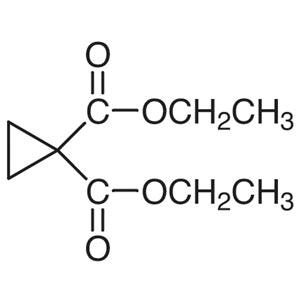
- TCI C1341 1559-02-0 Diethyl 1,1-Cyclopropanedicarboxylate
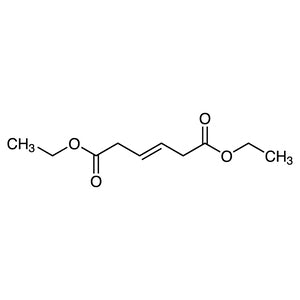
- TCI B1592 57042-08-7 Diethyl trans-3-Hexenedioate
- TCI N0430 18829-56-6 trans-2-Nonenal (contains trans-2-Nonenal Diethyl Acetal) (ca. 10% in Ethanol, ca. 0.57mol/L)
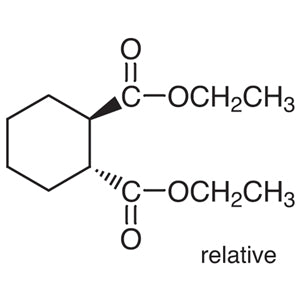
- TCI D3684 17351-22-3 Diethyl trans-1,2-Cyclohexanedicarboxylate
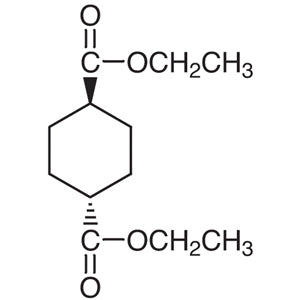
- TCI D3639 19145-96-1 Diethyl trans-1,4-Cyclohexanedicarboxylate
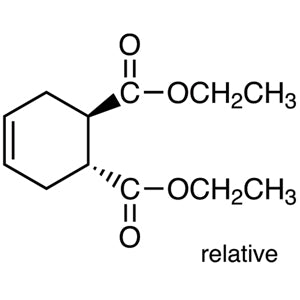
- TCI C1704 5048-50-0 Diethyl trans-4-Cyclohexene-1,2-dicarboxylate
- Multi-step organic synthesis: the defined trans-cyclopropane framework serves as a rigid starting scaffold whose geometry is carried forward through subsequent synthetic transformations with predictable spatial outcomes.
- Ester functional group transformations: both ethyl ester groups can be hydrolysed, reduced to the diol, or converted to amides, giving laboratories a versatile, well-understood handle for derivatisation.
- Stereochemically controlled molecule construction: the trans arrangement places the two ester substituents on opposite faces of the ring, allowing chemists to build target structures with controlled three-dimensional orientation.
- Strained-ring reactivity studies: the substantial ring strain of the cyclopropane unit makes this compound suitable for investigating how strained three-membered rings behave under different reaction conditions.
- Controlled ring-opening chemistry: the strained ring can be opened deliberately, a strategy frequently used to construct carbon chains with a predetermined and reproducible arrangement of substituents.
| Brand | TCI |
|---|---|
| CAS number | 3999-55-1 |
| Molecular formula | — |
| Purity | — |
| Category | Chemistry > Building Blocks > Non-Heterocyclic Building Blocks |
| Pack sizes | available in the standard research-scale packaging offered by the manufacturer |
| Physical form | — |
| Storage | keep in the original closed container under the conditions stated on the manufacturer's label |
- Chemical name: Diethyl trans-1,2-Cyclopropanedicarboxylate
Store the container tightly closed in a cool, dry, well-ventilated area, away from direct sunlight, heat sources, and incompatible materials, following the conditions indicated on the manufacturer's label and safety data sheet. Keep the material in its original supplier container, or in a clean, chemically compatible and clearly labelled vessel if transferred. Handle the compound in a fume hood using standard personal protective equipment, including safety glasses, gloves, and a laboratory coat. Avoid contact with skin and eyes and avoid inhalation of vapours. Close the container promptly after dispensing to limit exposure to moisture and air, and dispose of residues and contaminated materials in accordance with applicable laboratory chemical waste procedures.
—
Produk Terkait
-
Diethyl1,1-Cyclopropanedicarboxylate TCI C1341
Regular price From Rp 664.650,00Regular price -
Diethyltrans-3-Hexenedioate TCI B1592
Regular price Rp 5.062.050,00Regular price -
trans-2-Nonenal(containstrans-2-NonenalDiethylAcetal)(ca.10%inEthanol,ca.0.57mol/L) TCI N0430
Regular price Rp 1.405.950,00Regular price -
Diethyltrans-1,2-Cyclohexanedicarboxylate TCI D3684
Regular price Rp 9.223.200,00Regular price -
Diethyltrans-1,4-Cyclohexanedicarboxylate TCI D3639
Regular price From Rp 3.075.450,00Regular price -
Diethyltrans-4-Cyclohexene-1,2-dicarboxylate TCI C1704
Regular price From Rp 557.550,00Regular price -
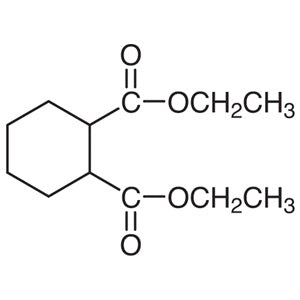
Diethylcis-1,2-Cyclohexanedicarboxylate(containsDiethyltrans-1,2-Cyclohexanedicarboxylate) TCI C0476
Regular price From Rp 1.749.300,00Regular price -
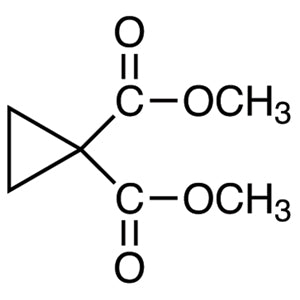
Dimethyl1,1-Cyclopropanedicarboxylate TCI C1471
Regular price Rp 1.378.650,00Regular price