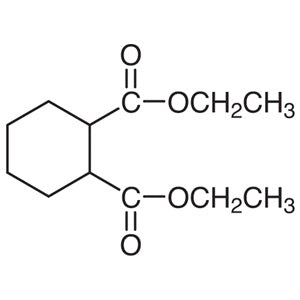
TCI D3684 Diethyl trans-1,2-Cyclohexanedicarboxylate is a cyclic aliphatic building block consisting of the ethyl diester of 1,2-cyclohexanedicarboxylic acid, with the two adjacent carboxylate groups arranged in the trans configuration. The rigid cyclohexane framework, combined with a clearly defined stereochemical arrangement, makes this compound a valuable starting material in organic synthesis, particularly when researchers require a saturated ring scaffold with controlled functional group orientation. In the laboratory it serves as a substrate for ester group transformation reactions, as a precursor to cyclic diols and diamines, and as a test compound in studies of selective reactions and catalysis.
The properties that make this material a preferred choice are its well-defined trans stereochemistry and the 1,2 relationship between the two ester groups, which together make it an ideal substrate for desymmetrization as well as for selective hydrolysis of a single ester group, whether performed chemically or with the assistance of lipase and esterase enzymes. The ethyl ester groups are relatively stable during storage yet readily converted into carboxylic acids, amides, alcohols, or aldehydes through standard reactions. Its liquid form at room temperature simplifies volumetric measurement and mixing during preparation.
In Indonesian laboratories, this building block is typically used in university research groups, synthetic and medicinal chemistry laboratories, and institutional research centres working on organic synthesis and biocatalysis. It suits work where a defined saturated scaffold is needed for method development, reaction screening, or the preparation of intermediates. Because it is supplied as a liquid, it fits routine bench workflows involving syringe or pipette transfer, small-scale reaction setup, and analytical follow-up by standard chromatographic and spectroscopic methods.
Related TCI products
- TCI M2526 15177-67-0 Monomethyl trans-1,4-Cyclohexanedicarboxylate
- TCI D3723 3399-22-2 Dimethyl trans-1,4-Cyclohexanedicarboxylate
- TCI D3713 17351-07-4 Diethyl cis-1,2-Cyclohexanedicarboxylate
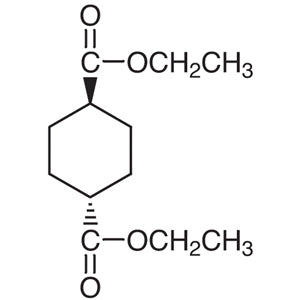
- TCI D3639 19145-96-1 Diethyl trans-1,4-Cyclohexanedicarboxylate
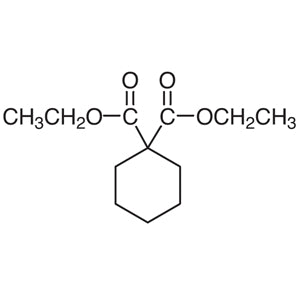
- TCI C1640 1139-13-5 Diethyl 1,1-Cyclohexanedicarboxylate
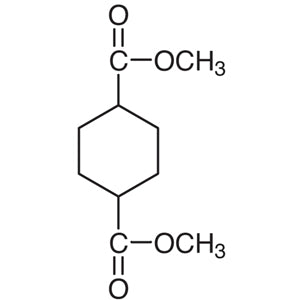
- TCI C1154 94-60-0 Dimethyl 1,4-Cyclohexanedicarboxylate (cis- and trans- mixture)
- Enzymatic desymmetrization studies: the defined trans arrangement of two adjacent ester groups makes this compound a suitable substrate for lipase and esterase mediated selective transformations.
- Selective mono-hydrolysis experiments: one of the two ester groups can be hydrolysed selectively, providing a practical model reaction for chemists developing selectivity methods.
- Precursor to cyclic diols and diamines: the ester functions can be reduced or converted, giving access to saturated ring intermediates with controlled substituent orientation.
- Ester transformation chemistry: the ethyl esters convert readily into carboxylic acids, amides, alcohols, or aldehydes using standard laboratory procedures and reagents.
- Catalysis and selective reaction research: the rigid cyclohexane scaffold with defined stereochemistry serves as a reliable test substrate when evaluating new catalysts or reaction conditions.
| Brand | TCI |
|---|---|
| CAS number | 17351-22-3 |
| Molecular formula | — |
| Purity | — |
| Category | Chemistry > Building Blocks > Non-Heterocyclic Building Blocks |
| Pack sizes | available in standard TCI catalogue pack sizes; please confirm the size required when ordering |
| Physical form | liquid at room temperature |
| Storage | keep in a tightly closed container in a cool, dry, well-ventilated area |
Store this product in its original tightly closed container in a cool, dry and well-ventilated area, away from direct sunlight, heat sources, ignition sources, and incompatible materials such as strong oxidising agents, strong acids, and strong bases. Amber glass bottles or the manufacturer's supplied packaging are suitable containers; avoid transferring the liquid into unsuitable plastic vessels. Handle in a fume hood and wear standard personal protective equipment, including safety glasses, chemical-resistant gloves, and a laboratory coat. Because the material is a liquid, use appropriate pipettes or syringes for transfer, close the container promptly after use to limit evaporation and moisture uptake, and label all secondary containers clearly. Clean up any spillage immediately with an inert absorbent and dispose of waste in accordance with institutional chemical waste procedures. Always consult the manufacturer's Safety Data Sheet before first use.
—
Produk Terkait
-
Monomethyltrans-1,4-Cyclohexanedicarboxylate TCI M2526
Regular price From Rp 1.008.000,00Regular price -
Dimethyltrans-1,4-Cyclohexanedicarboxylate TCI D3723
Regular price From Rp 1.008.000,00Regular price -
Diethylcis-1,2-Cyclohexanedicarboxylate TCI D3713
Regular price Rp 5.089.350,00Regular price -
Diethyltrans-1,4-Cyclohexanedicarboxylate TCI D3639
Regular price From Rp 3.075.450,00Regular price -
Diethyl1,1-Cyclohexanedicarboxylate TCI C1640
Regular price From Rp 1.060.500,00Regular price -
Dimethyl1,4-Cyclohexanedicarboxylate(cis-andtrans-mixture) TCI C1154
Regular price From Rp 717.150,00Regular price -
Diethylcis-1,2-Cyclohexanedicarboxylate(containsDiethyltrans-1,2-Cyclohexanedicarboxylate) TCI C0476
Regular price From Rp 1.749.300,00Regular price -
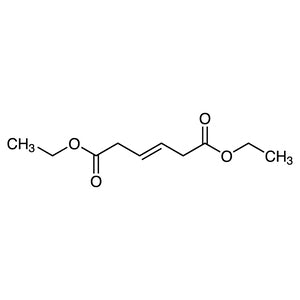
Diethyltrans-3-Hexenedioate TCI B1592
Regular price Rp 5.062.050,00Regular price