Pembayaran hanya melalui request quotation dan dilakukan setelah tim kami menghubungi Anda. Mohon cantumkan nomor WhatsApp aktif untuk konfirmasi pesanan & pembuatan invoice. Estimasi pengiriman 4-5 minggu setelah pembayaran.
Description
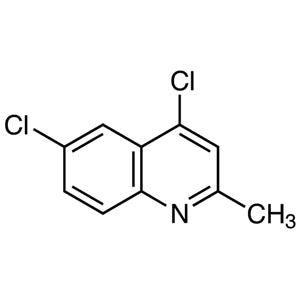
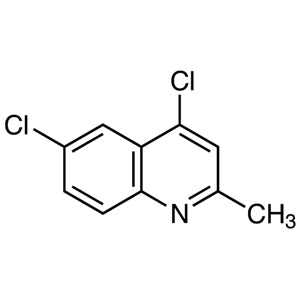
TCI D4782 4,6-Dichloro-2-methylquinoline is a heterocyclic building block based on the quinoline scaffold, carrying two chlorine atoms at the 4- and 6-positions together with a methyl group at the 2-position. Quinoline is one of the most important heterocyclic cores in medicinal chemistry and materials chemistry, because it appears in a large number of biologically active compounds, including antimalarial and antibacterial classes. In the laboratory, this compound serves as a pre-functionalised starting scaffold, allowing researchers to build target molecules directly through directed substitution reactions instead of assembling the quinoline ring from simple precursors.
The property that makes this material a preferred choice is the difference in reactivity between its two chlorine atoms. The chlorine at the 4-position sits adjacent to the ring nitrogen and is therefore far more readily displaced by nucleophilic aromatic substitution with amines, alkoxides, or thiolates, while the chlorine at the 6-position on the benzene ring is comparatively inert under those conditions and remains available for palladium-catalysed cross-coupling. This sequential selectivity is highly valuable in stepwise synthesis. The methyl group at the 2-position can additionally be activated to a carbanion for condensation reactions, giving a third independent handle on the same molecule.
In Indonesian laboratories, this building block is typically used in university and institutional research groups working on medicinal chemistry, heterocyclic synthesis, and functional organic materials. It suits programmes that prepare and screen libraries of quinoline derivatives, where a single well-defined scaffold can be diversified over several steps. Because the reactive positions are already installed, it also fits teaching and postgraduate laboratories that need reliable, reproducible substrates for nucleophilic aromatic substitution and cross-coupling practicals.
Laboratory Applications
- Medicinal chemistry scaffold development — the quinoline core is present in many active compound classes, so derivatives can be built directly toward pharmacologically relevant targets.
- Nucleophilic aromatic substitution at C-4 — the chlorine adjacent to the ring nitrogen is readily displaced by amines, alkoxides, or thiolates under controlled conditions.
- Palladium-catalysed cross-coupling at C-6 — the benzene-ring chlorine survives substitution conditions and can then be coupled to introduce carbon-based substituents.
- Stepwise multi-stage synthesis — the differing reactivity of the two chlorines lets chemists functionalise one position first and the other later, without protecting groups.
- Condensation chemistry via the 2-methyl group — this methyl can be deprotonated to a carbanion, providing an additional site for chain extension and ring-forming reactions.
Specifications
- Brand: TCI (Tokyo Chemical Industry)
- Product code: D4782
- CAS number: 53342-53-3
- Chemical name: 4,6-Dichloro-2-methylquinoline
- Category: Chemistry > Building Blocks > Heterocyclic Building Blocks
- Storage: store in the original tightly closed container in a cool, dry, well-ventilated place, as specified on the manufacturer's label
Handling and Storage
Keep the product in its original tightly closed container in a cool, dry, and well-ventilated storage area, away from heat sources, direct sunlight, moisture, and incompatible reagents such as strong oxidising agents. Follow the storage temperature stated on the manufacturer's label and packaging. Handle the solid in a fume hood using safety glasses, chemical-resistant gloves, and a laboratory coat, and avoid generating or inhaling dust. Use clean, dry spatulas and glassware when weighing to prevent contamination, reseal the container immediately after use, and label all secondary containers clearly. Dispose of residues and contaminated materials as chemical waste in accordance with your institution's laboratory waste procedures, and consult the manufacturer's safety data sheet before first use.





![Bicinchoninic Acid Disodium Salt [for Protein Research] (CAS 979-88-4) - TCI B5838 - AMI Scientific](http://amiscientific.com/cdn/shop/files/TCI2510B5838.jpg?v=1769180237&width=533)

![tert-Butyl 7'-Fluoro-1',4'-dihydro-2'H-spiro[piperidine-4,3'-quinoline]-1-carboxylate (CAS 1402232-83-0) - TCI B6776 - AMI Scientific](http://amiscientific.com/cdn/shop/files/TCI2510B6776.jpg?v=1771058548&width=533)
![tert-Butyl 5'-Fluoro-1',4'-dihydro-2'H-spiro[piperidine-4,3'-quinoline]-1-carboxylate (CAS 1402232-95-4) - TCI B6777 - AMI Scientific](http://amiscientific.com/cdn/shop/files/TCI2510B6777.jpg?v=1768816103&width=533)