TCI D4783 2,3-Dihydro-3-oxo-4H-1,4-benzoxazine-4-propionitrile is a heterocyclic building block built around a benzoxazinone core — a benzene ring fused to a six-membered oxazinone ring — carrying a propionitrile chain bonded to the ring nitrogen atom. The 2H-1,4-benzoxazin-3(4H)-one framework is a motif that appears frequently in bioactive molecules and agrochemical agents, which is what gives this compound its value as a synthetic intermediate. In the laboratory, its role is to supply a protected heterocyclic core together with a nitrile group that can be converted into a wide range of downstream functional groups.
The property that makes this material a preferred choice is the versatility of its nitrile group, which can be reduced to a primary amine, hydrolysed to a carboxylic acid or an amide, or transformed into tetrazoles and amidines — transformations that are all important in medicinal chemistry. Substitution on the lactam ring nitrogen leaves the cyclic amide group shielded from side reactions, so reaction selectivity is easier to control. The benzoxazinone framework itself is relatively rigid and contains both oxygen and nitrogen atoms capable of acting as hydrogen-bond acceptors, a character that is useful in structure-directed design work.
In Indonesian laboratories, a building block of this type is normally used at the bench scale in university research groups, pharmaceutical and agrochemical R&D units, and organic synthesis laboratories carrying out method development. It is typically weighed out in small portions for exploratory reactions, route scouting, and analogue preparation, then stored between uses. Because it is supplied as a defined single compound with a registered CAS identity, it also serves well as a reference starting material for repeat or verification work.
Related TCI products
- TCI D6133 51287-17-3 3-Phenyl-3,4-dihydro-2H-1,3-benzoxazine
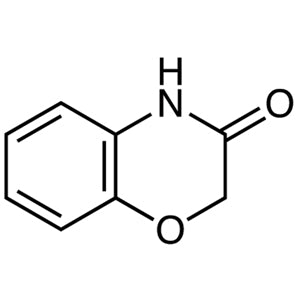
- TCI B4553 5466-88-6 2H-1,4-Benzoxazin-3(4H)-one
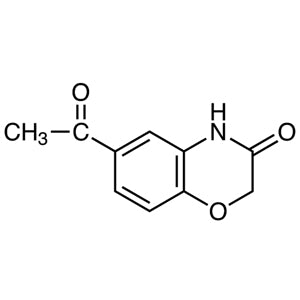
- TCI A2755 26518-71-8 6-Acetyl-2H-1,4-benzoxazin-3(4H)-one
- TCI N0999 81721-87-1 6-Nitro-2H-1,4-benzoxazin-3(4H)-one
- TCI H1653 1218-69-5 2-(2-Hydroxyphenyl)-4H-1,3-benzoxazin-4-one
- TCI B1512 7426-75-7 1,4-Bis(4,5-dihydro-2-oxazolyl)benzene
- Medicinal chemistry intermediate synthesis — the benzoxazinone core is a recognised bioactive motif, so this block shortens the route to candidate scaffolds without building the fused ring from scratch.
- Nitrile-to-amine conversion work — the pendant propionitrile chain can be reduced to a primary amine, giving direct access to aminoalkyl benzoxazinone derivatives for further coupling or derivatisation.
- Tetrazole and amidine preparation — the nitrile group serves as the entry point for these functional groups, which are widely used as bioisosteric replacements in drug design programmes.
- Agrochemical research and analogue preparation — because the 2H-1,4-benzoxazin-3(4H)-one framework occurs in agrochemical agents, this compound supports structure-activity exploration around that established motif.
- Carboxylic acid and amide route development — controlled hydrolysis of the nitrile provides acid or amide products while the substituted lactam nitrogen keeps the cyclic amide protected from competing side reactions.
| Brand | TCI (Tokyo Chemical Industry) |
|---|---|
| CAS number | 23866-12-8 |
| Molecular formula | — |
| Purity | — |
| Category | Chemistry > Building Blocks > Heterocyclic Building Blocks |
| Pack sizes | supplied in standard TCI research-scale packaging; please confirm the available pack size when ordering |
| Physical form | — |
| Storage | keep in the tightly closed original container, in a cool, dry, well-ventilated place away from light and moisture |
- Chemical name: 2,3-Dihydro-3-oxo-4H-1,4-benzoxazine-4-propionitrile
Store this material in its original tightly closed container in a cool, dry and well-ventilated area, protected from direct sunlight, heat sources and moisture, and kept away from strong oxidising agents and strong acids or bases. Amber glass or the manufacturer's supplied container is suitable; reseal immediately after each use to limit moisture uptake and keep the sample fit for repeat work. Handle in a fume hood using safety glasses, chemical-resistant gloves and a laboratory coat, avoid generating or inhaling dust, and avoid skin and eye contact. Use clean, dry spatulas when weighing, label all secondary containers clearly, and wash hands after handling. Nitrile-containing compounds should be treated as chemical waste and disposed of according to institutional procedures; always consult the manufacturer's current Safety Data Sheet before use.
—
Produk Terkait
-
3-Phenyl-3,4-dihydro-2H-1,3-benzoxazine TCI D6133
Regular price From Rp 2.254.350,00Regular price -
2H-1,4-Benzoxazin-3(4H)-one TCI B4553
Regular price From Rp 610.050,00Regular price -
6-Acetyl-2H-1,4-benzoxazin-3(4H)-one TCI A2755
Regular price From Rp 1.246.350,00Regular price -
6-Nitro-2H-1,4-benzoxazin-3(4H)-one TCI N0999
Regular price Rp 1.538.250,00Regular price -
2-(2-Hydroxyphenyl)-4H-1,3-benzoxazin-4-one TCI H1653
Regular price From Rp 637.350,00Regular price -
1,4-Bis(4,5-dihydro-2-oxazolyl)benzene TCI B1512
Regular price Rp 2.518.950,00Regular price -
1,3-Bis(4,5-dihydro-2-oxazolyl)benzene TCI B1511
Regular price From Rp 903.000,00Regular price -
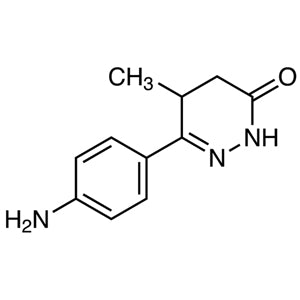
6-(4-Aminophenyl)-4,5-dihydro-5-methyl-3(2H)-pyridazinone TCI A2919
Regular price Rp 1.670.550,00Regular price