

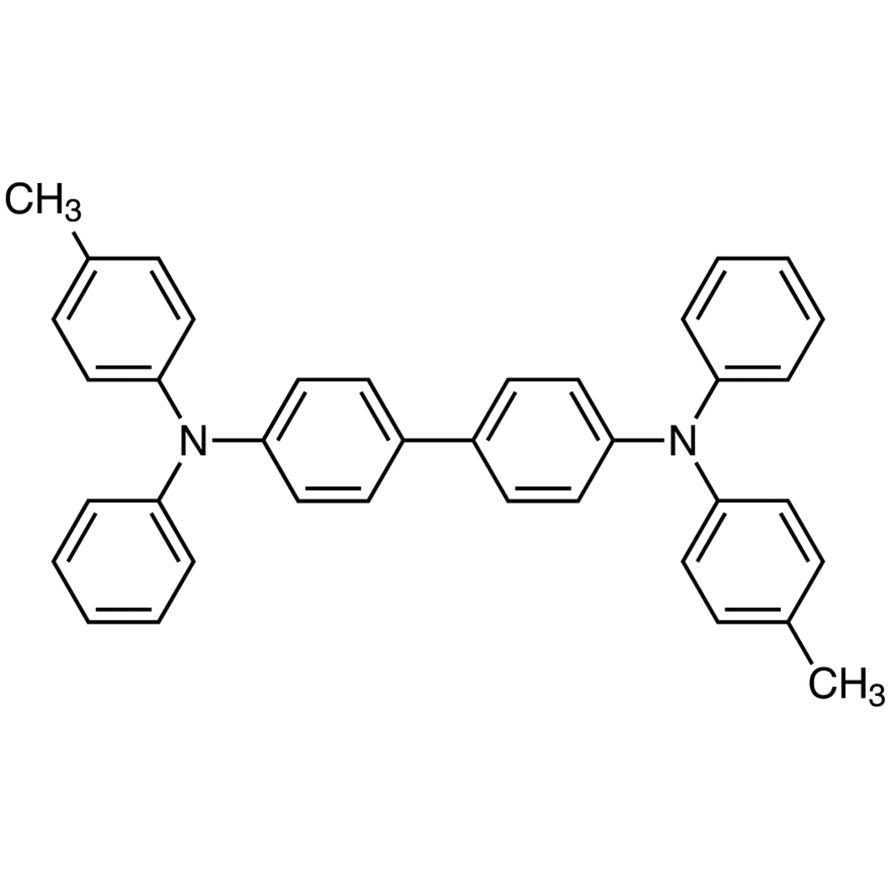
TCI D4834 is N,N'-Diphenyl-N,N'-di(p-tolyl)benzidine, a triarylamine compound built on a benzidine framework with four aryl groups — two phenyl groups and two p-tolyl groups — bonded to its two nitrogen atoms. Compounds of this class are a well-established family of materials in organic light-emitting diode research, particularly in their role as hole-transport materials. In organic electronic materials laboratories, materials of this type are used to form thin films that facilitate the movement of positive charge from the electrode toward the light-emitting layer within multilayer device structures.
The property that makes this compound a widely chosen option is the ability of the triarylamine nitrogen atoms to release electrons and form a relatively stable radical cation, which is the basis of good hole-transport capability. Its molecular structure is fairly large and not entirely planar, which helps prevent crystallisation, so the thin films that form tend to be amorphous and homogeneous. The methyl groups on the tolyl rings add electron donation while also influencing molecular packing in the solid state. The combination of thermal stability, good film-forming behaviour, and suitable orbital energy levels underpins its selection.
In Indonesian laboratories, this material is typically handled in organic electronics and materials science groups at universities and research institutes working on OLED device fabrication and characterisation. It is generally used in small quantities for preparing layered device stacks, for evaluating charge-transport behaviour, and as a reference hole-transport material when comparing new candidate compounds. Work of this kind is usually carried out under controlled laboratory conditions with attention to handling cleanliness, since film quality strongly influences device performance.
Related TCI products
- TCI T3265 76185-65-4 N,N,N',N'-Tetrakis(p-tolyl)benzidine (purified by sublimation)
- TCI T2269 76185-65-4 N,N,N',N'-Tetrakis(p-tolyl)benzidine
- TCI D4905 138171-14-9 N,N'-Diphenyl-N,N'-bis(p-tolyl)-1,4-phenylenediamine
- TCI D3236 65181-78-4 N,N'-Diphenyl-N,N'-di(m-tolyl)benzidine (purified by sublimation)
- TCI D2448 65181-78-4 N,N'-Diphenyl-N,N'-di(m-tolyl)benzidine
- TCI T3054 164724-35-0 N,N,N',N'-Tetrakis(4-biphenylyl)benzidine
- Hole-transport layer deposition — the triarylamine nitrogen centres readily donate electrons and form stable radical cations, giving the charge-carrying behaviour required between electrode and emissive layer.
- OLED device stack fabrication — its good film-forming behaviour allows preparation of the thin, uniform layers needed when building multilayer organic light-emitting diode structures in the laboratory.
- Amorphous thin-film studies — the large, non-planar molecular geometry resists crystallisation, making it suitable for research into homogeneous amorphous organic films and their morphological stability.
- Charge-transport characterisation — as a well-known hole-transport compound, it serves research measuring positive charge mobility and transport behaviour within organic semiconductor layers.
- Reference material for comparative studies — because this class of compound is widely recognised in OLED research, it is useful as a benchmark against newly synthesised hole-transport candidates.
| Brand | TCI |
|---|---|
| CAS number | 20441-06-9 |
| Molecular formula | — |
| Purity | — |
| Category | Materials Science > Electronic Materials > Organic Light-Emitting Diode (OLED) Materials |
| Pack sizes | available in standard research-scale packaging; please confirm the pack size required when ordering |
| Physical form | — |
| Storage | keep in the closed original container, protected from light and moisture |
- Chemical name: N,N'-Diphenyl-N,N'-di(p-tolyl)benzidine
Store the material in its original tightly closed container in a cool, dry, and well-ventilated place, protected from light and away from moisture, since organic electronic materials are sensitive to contamination that can degrade thin-film quality. Amber glass or the supplied original packaging is suitable, and secondary containment on a designated shelf is recommended. Handle in a fume hood using gloves, safety glasses, and a laboratory coat, avoiding dust formation and contact with skin or eyes. Use clean, dry spatulas to prevent cross-contamination, keep the container closed when not in use, and consult the manufacturer's safety data sheet before handling and disposal.
—
Produk Terkait
-
N,N,N',N'-Tetrakis(p-tolyl)benzidine(purifiedbysublimation) TCI T3265
Regular price Rp 2.094.750,00Regular price -
N,N,N',N'-Tetrakis(p-tolyl)benzidine TCI T2269
Regular price Rp 3.446.100,00Regular price -
N,N'-Diphenyl-N,N'-bis(p-tolyl)-1,4-phenylenediamine TCI D4905
Regular price From Rp 2.121.000,00Regular price -
N,N'-Diphenyl-N,N'-di(m-tolyl)benzidine(purifiedbysublimation) TCI D3236
Regular price From Rp 2.254.350,00Regular price -
N,N'-Diphenyl-N,N'-di(m-tolyl)benzidine TCI D2448
Regular price From Rp 1.115.100,00Regular price -
N,N,N',N'-Tetrakis(4-biphenylyl)benzidine TCI T3054
Regular price Rp 2.227.050,00Regular price -
4,4',4''-Tris[phenyl(m-tolyl)amino]triphenylamine TCI T2251
Regular price Rp 1.510.950,00Regular price -
2,7-Bis[N-(m-tolyl)anilino]-9,9'-spirobi[9H-fluorene] TCI B4882
Regular price From Rp 1.936.200,00Regular price



![124729-98-2 4,4',4''-Tris[phenyl(m-tolyl)amino]triphenylamine - AMI Scientific](http://amiscientific.com/cdn/shop/files/TCI2510T2251.jpg?v=1768819629&width=533)
![124729-98-2 4,4',4''-Tris[phenyl(m-tolyl)amino]triphenylamine - AMI Scientific](http://amiscientific.com/cdn/shop/files/TCI2510T2251_637d50c8-7890-4af5-807c-77070474f858.jpg?v=1772424561&width=533)
![1033035-83-4 2,7-Bis[N-(m-tolyl)anilino]-9,9'-spirobi[9H-fluorene] - AMI Scientific](http://amiscientific.com/cdn/shop/files/TCI2510B4882.jpg?v=1769145352&width=533)