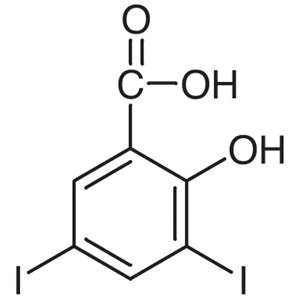
TCI D4848 3,5-Diiodosalicylaldehyde is a salicylaldehyde derivative that carries two iodine atoms at the 3 and 5 positions of its aromatic ring. The molecule brings together three structural elements at once: an aldehyde group, a phenolic hydroxyl group adjacent to it, and two heavy halogen atoms. This combination makes it a highly valued intermediate in coordination chemistry and ligand synthesis, because the ortho-positioned aldehyde and phenol pair is a classic chelating-ligand motif capable of binding metal ions strongly and stably.
The property that makes this compound a preferred choice is its ability to form Schiff base ligands while simultaneously providing points for further functionalization. When reacted with primary amines or diamines, it yields salicylaldimine and salen ligands that are widely used to build transition metal complexes for catalysis and magnetic studies. The two attached iodine atoms are not merely added weight: the carbon–iodine bond is well suited to palladium-catalyzed cross-coupling reactions such as Suzuki, Sonogashira, and Heck, so the basic framework can be extended into far more elaborate structures.
In Indonesian laboratories, this building block typically appears in university and institutional research settings where synthetic and coordination chemistry work is carried out. It is generally ordered in research-scale quantities for the preparation of ligands and metal complexes, for graduate and undergraduate thesis projects, and for method development work in synthetic organic chemistry groups that need a reliable, well-characterized starting material rather than a bulk commodity chemical.
TCI brochures (PDF)
- Iodinated Phenol/Benzoic Acid/Benzaldehyde Building Blocks 2024-11-15 · p. 1
- Schiff base ligand synthesis — reaction with primary amines gives salicylaldimine ligands directly, since the ortho aldehyde and phenol pair is exactly the motif required for this chemistry.
- Salen ligand preparation — condensation with diamines produces salen-type frameworks, and the iodine substituents remain intact for later modification of the finished ligand scaffold.
- Transition metal complex construction — the chelating aldehyde–phenol arrangement binds metal ions strongly and stably, making it a dependable starting point for coordination compound preparation.
- Palladium-catalyzed cross-coupling chemistry — the two carbon–iodine bonds are well suited to Suzuki, Sonogashira, and Heck reactions for extending the aromatic core.
- Catalysis and magnetic studies — metal complexes derived from its Schiff base and salen ligands are widely used in catalytic investigations and magnetic property research.
| Brand | TCI (Tokyo Chemical Industry) |
|---|---|
| CAS number | 2631-77-8 |
| Molecular formula | — |
| Purity | — |
| Category | Chemistry > Building Blocks > Non-Heterocyclic Building Blocks |
| Pack sizes | research-scale packaging as supplied by the manufacturer; please confirm the available pack size when ordering |
| Physical form | — |
| Storage | store according to the manufacturer's label and accompanying documentation |
- Product code: D4848
Store the container tightly closed in a cool, dry, well-ventilated area away from direct sunlight and from incompatible reagents, following the storage conditions stated on the manufacturer's label and safety data sheet. Keep the material in its original supplier container, or in a clean, chemically compatible and clearly labeled alternative if transfer is necessary. Handle in a fume hood using gloves, safety glasses, and a laboratory coat, avoid generating or inhaling dust during weighing, and close the container promptly after use. Consult the safety data sheet before first use and dispose of residues and contaminated materials through your institution's chemical waste procedures.
—
Produk Terkait
-
Salicylaldehyde TCI S0275
Regular price From Rp 584.850,00Regular price -
Salicylaldehyde TCI S0004
Regular price From Rp 689.850,00Regular price -
4-(Diethylamino)salicylaldehyde TCI D1752
Regular price From Rp 1.485.750,00Regular price -
Potassium3,5-Diiodosalicylate TCI D1686
Regular price Rp 2.227.050,00Regular price -
3,5-DiiodosalicylicAcid TCI D1677
Regular price From Rp 903.000,00Regular price -
Methyl4-Iodosalicylate TCI M1908
Regular price From Rp 1.273.650,00Regular price -
Methyl5-Iodosalicylate TCI I0539
Regular price From Rp 1.670.550,00Regular price -
5-IodosalicylicAcid TCI I0538
Regular price Rp 1.485.750,00Regular price