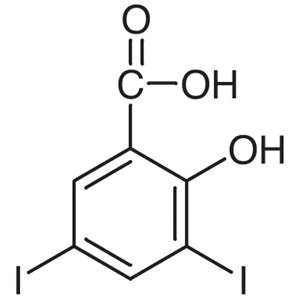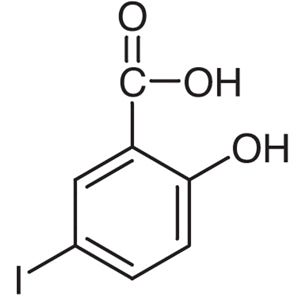
TCI I0538 5-Iodosalicylic Acid is a salicylic acid derivative that has been iodinated at the five position of its aromatic ring. The molecule carries three functional groups at once within a single simple framework: a carboxyl group, a phenolic hydroxyl group in the ortho position, and an iodine atom. This density of functional groups makes it a highly versatile building block in the synthesis laboratory, because one material can lead researchers toward many different derivative directions. The salicylate framework itself has a long history in medicinal chemistry, analytical chemistry, and coordination chemistry, so its iodinated version attracts broad interest.
The properties that make this material a preferred choice are rooted in the relationship between the carboxyl group and the adjacent hydroxyl group. The two form an intramolecular hydrogen bond that stabilises the molecule while simultaneously creating a bidentate chelation site capable of binding metal ions strongly. The substituted iodine atom increases the acidity of the phenolic group through its electron-withdrawing effect, adds molecular weight and electron density useful in crystallography, and at the same time provides an attachment point for transition-metal-catalysed coupling reactions.
As a building block within the Non-Heterocyclic Building Blocks category, this compound is typically used in Indonesian laboratories in university and institutional research settings where organic synthesis, coordination chemistry, and analytical method development are carried out. It suits research groups that prepare derivatives on a small to moderate scale, as well as laboratories developing ligands and reference materials. Researchers generally order it as a catalogue-grade reagent supporting exploratory synthesis rather than routine production work.
TCI brochures (PDF)
- Iodinated Phenol/Benzoic Acid/Benzaldehyde Building Blocks 2024-11-15 · p. 1
- Transition-metal-catalysed coupling reactions, where the iodine substituent serves as a reliable attachment point for building larger aromatic structures from a simple and readily handled starting framework.
- Coordination chemistry and metal complex preparation, since the adjacent carboxyl and phenolic hydroxyl groups form a bidentate chelation site that binds metal ions strongly and predictably.
- Ligand design and synthesis, because the salicylate framework has a long established history in coordination chemistry and its iodinated version extends that framework with an additional reactive handle.
- Crystallographic studies, where the iodine atom contributes added molecular weight and electron density that are useful when structural work requires a heavier scattering centre.
- Medicinal chemistry derivative synthesis, as the salicylate core is long established in that field and the three functional groups allow many different derivative directions from one material.
| Brand | TCI |
|---|---|
| CAS number | 119-30-2 |
| Molecular formula | — |
| Purity | — |
| Category | Chemistry > Building Blocks > Non-Heterocyclic Building Blocks |
| Pack sizes | available in standard TCI catalogue pack sizes; please confirm the packaging option when ordering. |
| Physical form | — |
| Storage | store according to the conditions stated on the manufacturer label and accompanying safety data sheet. |
- Catalogue code: I0538
Store this material in its original tightly closed container, in a cool, dry, and well-ventilated area away from direct sunlight, moisture, and incompatible materials. Keep the container sealed when not in use to prevent contamination and the uptake of atmospheric moisture. Handle in a fume hood using standard personal protective equipment, including safety glasses, gloves, and a laboratory coat, and avoid generating dust during weighing and transfer. Use clean, dry spatulas and glassware, return the material to storage promptly after use, and always consult the manufacturer safety data sheet before handling, since it remains the authoritative reference for specific conditions, incompatibilities, and disposal requirements.
—
Produk Terkait
-
3,5-DiiodosalicylicAcid TCI D1677
Regular price From Rp 903.000,00Regular price -
Methyl4-Iodosalicylate TCI M1908
Regular price From Rp 1.273.650,00Regular price -
Methyl5-Iodosalicylate TCI I0539
Regular price From Rp 1.670.550,00Regular price -
3,5-Diiodosalicylaldehyde TCI D4848
Regular price From Rp 1.353.450,00Regular price -
Potassium3,5-Diiodosalicylate TCI D1686
Regular price Rp 2.227.050,00Regular price -
3,5,6-TrichlorosalicylicAcid TCI T1406
Regular price From Rp 769.650,00Regular price -
5-BromosalicylicAcid TCI B0895
Regular price Rp 1.353.450,00Regular price -
5-NitrosalicylicAcid TCI N0257
Regular price From Rp 1.485.750,00Regular price