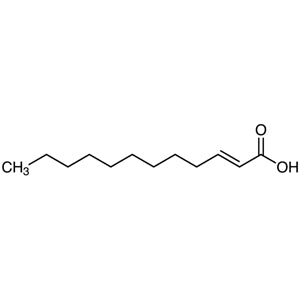
TCI D5660 trans-2-Dodecenoic Acid is an unsaturated fatty acid built on a twelve-carbon chain carrying a single double bond in the trans configuration, positioned at the alpha-beta site directly adjacent to the carboxylic acid group. TCI supplies this compound as a non-heterocyclic building block intended for organic synthesis and lipid research. In the laboratory it serves as a starting material for the preparation of fatty acid derivatives, as an analytical reference substance in lipid profiling studies, and as a reagent in natural product chemistry work involving medium-chain fatty acids.
The property that distinguishes this compound from an ordinary fatty acid is the placement of its double bond, which is directly conjugated with the carbonyl group. That conjugation renders the beta carbon electrophilic, so the molecule functions as a Michael acceptor capable of receiving conjugate addition from nucleophiles such as thiols and amines. The defined trans configuration gives the chain a straight geometry and a molecular packing pattern different from that of the cis isomer, a distinction that matters in studies of lipid physical properties as well as biological interactions. The free carboxylic acid group adds a further point of functionality for coupling, esterification, or amidation chemistry.
In Indonesian laboratories, this material is typically ordered by university and institutional research groups working on lipid chemistry, natural product isolation, and synthetic methodology. It is used in organic synthesis laboratories where a defined alpha-beta unsaturated acid is required as a scaffold, and in analytical laboratories that need a structurally characterized fatty acid as a comparison standard. The compound is normally handled in modest quantities at the bench, consistent with its role as a research building block rather than a bulk process chemical.
- Fatty acid derivative synthesis — the free carboxylic acid group provides a direct handle for esterification, amidation, and coupling reactions, making this a convenient starting point for preparing tailored fatty acid analogues.
- Michael addition chemistry — because the double bond is conjugated to the carbonyl, the electrophilic beta carbon accepts conjugate addition from thiols and amines, supporting the construction of functionalized carbon and heteroatom linkages.
- Analytical reference material in lipid profiling — the defined twelve-carbon chain length and confirmed trans geometry allow this compound to serve as a comparison substance when identifying unsaturated fatty acids in sample analysis.
- Natural product chemistry involving medium-chain fatty acids — researchers use it as a reagent and reference structure when working with medium-chain fatty acid motifs isolated from natural sources.
- Studies of lipid geometry and packing behaviour — the straight trans chain packs differently from the corresponding cis isomer, which makes it useful for investigating how double bond configuration influences physical properties and biological interactions.
| Brand | TCI (Tokyo Chemical Industry) |
|---|---|
| CAS number | 32466-54-9 |
| Molecular formula | — |
| Purity | — |
| Category | Chemistry > Building Blocks > Non-Heterocyclic Building Blocks |
| Pack sizes | available in the standard research-scale pack sizes offered by TCI; please confirm the desired packaging when ordering |
| Physical form | — |
| Storage | keep in the original closed container under the conditions stated on the manufacturer's label and safety data sheet |
- Catalogue code: D5660
- Chemical class: twelve-carbon unsaturated fatty acid with a trans double bond at the alpha-beta position
Store the material in its original tightly closed container in a cool, dry, well-ventilated area, away from heat, direct sunlight, and incompatible substances such as strong bases and strong oxidizing agents. Keep the container sealed when not in use to limit exposure to air and moisture. Compatible glass or the manufacturer's supplied packaging is appropriate for storage; transfer only into clean, chemically compatible and clearly labelled vessels. Because this is a carboxylic acid and a reactive Michael acceptor, handle it in a fume hood using safety glasses, chemically resistant gloves, and a laboratory coat, and avoid contact with skin and eyes as well as inhalation of any dust or vapour. Always consult the manufacturer's safety data sheet before handling, and follow institutional procedures for waste collection and spill response.
—
Product Categories
Produk Terkait
-
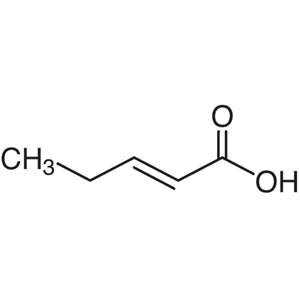
trans-2-PentenoicAcid TCI P0345
Regular price From Rp 1.193.850,00Regular price -
trans-2-OctenoicAcid TCI O0004
Regular price Rp 2.016.000,00Regular price -
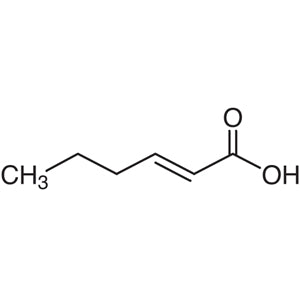
trans-2-HexenoicAcid TCI H0383
Regular price From Rp 1.565.550,00Regular price -
trans-3-HexenoicAcid TCI H0077
Regular price Rp 2.174.550,00Regular price -
10-UndecenoicAcid TCI U0007
Regular price From Rp 505.050,00Regular price -
ValericAcid TCI V0003
Regular price From Rp 610.050,00Regular price -
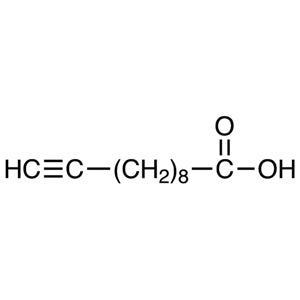
10-UndecynoicAcid TCI U0054
Regular price From Rp 1.008.000,00Regular price -
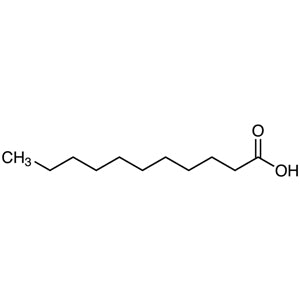
UndecanoicAcid TCI U0004
Regular price From Rp 955.500,00Regular price