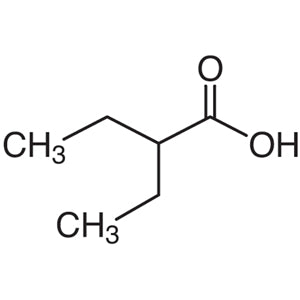
TCI E0070 2-Ethylbutyric Acid is a branched aliphatic carboxylic acid carrying a carboxyl group at the end of the chain and an ethyl branch on the alpha carbon. As a non-heterocyclic building block, this compound supplies an acid group that is readily converted into esters, amides, acid chlorides, or metal carboxylate salts. In the laboratory its role is twofold: it serves as a synthetic starting material that introduces a branched carbon skeleton into target molecules, and it acts as a source of carboxylate ligands in the preparation of metal complexes and precursors for inorganic materials.
The property that makes this compound a frequent choice is the branching at the alpha position, which creates steric hindrance around the carboxyl group. That hindrance lowers the tendency toward aggregation and improves the solubility of its metal salts in organic solvents, an important advantage when researchers prepare precursor solutions that must remain homogeneous. The relatively short yet branched carbon chain also balances lipophilicity against volatility, so that ester derivatives are easily purified by distillation. Its liquid form simplifies dispensing and measurement during routine bench work.
In Indonesian laboratories, the material fits both academic and industrial research settings where branched carboxylic acid frameworks are required. Availability in 25 mL and 500 mL packs accommodates small-scale trials as well as larger preparative work, allowing a research group to begin with exploratory reactions and then scale up without changing the source material. The liquid presentation supports straightforward volumetric handling on standard synthetic benches.
TCI brochures (PDF)
- Colloidal Quantum Dot (QD) Research Reagents 2026-05-21 · p. 5
- Esterification and ester synthesis: the carboxyl group reacts readily to form esters whose branched skeleton and balanced volatility allow convenient purification by distillation.
- Amide and acid chloride preparation: the acid function is straightforwardly converted into amides or acid chlorides, giving access to further derivatives from a single branched starting material.
- Metal carboxylate synthesis: it acts as a carboxylate ligand source, and its alpha branching yields metal salts with improved solubility in organic solvents.
- Inorganic materials precursor work: metal carboxylates derived from this acid help maintain homogeneous precursor solutions, which supports consistent preparation of inorganic material systems.
- Introduction of branched carbon skeletons: as a non-heterocyclic building block, it installs an alpha-branched fragment into target molecules during multistep organic synthesis.
| Brand | TCI |
|---|---|
| CAS number | 88-09-5 |
| Molecular formula | — |
| Purity | — |
| Category | Chemistry > Building Blocks > Non-Heterocyclic Building Blocks |
| Pack sizes | 25 mL and 500 mL |
| Physical form | liquid |
| Storage | keep in a tightly closed container in a cool, well-ventilated area away from incompatible materials |
Store the container tightly closed in a cool, dry and well-ventilated place, away from heat sources, ignition sources and incompatible materials such as strong bases and strong oxidising agents. Use containers of a material resistant to organic acids, and keep the original supplier packaging wherever possible so that the label and batch identification remain intact. As with any carboxylic acid, dispense inside a fume hood and wear a laboratory coat, chemical splash goggles and suitable chemical-resistant gloves. Avoid contact with skin and eyes and avoid breathing vapour. Return the container to its designated storage location promptly after use, wipe up any spillage immediately, and dispose of residues and contaminated materials according to institutional chemical waste procedures.
—
Produk Terkait
-
DL-2-MethylbutyricAcid TCI M0181
Regular price From Rp 955.500,00Regular price -
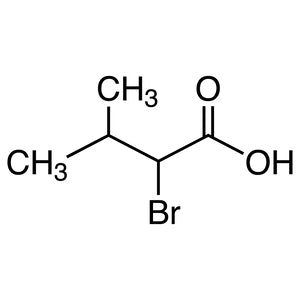
2-Bromo-3-methylbutyricAcid TCI B0668
Regular price Rp 2.016.000,00Regular price -
2-Hydroxy-2-methylbutyricAcid TCI H0636
Regular price From Rp 1.167.600,00Regular price -
2,2-DimethylbutyricAcid TCI D2429
Regular price From Rp 1.670.550,00Regular price -
2-(4-Chlorophenyl)-3-methylbutyricAcid TCI C2741
Regular price Rp 1.618.050,00Regular price -
ValericAcid TCI V0003
Regular price From Rp 610.050,00Regular price -
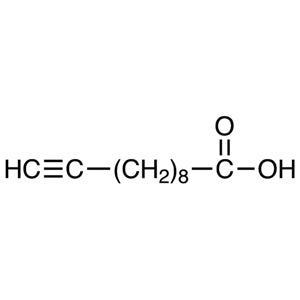
10-UndecynoicAcid TCI U0054
Regular price From Rp 1.008.000,00Regular price -
10-UndecenoicAcid TCI U0007
Regular price From Rp 505.050,00Regular price