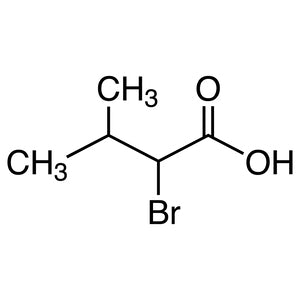
2-Bromo-3-methylbutyric Acid is a chemical compound widely used in organic synthesis reactions. It serves as a fundamental building block in the development of complex molecular structures, making it an essential component in many laboratory processes. This compound is commonly utilized in chemical laboratories as a precursor for the synthesis of various organic compounds, particularly in the pharmaceutical and chemical industries. Its role is critical in the creation of new substances with specific functional groups and molecular configurations.
The compound’s molecular structure, featuring a bromo group at the second carbon position, contributes to its reactivity in substitution and electrophilic reactions. This reactivity makes it a preferred choice for chemists looking to introduce bromine functionality into organic molecules. Additionally, its stability under controlled laboratory conditions ensures reliable performance in a wide range of synthetic procedures. These properties make it a versatile and dependable reagent for both research and industrial applications.
In Indonesian laboratories, 2-Bromo-3-methylbutyric Acid is frequently used in organic chemistry research, especially in the development of new compounds and molecular structure studies. It is also integral to pharmaceutical research projects involving the synthesis of active compounds. Its availability and chemical properties make it a valuable resource for scientists working on advanced chemical synthesis and structural analysis.
- Organic Synthesis: This compound is ideal for creating complex molecular structures due to its reactive bromo group, enabling substitution and electrophilic reactions.
- Pharmaceutical Research: It is used to develop active pharmaceutical ingredients by introducing bromine functionality into organic frameworks.
- Structural Chemistry Studies: Its simple molecular structure allows for detailed analysis and modification in molecular design experiments.
- Industrial Chemistry Projects: It serves as a reliable building block for the synthesis of various chemical products in industrial settings.
- Academic Research: It is commonly used in university and research institutions for teaching and experimental purposes in organic chemistry.
| Brand | TCI |
|---|---|
| CAS number | 565-74-2 |
| Molecular formula | — |
| Purity | — |
| Category | Chemistry > Building Blocks > Non-Heterocyclic Building Blocks |
| Pack sizes | Available in various quantities as per standard laboratory supply |
| Physical form | Solid |
| Storage | Store in a cool, dry place away from light and moisture |
This compound should be stored in a cool, dry environment, away from direct sunlight and moisture to maintain its chemical stability. It is recommended to use airtight containers to prevent exposure to air and humidity, which could affect its reactivity. Proper labeling of storage containers is essential for safety and identification. In laboratory settings, it should be handled with appropriate personal protective equipment, such as gloves and safety goggles, to ensure safe handling. Due to its brominated nature, it is important to follow standard chemical safety protocols to minimize risks during use and storage.
—
Produk Terkait
-
DL-2-MethylbutyricAcid TCI M0181
Regular price From Rp 955.500,00Regular priceRp 667.800,00Sale price From Rp 955.500,00 -
2-Hydroxy-2-methylbutyricAcid TCI H0636
Regular price From Rp 1.220.100,00Regular priceRp 868.350,00Sale price From Rp 1.220.100,00 -
2-(4-Chlorophenyl)-3-methylbutyricAcid TCI C2741
Regular price Rp 1.670.550,00Regular priceRp 1.183.350,00Sale price Rp 1.670.550,00 -
2-EthylbutyricAcid TCI E0070
Regular price From Rp 900.900,00Regular priceRp 645.750,00Sale price From Rp 900.900,00 -
2,2-DimethylbutyricAcid TCI D2429
Regular price From Rp 1.723.050,00Regular priceRp 1.220.100,00Sale price From Rp 1.723.050,00 -
2-MethylbutylAcetate TCI A1076
Regular price From Rp 928.200,00Regular priceRp 648.900,00Sale price From Rp 928.200,00 -
3-Methoxy-3-methylbutylAcetate TCI A0964
Regular price From Rp 505.050,00Regular priceRp 352.800,00Sale price From Rp 505.050,00 -
Isoamyln-Octanoate(contains2-Methylbutyln-Octanoate) TCI O0031
Regular price Rp 689.850,00Regular priceRp 497.700,00Sale price Rp 689.850,00