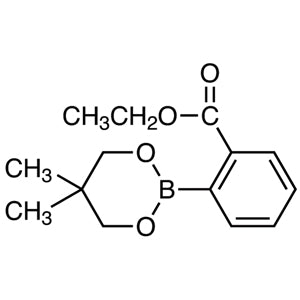
TCI E0667, Ethyl 2-(5,5-Dimethyl-1,3,2-dioxaborinan-2-yl)benzoate, is an organoboron reagent that combines a benzene ring bearing an ethyl ester group with a six-membered cyclic boronate ester derived from neopentyl glycol. The boron atom sits at the ortho position relative to the ester group, which makes this molecule a specialised building block for constructing biphenyl and biaryl frameworks that carry an ortho-carboxylate substituent. In the laboratory, the compound serves primarily as the nucleophilic partner in Suzuki–Miyaura cross-coupling reactions, one of the most reliable methods available for forming carbon–carbon bonds between aromatic rings.
The reason chemists select this reagent relates directly to its neopentyl glycolate boronate ester form. Free boronic acids are frequently hygroscopic, readily form boroxines, and tend to undergo protodeboronation during storage or on heating. Esterification with 5,5-dimethyl-1,3,2-dioxaborinane yields a considerably more stable solid that is easier to weigh accurately and easier to purify by chromatography. During the coupling reaction, the ester remains capable of transmetalation with the assistance of base and water, so the added stability does not come at the cost of reactivity.
The ortho ethyl ester group functions as a handle for further transformation, allowing the coupled product to be carried forward into subsequent chemistry. In Indonesian laboratories, reagents of this type are typically used in synthetic organic and medicinal chemistry research groups at universities and research institutes, as well as in industrial R&D settings where biaryl intermediates are prepared on a research scale for method development and route scouting.
TCI brochures (PDF)
- Suzuki-Miyaura Cross Coupling Reaction 2025-12-01 · p. 16
- Boron Compounds 2025-10-07 · p. 15
Related TCI products
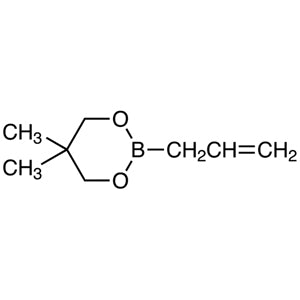
- TCI A2574 911482-75-2 2-Allyl-5,5-dimethyl-1,3,2-dioxaborinane (stabilized with Phenothiazine)
- TCI F0531 346656-39-1 2-(2-Fluorophenyl)-5,5-dimethyl-1,3,2-dioxaborinane
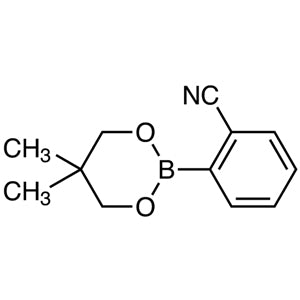
- TCI C2823 214360-47-1 2-(2-Cyanophenyl)-5,5-dimethyl-1,3,2-dioxaborinane
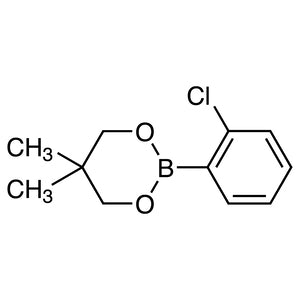
- TCI C2004 346656-42-6 2-(2-Chlorophenyl)-5,5-dimethyl-1,3,2-dioxaborinane
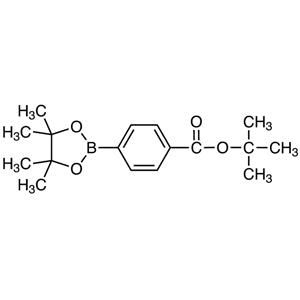
- TCI B5132 850568-72-8 tert-Butyl 4-(4,4,5,5-Tetramethyl-1,3,2-dioxaborolan-2-yl)benzoate
- TCI M3233 653589-95-8 Methyl 2-(4,4,5,5-Tetramethyl-1,3,2-dioxaborolan-2-yl)benzoate
- Suzuki–Miyaura cross-coupling — acts as the nucleophilic boron partner that transfers the ester-substituted aryl group to an aryl halide under palladium catalysis with base and water present.
- Synthesis of ortho-carboxylate biaryls — the ortho positioning of boron relative to the ethyl ester places the carboxylate handle directly adjacent to the newly formed biaryl bond.
- Preparation of biphenyl frameworks — provides a stable, weighable source of the arylboron unit needed to assemble substituted biphenyl cores in multi-step synthetic sequences.
- Medicinal chemistry intermediate preparation — the ethyl ester serves as a functional handle for downstream transformation, making coupled products convenient starting points for further elaboration.
- Cross-coupling method development — the boronate ester form resists protodeboronation and boroxine formation, giving reproducible behaviour when screening catalysts, ligands, bases, and solvent systems.
| Brand | TCI (Tokyo Chemical Industry) |
|---|---|
| CAS number | 346656-34-6 |
| Molecular formula | — |
| Purity | — |
| Category | Chemistry > Organometallic Reagents > Organoboron [Organometallic Reagents] |
| Pack sizes | available in standard TCI research-scale packaging; please confirm the currently offered pack size on enquiry |
| Physical form | solid, supplied as the neopentyl glycolate boronate ester |
| Storage | — |
- Chemical name: Ethyl 2-(5,5-Dimethyl-1,3,2-dioxaborinan-2-yl)benzoate; catalogue code E0667
Store the reagent in its original tightly closed container in a cool, dry place, protected from moisture and away from direct sunlight and heat sources. Because boronate esters are sensitive to prolonged exposure to atmospheric humidity, keep the container sealed between uses and allow it to reach ambient temperature before opening to avoid condensation on the solid. Amber glass or the supplied original packaging is suitable; for extended storage, keeping the container under an inert atmosphere in a desiccator is good practice. Handle in a well-ventilated fume hood using safety glasses, gloves, and a laboratory coat, avoid generating dust during weighing, and consult the manufacturer's safety data sheet before use.
—
Produk Terkait
-
2-Allyl-5,5-dimethyl-1,3,2-dioxaborinane(stabilizedwithPhenothiazine) TCI A2574
Regular price From Rp 3.021.900,00Regular price -
2-(2-Fluorophenyl)-5,5-dimethyl-1,3,2-dioxaborinane TCI F0531
Regular price Rp 2.199.750,00Regular price -
2-(2-Cyanophenyl)-5,5-dimethyl-1,3,2-dioxaborinane TCI C2823
Regular price From Rp 1.140.300,00Regular price -
2-(2-Chlorophenyl)-5,5-dimethyl-1,3,2-dioxaborinane TCI C2004
Regular price Rp 4.161.150,00Regular price -
tert-Butyl4-(4,4,5,5-Tetramethyl-1,3,2-dioxaborolan-2-yl)benzoate TCI B5132
Regular price From Rp 1.988.700,00Regular price -
Methyl2-(4,4,5,5-Tetramethyl-1,3,2-dioxaborolan-2-yl)benzoate TCI M3233
Regular price From Rp 823.200,00Regular price -
Methyl4-(4,4,5,5-Tetramethyl-1,3,2-dioxaborolan-2-yl)benzoate TCI M3057
Regular price From Rp 717.150,00Regular price -
Methyl3-(4,4,5,5-Tetramethyl-1,3,2-dioxaborolan-2-yl)benzoate TCI M2665
Regular price From Rp 1.087.800,00Regular price