

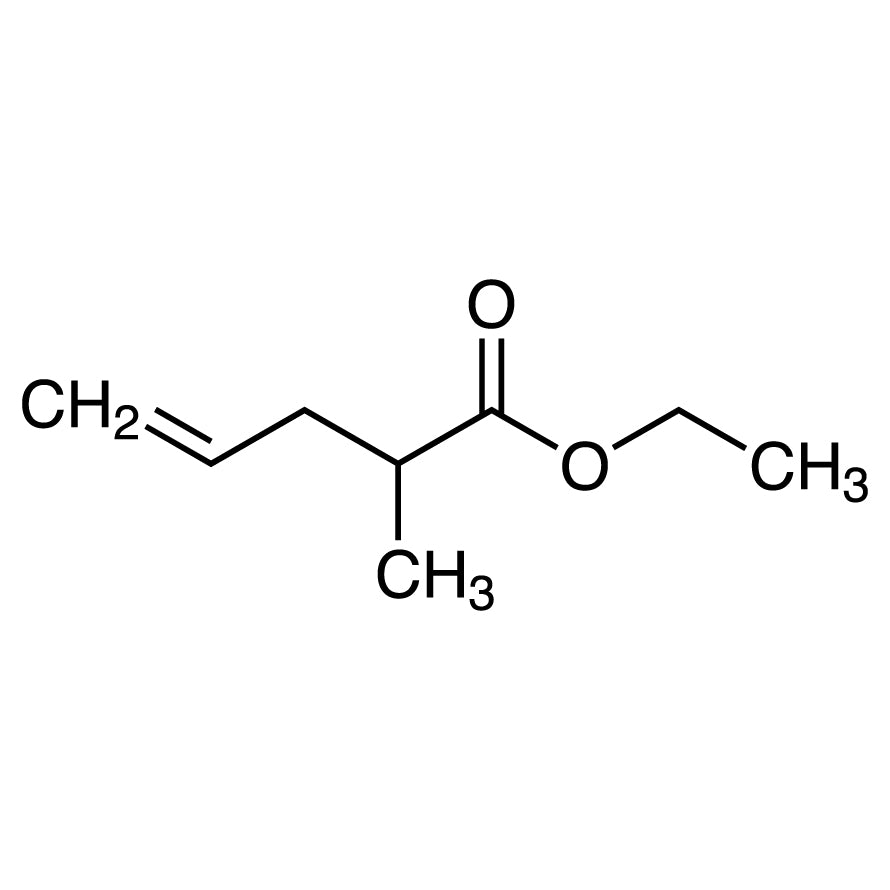
TCI E0717 Ethyl 2-Methyl-4-pentenoate is a bifunctional aliphatic ester that carries a methyl group at the position alpha to the ester and a terminal double bond at the end of the chain. TCI supplies it as a non-heterocyclic building block for organic synthesis work. The methyl branch next to the carbonyl group distinguishes this compound from straight-chain pentenoate esters, because that position is a potential stereogenic centre and at the same time a point commonly exploited in enolate alkylation reactions. In the laboratory, a molecule of this kind is useful when researchers want to assemble a branched carbon skeleton in a directed manner while retaining a reactive point of attachment.
The property that makes it a preferred choice is the combination of three reactive regions that remain separate from one another. The terminal double bond reacts without steric hindrance in addition, metathesis, and hydrofunctionalisation; the ester group can be hydrolysed, reduced, or converted into an amide; while the already-methylated alpha position allows enolate formation for further alkylation that generates a quaternary centre. Because the alkene is not conjugated with the ester, reaction selectivity is more easily maintained. The methyl branch also provides a controlled degree of steric hindrance that can influence the approach of reagents at that centre.
In Indonesian laboratories, a reagent of this type is normally used in university and institutional research groups working on organic synthesis, methodology development, and the preparation of intermediates on a small scale. It is ordered in modest quantities suited to exploratory and multi-step synthetic routes rather than production volumes, and is handled by users who already work routinely with volatile esters and with standard glassware, fume hoods, and inert-atmosphere technique.
- Enolate alkylation to build quaternary carbon centres: the alpha position already bears a methyl group, so deprotonation and reaction with an electrophile installs a second substituent at the same carbon.
- Olefin metathesis and ring-closing strategies: the unhindered terminal alkene is a clean partner for metathesis catalysts, while the ester survives the reaction and remains available for later modification.
- Hydrofunctionalisation of the terminal double bond: hydroboration, hydrosilylation, hydroformylation, and related additions proceed at the chain end without competing reaction at the non-conjugated ester.
- Preparation of branched-chain intermediates for multi-step synthesis: the separated reactive regions let a chemist elaborate one end of the molecule and then address the other in a directed sequence.
- Ester-group transformations toward alcohols, acids, and amides: hydrolysis, reduction, or amidation converts the ester while the alkene is retained as a handle for subsequent carbon-carbon bond formation.
| Brand | TCI (Tokyo Chemical Industry) |
|---|---|
| CAS number | 53399-81-8 |
| Molecular formula | — |
| Purity | — |
| Category | Chemistry > Building Blocks > Non-Heterocyclic Building Blocks |
| Pack sizes | as listed on the TCI product page for this catalogue number |
| Physical form | — |
| Storage | — |
- Product code: E0717
- Chemical name: Ethyl 2-Methyl-4-pentenoate
Store the container tightly closed in a cool, well-ventilated place away from heat, sparks, open flame, and direct sunlight, following the storage class stated on the manufacturer's label and Safety Data Sheet for this catalogue number. Keep the material in its original glass or manufacturer-supplied container; if transfer is necessary, use glassware compatible with volatile organic esters and label it clearly. Handle the compound inside a fume hood, wear safety glasses, nitrile gloves, and a laboratory coat, and avoid inhaling vapour or contact with skin and eyes. Keep away from strong oxidising agents and strong bases, close the container promptly after use to limit evaporation, and consult the Safety Data Sheet before first use and before disposal.
—
Produk Terkait
-
Methyltrans-3-Pentenoate TCI P1210
Regular price From Rp 3.207.750,00Regular price -
Ethyl4-Pentenoate TCI E0715
Regular price Rp 3.180.450,00Regular price -
Methyl3,3-Dimethyl-4-pentenoate TCI D2153
Regular price Rp 2.094.750,00Regular price


