

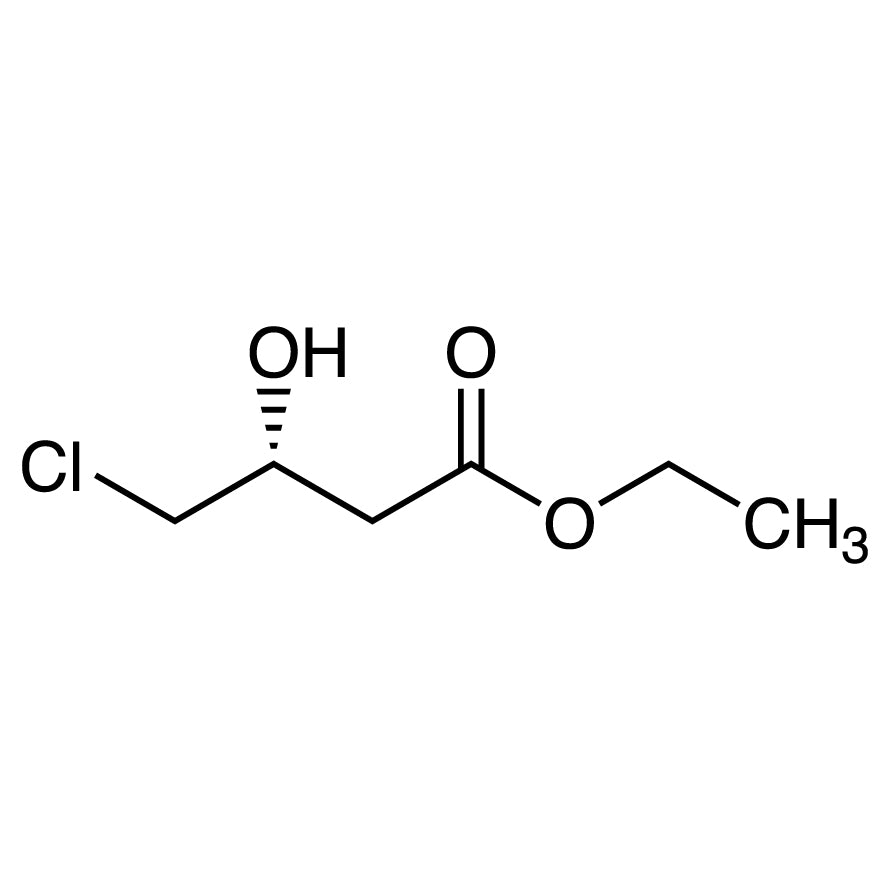
Ethyl (R)-4-Chloro-3-hydroxybutanoate is a chiral building block widely used in asymmetric synthesis to construct molecules with specific biological activities. This compound plays a crucial role in organic chemistry laboratories by enabling the creation of complex molecular structures with defined stereochemistry. Its unique chemical structure, featuring both a hydroxyl group and a chloro substituent, makes it highly reactive and suitable for various synthetic transformations. As a key component in the development of pharmaceuticals and bioactive compounds, this material is essential for researchers aiming to achieve precise control over molecular configuration.
The compound’s chiral nature and functional groups contribute to its versatility in synthetic applications. Its ability to participate in multiple chemical reactions allows it to be a valuable tool in the synthesis of enantiomerically pure compounds. The presence of the hydroxyl group enhances its reactivity, making it suitable for a range of chemical modifications. Additionally, its structural characteristics enable it to serve as a versatile intermediate in the preparation of various pharmaceutical and agrochemical compounds. These properties make it a preferred choice for chemists working in both academic and industrial settings.
In Indonesian laboratories, Ethyl (R)-4-Chloro-3-hydroxybutanoate is commonly used in organic chemistry research, particularly in the field of asymmetric synthesis. It is frequently employed in the development of bioactive compounds and pharmaceuticals, where precise stereochemical control is essential. Many research institutions and universities in Indonesia utilize this compound for synthetic studies, contributing to advancements in medicinal chemistry and chemical innovation.
Related TCI products
- TCI H1341 625-72-9 (R)-3-Hydroxybutanoic Acid
- TCI M2383 32345-60-1 Methyl 2-Chloro-L-mandelate
- TCI M2382 32345-59-8 Methyl 2-Chloro-D-mandelate
- TCI M0967 57090-45-6 (R)-(-)-3-Chloro-1,2-propanediol
- TCI C3562 70111-05-6 (S)-(+)-2-Chloro-1-phenylethanol
- TCI C3561 56751-12-3 (R)-(-)-2-Chloro-1-phenylethanol
- Asymmetric synthesis is a key application where this compound enables the creation of enantiomerically pure molecules, crucial for pharmaceutical development.
- Organic chemistry research benefits from its reactivity and chiral structure, allowing for the synthesis of complex molecular frameworks.
- Pharmaceutical compound development relies on its ability to provide stereochemical control, essential for designing drugs with specific biological activities.
- Bioactive molecule synthesis utilizes its functional groups to facilitate various chemical transformations in synthetic pathways.
- Academic research in chemical sciences employs it to explore new synthetic methods and understand stereochemical behavior in molecular structures.
| Brand | TCI |
|---|---|
| CAS number | 90866-33-4 |
| Molecular formula | — |
| Purity | — |
| Category | Chemistry > Asymmetric Synthesis > Chiral Building Blocks |
| Pack sizes | Available in various quantities as per supplier specifications |
| Physical form | Liquid or solid, depending on the specific formulation |
| Storage | Store in a cool, dry place away from light and moisture |
This compound should be stored in a cool, dry location, away from direct light and moisture to maintain its stability and purity. It is recommended to use airtight containers made of glass or high-density polyethylene to prevent contamination and degradation. Due to its reactive nature, it should be handled with care, using appropriate personal protective equipment such as gloves and safety goggles. In laboratory settings, it is important to ensure proper ventilation to minimize exposure to vapors. Avoid contact with incompatible substances, and always follow standard safety protocols when working with chiral building blocks. Proper storage and handling are essential to preserve the compound’s integrity and ensure safe usage in research applications.
—
Produk Terkait
-
(R)-3-HydroxybutanoicAcid TCI H1341
Regular price From Rp 4.531.800,00Regular price -
Methyl2-Chloro-L-mandelate TCI M2383
Regular price Rp 1.749.300,00Regular price -
Methyl2-Chloro-D-mandelate TCI M2382
Regular price From Rp 1.644.300,00Regular price -
(R)-(-)-3-Chloro-1,2-propanediol TCI M0967
Regular price From Rp 1.749.300,00Regular price -
(S)-(+)-2-Chloro-1-phenylethanol TCI C3562
Regular price From Rp 980.700,00Regular price -
(R)-(-)-2-Chloro-1-phenylethanol TCI C3561
Regular price From Rp 2.597.700,00Regular price -
(S)-(-)-4-Chloro-3-hydroxybutyronitrile TCI C3331
Regular price From Rp 769.650,00Regular price -
(R)-(+)-4-Chloro-3-hydroxybutyronitrile TCI C2763
Regular price From Rp 1.087.800,00Regular price


