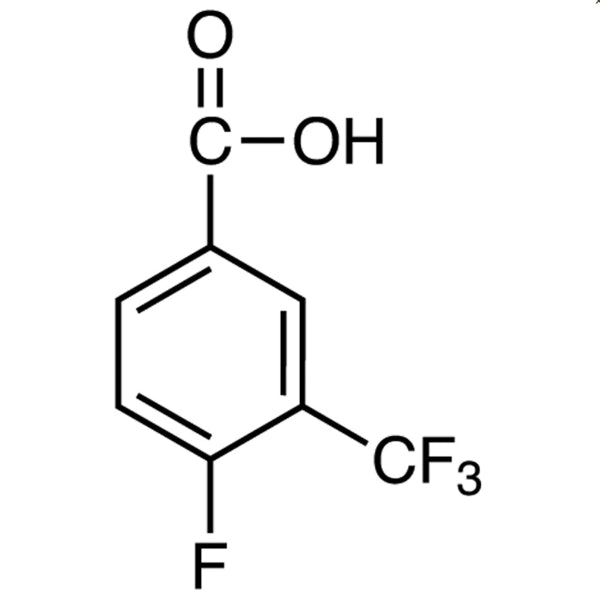
4-Fluoro-3-(trifluoromethyl)benzoic Acid is a fluorinated benzoic acid carrying a fluorine atom at the para position and a trifluoromethyl group at the meta position relative to the carboxyl group. This arrangement produces one of the most frequently encountered aromatic motifs in modern pharmaceutical and agrochemical active compounds. In the laboratory, the material serves as a ready-to-use building block: its carboxyl group can be activated for amide bond formation, while the para fluorine atom, activated by the adjacent trifluoromethyl group, opens the way to nucleophilic aromatic substitution for installing amine or ether groups.
The advantage that makes it a popular choice is the presence of two complementary reaction points within a single molecule. The trifluoromethyl group withdraws electrons strongly and thereby activates its neighbouring fluorine atom toward nucleophilic attack, a property exploited to add structural diversity without the need for a metal catalyst. At the same time, the carboxyl group remains available for standard coupling chemistry. Both fluorinated groups also raise lipophilicity and hinder metabolic oxidation in the resulting derivatives, while the characteristic fluorine NMR signals make reaction monitoring considerably easier.
In Indonesian laboratories, this building block is typically used in medicinal chemistry and agrochemical research groups at universities and research institutes, as well as in synthesis and formulation development laboratories that prepare fluorinated intermediates. It commonly appears in exploratory work where a small set of analogues is assembled from a shared aromatic core, and in method development where the distinctive fluorine NMR response supports straightforward tracking of conversion at laboratory scale.
TCI brochures (PDF)
- Fluorination Reagents, Fluorinated Building Blocks 2026-03-18 · p. 19
Related TCI products
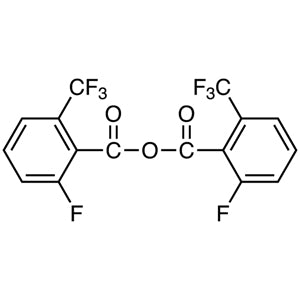
- TCI F1184 2118332-08-2 2-Fluoro-6-(trifluoromethyl)benzoic Anhydride
- TCI F0759 161622-05-5 3-Fluoro-5-(trifluoromethyl)benzoic Acid
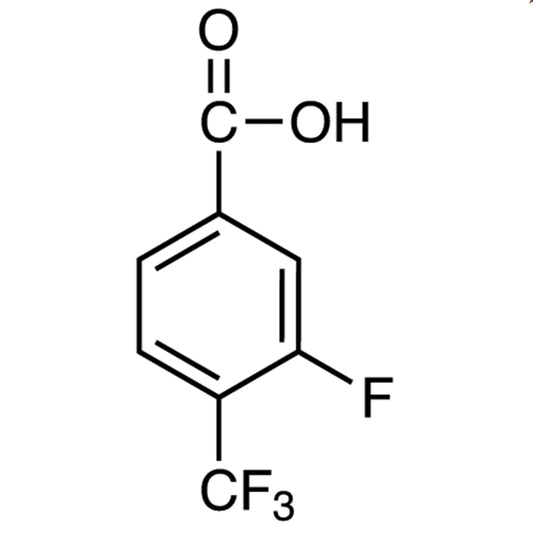
- TCI F0758 115754-21-7 3-Fluoro-4-(trifluoromethyl)benzoic Acid
- TCI F0757 32890-94-1 2-Fluoro-6-(trifluoromethyl)benzoic Acid
- TCI F0620 115029-23-7 2-Fluoro-5-(trifluoromethyl)benzoic Acid
- TCI F0619 115029-22-6 2-Fluoro-3-(trifluoromethyl)benzoic Acid
- Amide bond formation — the carboxyl group is readily activated with standard coupling reagents, making the compound a direct acyl donor for building amide-linked analogue series.
- Nucleophilic aromatic substitution — the trifluoromethyl group activates the adjacent para fluorine, allowing amines or alcohols to displace it and introduce diversity without any metal catalyst.
- Medicinal chemistry analogue synthesis — the fluorine and trifluoromethyl substituents raise lipophilicity and slow metabolic oxidation, properties routinely sought when optimising candidate structures.
- Agrochemical intermediate preparation — this substitution pattern is among the aromatic motifs most often found in modern agrochemical actives, making it a practical starting material.
- Reaction monitoring and method development — the distinctive fluorine NMR signals of both groups allow chemists to follow conversion and identify products with clear, well-separated resonances.
| Brand | TCI, catalogue number F0760 |
|---|---|
| CAS number | 67515-55-3 |
| Molecular formula | — |
| Purity | — |
| Category | Chemistry > Building Blocks > Fluorinated Building Blocks |
| Pack sizes | available in the standard research pack sizes offered by TCI for this catalogue item |
| Physical form | — |
| Storage | keep in the tightly closed original container in a cool, dry place away from moisture |
- Chemical class: fluorinated benzoic acid bearing a para fluorine and a meta trifluoromethyl group
Store the material in its original tightly closed container in a cool, dry and well-ventilated area, protected from moisture and kept away from direct sunlight and sources of heat. As a carboxylic acid, it should be separated from strong bases and strong oxidising agents. Handle the solid in a fume hood or a well-ventilated workspace, wearing safety glasses, chemical-resistant gloves and a laboratory coat, and avoid generating or inhaling dust during weighing and transfer. Use clean, dry glassware or compatible plastic containers for aliquots, label all sub-portions clearly, and close containers promptly to limit moisture uptake. Dispose of residues and contaminated materials as chemical waste in accordance with local laboratory regulations, and consult the supplier's safety data sheet before first use.
—
Produk Terkait
-
2-Fluoro-6-(trifluoromethyl)benzoicAnhydride TCI F1184
Regular price Rp 2.016.000,00Regular price -
3-Fluoro-5-(trifluoromethyl)benzoicAcid TCI F0759
Regular price From Rp 477.750,00Regular price -
3-Fluoro-4-(trifluoromethyl)benzoicAcid TCI F0758
Regular price From Rp 823.200,00Regular price -
2-Fluoro-6-(trifluoromethyl)benzoicAcid TCI F0757
Regular price From Rp 584.850,00Regular price -
2-Fluoro-5-(trifluoromethyl)benzoicAcid TCI F0620
Regular price From Rp 505.050,00Regular price -
2-Fluoro-3-(trifluoromethyl)benzoicAcid TCI F0619
Regular price From Rp 477.750,00Regular price -
4-Fluoro-2-(trifluoromethyl)benzoicAcid TCI F0577
Regular price From Rp 637.350,00Regular price -
2-(Trifluoromethyl)benzoicAcid TCI T1302
Regular price Rp 1.803.900,00Regular price