

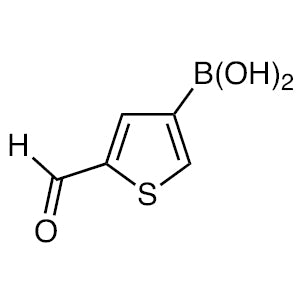
(5-Formylthiophen-3-yl)boronic Acid is a versatile organic compound widely used in laboratory settings for its role in various synthetic reactions. It serves as a key reagent in the synthesis of heterocyclic compounds and complex molecular structures, making it essential for advanced chemical research. This compound is particularly valuable in the field of organoboron chemistry, where it contributes to the development of new materials and pharmaceutical compounds. Its unique chemical properties allow it to participate in multiple reaction pathways, enhancing its utility across different experimental applications.
The compound is known for its high reactivity and ability to form stable bonds with organic ligands and metals. These properties make it a preferred choice for reactions such as the Suzuki-Miyaura and Heck coupling reactions, which are fundamental in organic synthesis. Its stability under certain conditions ensures reliable results, making it a trusted reagent in both academic and industrial laboratories. The combination of reactivity and stability allows researchers to achieve precise and consistent outcomes in their experiments.
In Indonesian laboratories, (5-Formylthiophen-3-yl)boronic Acid is commonly used in organic chemistry research, especially in the synthesis of complex compounds and drug development. Its availability and reliability make it a staple in chemical laboratories, supporting a wide range of experimental needs. The compound's role in creating new molecular structures underscores its importance in advancing scientific research in Indonesia.
TCI brochures (PDF)
- Boron Compounds 2025-10-07 · p. 14
- Building Blocks for Organic Semiconductor 2026-03-24 · p. 26
Related TCI products
- TCI T2621 160032-40-6 Thieno[3,2-b]thiophene-2-boronic Acid (contains varying amounts of Anhydride)
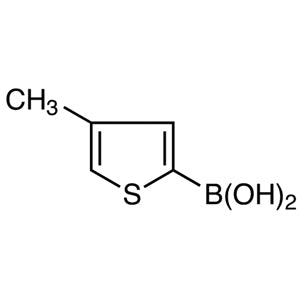
- TCI M2840 162607-15-0 4-Methyl-2-thiopheneboronic Acid (contains varying amounts of Anhydride)
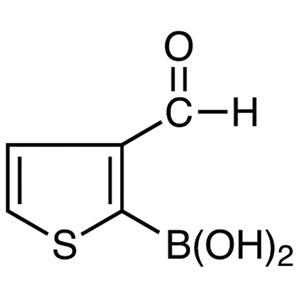
- TCI F0801 17303-83-2 3-Formyl-2-thiopheneboronic Acid (contains varying amounts of Anhydride)
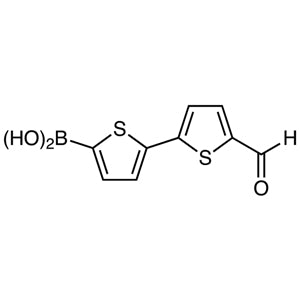
- TCI F0548 1369328-62-0 5'-Formyl-2,2'-bithiophene-5-boronic Acid (contains varying amounts of Anhydride)
- TCI B4774 113893-08-6 Benzo[b]thiophene-3-boronic Acid (contains varying amounts of Anhydride)
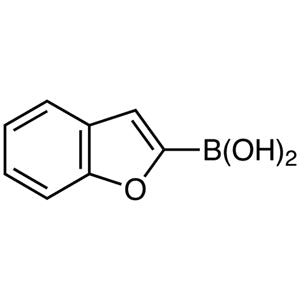
- TCI B2978 98437-24-2 Benzofuran-2-boronic Acid (contains varying amounts of Anhydride)
- Organic synthesis of heterocyclic compounds due to its reactivity and ability to form stable bonds with various ligands.
- Use in Suzuki-Miyaura coupling reactions for efficient cross-coupling of aryl halides with boronic acids.
- Application in Heck reactions for the formation of carbon-carbon bonds in complex molecule synthesis.
- Support in the development of pharmaceutical compounds through its role in creating boron-containing structures.
- Utilization in material science research for the synthesis of advanced polymers and functional materials.
| Brand | TCI |
|---|---|
| CAS number | 175592-59-3 |
| Molecular formula | — |
| Purity | — |
| Category | Chemistry > Organometallic Reagents > Organoboron [Organometallic Reagents] |
| Pack sizes | Varies as per supplier |
| Physical form | Solid |
| Storage | Store in a cool, dry place away from moisture and direct sunlight |
This compound should be stored in a cool, dry environment to maintain its stability and prevent degradation. It is recommended to keep it in a sealed container to avoid exposure to moisture, which can affect its reactivity. Due to its chemical nature, it should be handled in a well-ventilated area to minimize inhalation risks. Laboratory personnel should wear appropriate personal protective equipment, such as gloves and safety goggles, when handling the material. Proper disposal methods should be followed to ensure compliance with environmental and safety regulations. The compound is not classified as hazardous under standard laboratory conditions, but standard chemical safety protocols should still be observed.
—
Produk Terkait
-
Thieno[3,2-b]thiophene-2-boronicAcid(containsvaryingamountsofAnhydride) TCI T2621
Regular price Rp 5.830.650,00Regular price -
4-Methyl-2-thiopheneboronicAcid(containsvaryingamountsofAnhydride) TCI M2840
Regular price From Rp 1.405.950,00Regular price -
3-Formyl-2-thiopheneboronicAcid(containsvaryingamountsofAnhydride) TCI F0801
Regular price From Rp 3.578.400,00Regular price -
5'-Formyl-2,2'-bithiophene-5-boronicAcid(containsvaryingamountsofAnhydride) TCI F0548
Regular price Rp 10.467.450,00Regular price -
Benzo[b]thiophene-3-boronicAcid(containsvaryingamountsofAnhydride) TCI B4774
Regular price From Rp 1.220.100,00Regular price -
Benzofuran-2-boronicAcid(containsvaryingamountsofAnhydride) TCI B2978
Regular price Rp 1.035.300,00Regular price -
Benzo[b]thiophene-2-boronicAcid(containsvaryingamountsofAnhydride) TCI B2893
Regular price From Rp 743.400,00Regular price -
4-(2-Phenyl-1H-benzimidazol-1-yl)phenylboronicAcid(containsvaryingamountsofAnhydride) TCI P2282
Regular price Rp 2.625.000,00Regular price
![160032-40-6 Thieno[3,2-b]thiophene-2-boronic Acid (contains varying amounts of Anhydride) - AMI Scientific](http://amiscientific.com/cdn/shop/files/TCI2510T2621.jpg?v=1768206488&width=533)
![113893-08-6 Benzo[b]thiophene-3-boronic Acid (contains varying amounts of Anhydride) - AMI Scientific](http://amiscientific.com/cdn/shop/files/TCI2510B4774_65b85fee-ce4d-45b9-ad87-4962d8f3452c.jpg?v=1767853515&width=533)
![98437-23-1 Benzo[b]thiophene-2-boronic Acid (contains varying amounts of Anhydride) - AMI Scientific](http://amiscientific.com/cdn/shop/files/TCI2510B2893_29d53da9-04a5-422a-acac-439fc05f1bb6.jpg?v=1767339122&width=533)
