

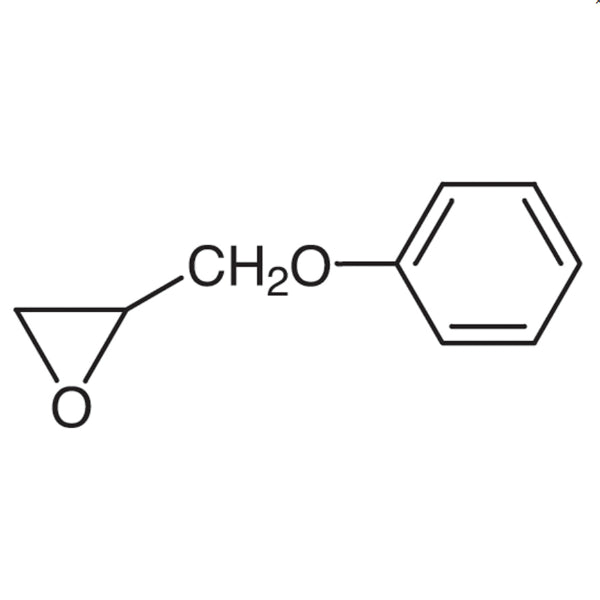
Glycidyl Phenyl Ether (GPE), also known as TCI G0098 122-60-1, is a versatile chemical compound widely used in laboratory settings for its unique reactivity and structural properties. It serves as a key building block in the synthesis of heterocyclic compounds, which are essential in pharmaceutical, polymer, and industrial chemistry. Its molecular structure features an epoxide group, making it highly reactive and suitable for various chemical transformations. This reactivity allows it to participate in multiple types of reactions, making it a valuable tool for researchers seeking to develop new materials and compounds.
The compound's reactivity, combined with its stability under controlled conditions, makes it a preferred choice for laboratory applications. Its non-volatile nature ensures that it remains consistent during experiments, reducing the risk of evaporation and maintaining the integrity of chemical reactions. Additionally, its ability to form stable intermediates in synthetic pathways enhances its utility in complex chemical syntheses. These properties make GPE a reliable and efficient reagent for a wide range of chemical processes.
In Indonesian laboratories, Glycidyl Phenyl Ether is commonly used in chemical research, particularly in the synthesis of heterocyclic compounds and the development of new materials. It is widely utilized by research institutions and universities for experiments requiring high reactivity and chemical stability. Its availability and reliability make it a standard component in many laboratory workflows, supporting both academic and industrial research efforts.
TCI brochures (PDF)
- Epoxide Monomers 2025-09-19 · p. 1
- Monomers 2025-05-28 · p. 21
- Heterocyclic Compound Synthesis: Glycidyl Phenyl Ether is ideal for synthesizing complex heterocyclic structures due to its reactive epoxide group, enabling efficient bond formation with various functional groups.
- Pharmaceutical Research: Its reactivity makes it suitable for drug development, where it can be used to create novel compounds with specific biological activities.
- Polymer Chemistry: The compound is used in the creation of specialty polymers due to its ability to form stable cross-linking structures.
- Industrial Chemical Development: It serves as a building block for the synthesis of industrial chemicals, offering versatility in reaction pathways.
- Material Science Research: Its chemical stability and reactivity make it a valuable reagent in the development of advanced materials with specific properties.
| Brand | TCI |
|---|---|
| CAS number | 122-60-1 |
| Molecular formula | — |
| Purity | — |
| Category | Chemistry > Building Blocks > Heterocyclic Building Blocks |
| Pack sizes | Available in various quantities as per standard laboratory supply |
| Physical form | Liquid |
| Storage | Store in a cool, dry place away from direct sunlight and incompatible materials |
Glycidyl Phenyl Ether should be stored in a cool, dry environment to maintain its chemical stability and prevent degradation. It is recommended to keep the compound in a sealed container to avoid exposure to moisture and air, which may affect its reactivity. Suitable containers for storage include glass or high-density polyethylene bottles, which are resistant to chemical interactions. In laboratory settings, it is important to handle the compound with appropriate personal protective equipment, such as gloves and safety goggles, to ensure safety during use. Proper labeling and storage conditions help maintain the integrity of the material and support safe laboratory practices.
—
Produk Terkait
-
AllylGlycidylEther TCI A0221
Regular price From Rp 477.750,00Regular priceRp 333.900,00Sale price From Rp 477.750,00 -
4-tert-ButylphenylGlycidylEther TCI B4831
Regular price From Rp 2.279.550,00Regular priceRp 1.593.900,00Sale price From Rp 2.279.550,00 -
BenzylGlycidylEther TCI B2108
Regular price From Rp 1.510.950,00Regular priceRp 1.056.300,00Sale price From Rp 1.510.950,00 -
tert-ButylGlycidylEther TCI B1840
Regular price Rp 1.220.100,00Regular priceRp 852.600,00Sale price Rp 1.220.100,00 -
ButylGlycidylEther TCI B0697
Regular price From Rp 530.250,00Regular priceRp 370.650,00Sale price From Rp 530.250,00 -
GlycidylLaurylEther TCI G0448
Regular price From Rp 1.298.850,00Regular priceRp 908.250,00Sale price From Rp 1.298.850,00 -
GlycidylPropargylEther TCI G0445
Regular price From Rp 980.700,00Regular priceRp 685.650,00Sale price From Rp 980.700,00 -
Glycidyl2-MethoxyphenylEther TCI G0416
Regular price From Rp 1.273.650,00Regular priceRp 890.400,00Sale price From Rp 1.273.650,00


