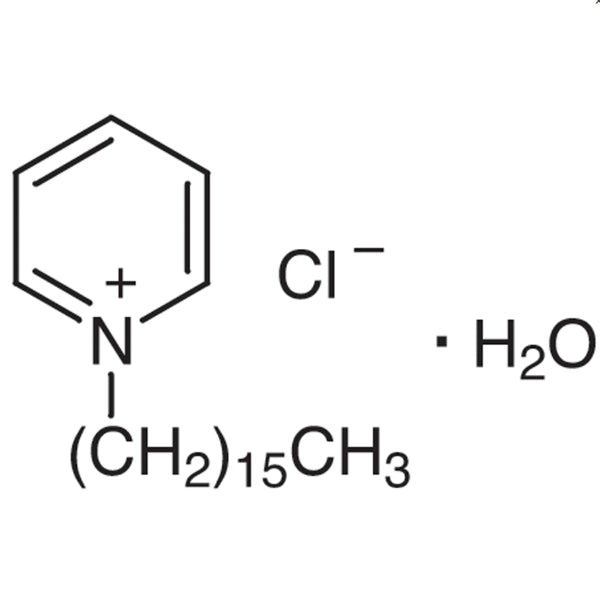
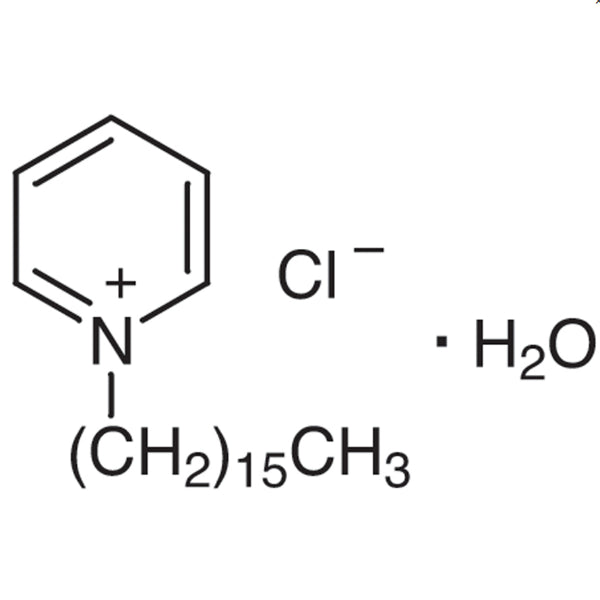
TCI H0078 Hexadecylpyridinium Chloride Monohydrate, also known as cetylpyridinium chloride monohydrate, is a cationic surfactant built from a positively charged pyridinium ring joined to a sixteen-carbon hexadecyl chain. This structure makes it one of the most widely used cationic surfactants in the laboratory, serving both as an object of research in its own right and as a process aid. Its roles include micelle formation, modification of negatively charged surfaces, and control of interfaces in polymer and colloidal systems. Within the polymer additives category, the compound is frequently used to alter the compatibility of inorganic fillers toward organic matrices.
The most prominent property of this material is the permanent positive charge carried by the nitrogen atom of the pyridinium ring, which does not depend on the pH of the surrounding medium. That fixed charge allows the compound to adsorb strongly onto negatively charged surfaces such as clay, silica, cellulose fibre, and glass, then orient its hydrocarbon chain outward so that the surface becomes hydrophobic. The compound also presents as a white crystalline solid that is easy to weigh out and dissolves readily in water and polar solvents, making stock solution preparation straightforward. The monohydrate form contributes to consistent, reproducible handling.
In Indonesian laboratories, this reagent is typically used in materials science and polymer research groups working on filler modification, colloid chemistry, and surface treatment. University and institutional laboratories rely on it when preparing organomodified clays, when studying micellar systems, and when a well-characterised cationic surfactant is needed as a reference material. Its solid crystalline form and simple dissolution behaviour suit teaching laboratories and routine research work alike, where straightforward weighing and solution preparation matter.
- Organomodification of clays and silicate fillers, where the permanent cationic charge anchors the molecule onto negatively charged mineral surfaces and the hexadecyl chain improves compatibility with organic polymer matrices.
- Micelle formation studies, since the combination of a charged pyridinium head group and a long sixteen-carbon tail makes this a classic model cationic surfactant for investigating aggregation behaviour in aqueous systems.
- Surface hydrophobisation of substrates such as silica, glass, and cellulose fibre, because adsorbed molecules orient their hydrocarbon chains outward and convert a wettable surface into a water-repellent one.
- Interfacial control in colloidal and polymer dispersions, where the pH-independent positive charge provides consistent surface interaction regardless of the acidity or alkalinity of the working medium.
- Preparation of cationic surfactant stock solutions for general research use, as the white crystalline solid is easy to weigh accurately and dissolves readily in water and polar solvents.
| Brand | TCI |
|---|---|
| CAS number | 6004-24-6 |
| Molecular formula | — |
| Purity | — |
| Category | Materials Science > Polymer/Macromolecule Reagents > Polymer Additives |
| Pack sizes | available in standard TCI catalogue pack sizes; please confirm the required size when ordering |
| Physical form | white crystalline solid; monohydrate |
| Storage | keep in a tightly closed container in a cool, dry place |
Store the container tightly closed in a cool, dry, well-ventilated place, away from moisture, since the material is supplied as a hydrated crystalline solid and can absorb atmospheric water. Amber or opaque glass bottles with well-sealing caps are suitable, as are the original supplier containers; reseal promptly after each use. Handle the solid in a fume hood or a well-ventilated area to avoid inhaling dust, and wear safety glasses, gloves, and a laboratory coat. Use clean, dry spatulas when weighing to prevent contamination of the bulk material. Label all prepared stock solutions clearly with the compound name, concentration, and preparation date, and consult the manufacturer's safety data sheet before first use.
—
Produk Terkait
-
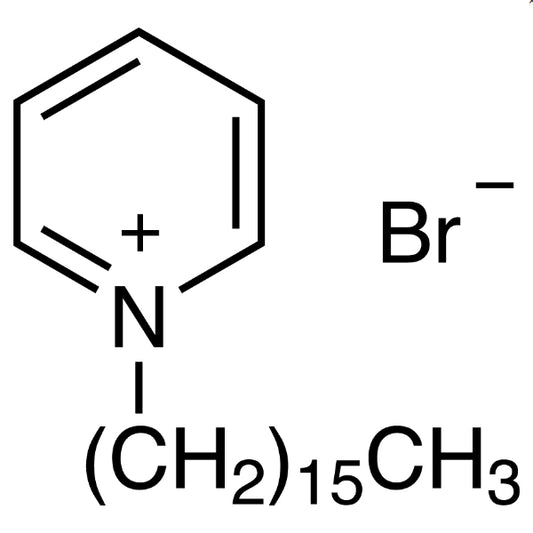
HexadecylpyridiniumBromide TCI H0162
Regular price From Rp 980.700,00Regular price -
BenzyldimethyltetradecylammoniumChloride TCI A0208
Regular price From Rp 610.050,00Regular price -
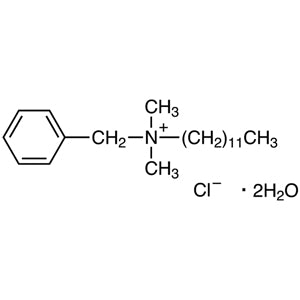
BenzyldodecyldimethylammoniumChlorideDihydrate TCI B2171
Regular price Rp 1.829.100,00Regular price -
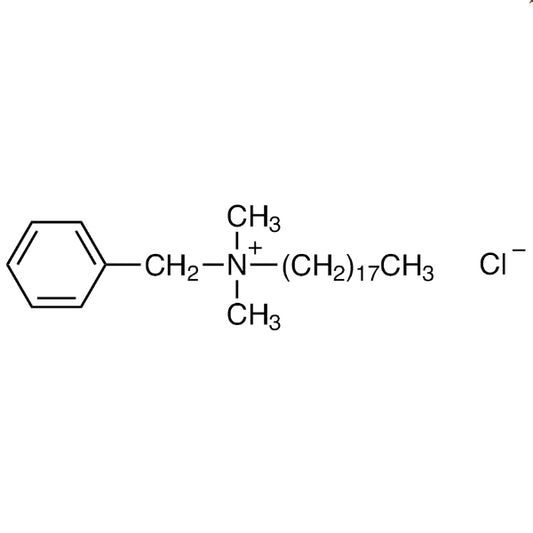
BenzyldimethylstearylammoniumChloride TCI B1297
Regular price From Rp 903.000,00Regular price -
BenzylcetyldimethylammoniumChloride TCI B0237
Regular price From Rp 903.000,00Regular price -
BenzethoniumChloride TCI B0044
Regular price From Rp 637.350,00Regular price -
TrimethyltetradecylammoniumChloride TCI T0926
Regular price From Rp 955.500,00Regular price -
TrimethylstearylammoniumChloride TCI S0087
Regular price From Rp 1.008.000,00Regular price