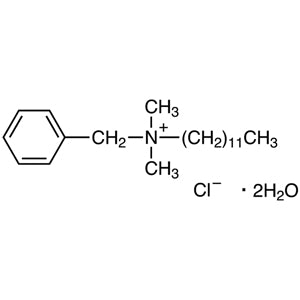
Benzylcetyldimethylammonium Chloride (BCDAC), also known as TCI B0237, is a synthetic reagent widely used in laboratory settings as a phase transfer catalyst. This compound plays a crucial role in facilitating chemical reactions between immiscible phases, such as aqueous and organic solvents. Its unique molecular structure allows it to act as a bridge between polar and nonpolar environments, making it indispensable in reactions that require interfacial interactions. In the laboratory, BCDAC is particularly valuable for accelerating reactions that would otherwise be slow or inefficient due to phase incompatibility.
The properties that make BCDAC a preferred choice include its cationic surfactant nature, which provides emulsifying and stabilizing effects. It has excellent solubility in both organic solvents and water, enabling its use in a wide range of experimental conditions. Additionally, its hydrophobic chain and hydrophilic head group allow it to function effectively as a phase transfer agent. These characteristics make BCDAC highly versatile, suitable for various synthetic and analytical applications. Its stability and effectiveness in different reaction systems further enhance its appeal among chemists.
In Indonesian laboratories, BCDAC is commonly used in organic chemistry research, complex compound synthesis, and separation and purification processes. It is a key reagent in studies involving ion transfer and interfacial reactions. Its ability to enhance reaction efficiency and simplify experimental procedures makes it a preferred choice for researchers working in both academic and industrial settings. BCDAC is widely integrated into the workflow of Indonesian chemical laboratories due to its reliability and performance in diverse applications.
TCI brochures (PDF)
- Quaternary Ammonium Salts 2025-11-10 · p. 4
- Polymer Additives 2026-04-16 · p. 12
Related TCI products
- TCI A0208 139-08-2 Benzyldimethyltetradecylammonium Chloride
- TCI B2171 147228-80-6 Benzyldodecyldimethylammonium Chloride Dihydrate
- TCI T0926 4574-04-3 Trimethyltetradecylammonium Chloride
- TCI O0178 10108-86-8 n-Octyltrimethylammonium Chloride
- TCI H0082 112-02-7 Hexadecyltrimethylammonium Chloride
- TCI D6051 7173-51-5 Didecyldimethylammonium Chloride
- Organic chemistry research benefits from BCDAC’s ability to facilitate reactions between immiscible phases, enhancing reaction efficiency and yield.
- Complex compound synthesis relies on BCDAC to improve interfacial interactions, enabling the formation of desired products in aqueous-organic systems.
- Separation and purification processes utilize BCDAC’s surfactant properties to stabilize emulsions and improve phase clarity during extraction.
- Ion transfer reactions are significantly accelerated by BCDAC’s cationic structure, making it ideal for electrochemical and analytical applications.
- Industrial chemical processes incorporate BCDAC to optimize reaction conditions, reducing energy and time requirements in large-scale synthesis.
| Brand | TCI |
|---|---|
| CAS number | 122-18-9 |
| Molecular formula | — |
| Purity | — |
| Category | Chemistry > Synthetic Reagents > Phase Transfer Catalysts |
| Pack sizes | Available in various quantities as per standard laboratory supply |
| Physical form | Solid powder |
| Storage | Store in a cool, dry place away from moisture and direct sunlight |
BCDAC should be stored in a cool, dry place, away from moisture and direct sunlight to maintain its chemical integrity. It is recommended to use airtight containers to prevent exposure to humidity, which could affect its performance. As a solid powder, it is generally handled using standard laboratory techniques to avoid inhalation or skin contact. Proper personal protective equipment, such as gloves and safety goggles, should be worn during handling. Due to its surfactant nature, it is important to ensure that it does not come into contact with incompatible materials. Routine storage in a well-ventilated area ensures safety and maintains the reagent’s effectiveness for laboratory use.
—
Produk Terkait
-
BenzyldimethyltetradecylammoniumChloride TCI A0208
Regular price From Rp 662.550,00Regular priceRp 478.800,00Sale price From Rp 662.550,00 -
BenzyldodecyldimethylammoniumChlorideDihydrate TCI B2171
Regular price Rp 1.881.600,00Regular priceRp 1.331.400,00Sale price Rp 1.881.600,00 -
TrimethyltetradecylammoniumChloride TCI T0926
Regular price From Rp 1.008.000,00Regular priceRp 720.300,00Sale price From Rp 1.008.000,00 -
n-OctyltrimethylammoniumChloride TCI O0178
Regular price From Rp 1.220.100,00Regular priceRp 868.350,00Sale price From Rp 1.220.100,00 -
HexadecyltrimethylammoniumChloride TCI H0082
Regular price From Rp 928.200,00Regular priceRp 664.650,00Sale price From Rp 928.200,00 -
DidecyldimethylammoniumChloride TCI D6051
Regular price Rp 2.359.350,00Regular priceRp 1.665.300,00Sale price Rp 2.359.350,00 -
Di-n-alkyldimethylammoniumChloride(mixture) TCI D1630
Regular price From Rp 822.150,00Regular priceRp 590.100,00Sale price From Rp 822.150,00 -
DecyltrimethylammoniumChloride TCI D1306
Regular price Rp 2.757.300,00Regular priceRp 1.943.550,00Sale price Rp 2.757.300,00