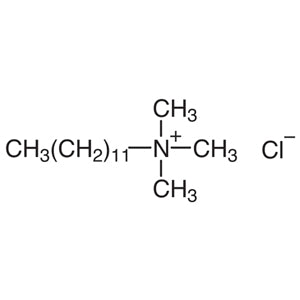
TCI H0082 Hexadecyltrimethylammonium Chloride, commonly abbreviated as CTAC, is a quaternary ammonium salt built on the same cationic framework as CTAB but paired with a chloride anion instead of bromide. This apparently minor difference in counter-ion turns out to matter a great deal in day-to-day laboratory practice, because the choice of anion influences solubility, micellar behaviour, and the tendency of the surfactant to adsorb onto surfaces. As a phase transfer catalyst, CTAC carries reactive anions from the aqueous phase into the organic phase, allowing two-phase reactions to proceed at a workable rate without the need to redesign the entire solvent system.
The properties that make CTAC a preferred choice follow directly from its chloride counter-ion. Because chloride is smaller and more strongly hydrated than bromide, CTAC is generally more readily soluble in water than its bromide analogue, which is advantageous whenever a researcher needs to prepare highly concentrated surfactant solutions. Chloride is also regarded as the more weakly coordinating anion, so in nanomaterial synthesis it interferes less with the surfaces of growing particles. Meanwhile, the permanently charged hexadecyltrimethylammonium cation retains strong adsorption onto negatively charged surfaces and forms well-ordered micelles — two characteristics that are the principal reason this class of compound is chosen in the first place.
In Indonesian laboratories, CTAC is typically used wherever a cationic surfactant or phase transfer catalyst is required in aqueous-organic systems: synthetic chemistry groups running two-phase reactions, materials and nanomaterial laboratories preparing templated or surface-modified particles, and analytical or teaching laboratories that need a well-characterised quaternary ammonium salt. Its high water solubility makes it convenient for stock solution preparation under ordinary bench conditions, and the TCI grade provides consistency between batches for work that must be reproduced.
TCI brochures (PDF)
- Quaternary Ammonium Salts 2025-11-10 · p. 4
- Colloidal Quantum Dot (QD) Research Reagents 2026-05-21 · p. 9
- Polymer Additives 2026-04-16 · p. 11
Related TCI products
- TCI H0081 57-09-0 Hexadecyltrimethylammonium Bromide
- TCI D1467 2082-84-0 Decyltrimethylammonium Bromide
- TCI D1306 10108-87-9 Decyltrimethylammonium Chloride
- TCI D1468 1119-94-4 Dodecyltrimethylammonium Bromide
- TCI D1016 112-00-5 Dodecyltrimethylammonium Chloride
- TCI T0906 1119-97-7 Tetradecyltrimethylammonium Bromide
- Phase transfer catalysis in two-phase reactions — CTAC transports reactive anions from the aqueous layer into the organic layer, so reactions that would otherwise stall proceed at an acceptable rate without changing the solvent system.
- Nanomaterial and nanoparticle synthesis — the weakly coordinating chloride anion interferes less with the surfaces of growing particles, giving researchers cleaner control over particle growth than a more strongly binding counter-ion allows.
- Preparation of concentrated cationic surfactant solutions — because the chloride salt is more water soluble than the bromide analogue, high-concentration stock solutions can be made up without solubility problems at the bench.
- Surface modification of negatively charged substrates — the permanently charged hexadecyltrimethylammonium cation adsorbs strongly onto negatively charged surfaces, making CTAC useful for altering the charge and wettability of such materials.
- Micelle formation and micellar systems — the compound forms well-ordered micelles in aqueous media, which supports studies of aggregation behaviour and reactions or formulations that depend on a structured micellar environment.
| Brand | TCI (Tokyo Chemical Industry) |
|---|---|
| CAS number | 112-02-7 |
| Molecular formula | — |
| Purity | — |
| Category | Chemistry > Synthetic Reagents > Phase Transfer Catalysts |
| Pack sizes | available in standard TCI research and laboratory pack sizes — please confirm the size required when ordering |
| Physical form | — |
| Storage | keep in a tightly closed container in a cool, dry place, protected from moisture |
- Catalogue number: H0082
- Chemical class: Quaternary ammonium salt; cationic surfactant and phase transfer catalyst
Store TCI H0082 in its original tightly closed container in a cool, dry, well-ventilated place, away from moisture, since quaternary ammonium salts of this type readily take up water from humid air and may cake or become difficult to weigh. Amber glass or the supplier's original packaging is suitable; transfer aliquots with clean, dry spatulas to avoid contaminating the bulk material. Handle the solid in a fume hood or a well-ventilated area to limit dust formation, and wear safety glasses, gloves, and a laboratory coat. Avoid contact with skin and eyes and avoid inhaling the powder. Prepare aqueous stock solutions in clearly labelled vessels, keep the material away from incompatible substances, and dispose of residues and rinsings according to the applicable institutional chemical waste procedures. Always consult the manufacturer's safety data sheet before first use.
—
Product Categories
Produk Terkait
-
HexadecyltrimethylammoniumBromide TCI H0081
Regular price From Rp 530.250,00Regular priceRp 386.400,00Sale price From Rp 530.250,00 -
DecyltrimethylammoniumBromide TCI D1467
Regular price From Rp 1.087.800,00Regular priceRp 775.950,00Sale price From Rp 1.087.800,00 -
DecyltrimethylammoniumChloride TCI D1306
Regular price Rp 2.757.300,00Regular priceRp 1.943.550,00Sale price Rp 2.757.300,00 -
DodecyltrimethylammoniumBromide TCI D1468
Regular price From Rp 928.200,00Regular priceRp 664.650,00Sale price From Rp 928.200,00 -
DodecyltrimethylammoniumChloride TCI D1016
Regular price From Rp 980.700,00Regular priceRp 701.400,00Sale price From Rp 980.700,00 -
TetradecyltrimethylammoniumBromide TCI T0906
Regular price From Rp 582.750,00Regular priceRp 423.150,00Sale price From Rp 582.750,00 -
TrimethyltetradecylammoniumChloride TCI T0926
Regular price From Rp 1.008.000,00Regular priceRp 720.300,00Sale price From Rp 1.008.000,00 -
n-OctyltrimethylammoniumChloride TCI O0178
Regular price From Rp 1.220.100,00Regular priceRp 868.350,00Sale price From Rp 1.220.100,00