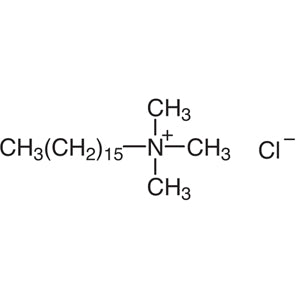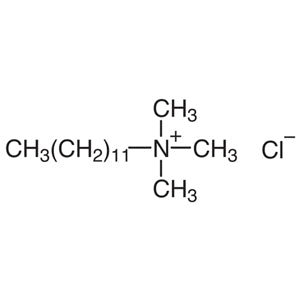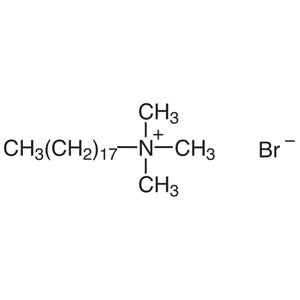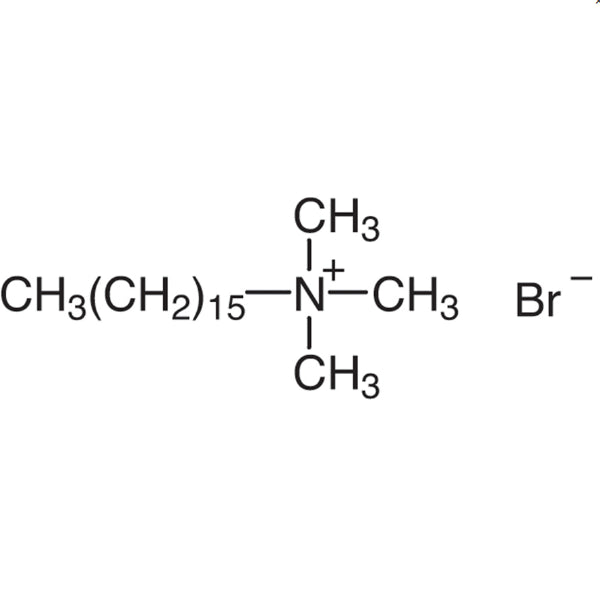
TCI H0081 Hexadecyltrimethylammonium Bromide, widely known by the abbreviation CTAB, is a quaternary ammonium salt built from a long hexadecyl chain and three methyl groups attached to the nitrogen atom. It ranks among the most frequently used reagents in laboratories worldwide. In line with its category as a phase transfer catalyst, CTAB works by carrying anions from the aqueous phase into the organic phase, so that reactions which would otherwise proceed slowly — because the two reactants never meet — are able to run efficiently without requiring expensive and difficult-to-handle polar aprotic solvents.
The advantages of CTAB stem from its permanently charged quaternary ammonium cation paired with a long hydrocarbon tail. This combination gives it good solubility in warm water, allows it to form micelles above a certain concentration, and at the same time enables it to carry its counter-ion across the interface into the organic phase. The relatively soft bromide anion also contributes a distinctive ion-exchange character that is often exploited in templated materials synthesis. The material presents as a stable white powder or crystalline solid that is easy to weigh accurately and can be stored for long periods without meaningful loss of quality, provided it is protected from moisture.
In Indonesian laboratories, CTAB is a routine shelf item across university research groups, industrial process development units, and analytical service laboratories. Its dual role as both a phase transfer catalyst and a cationic surfactant means a single container typically serves several different workflows, making it a practical choice for laboratories that must cover broad synthetic and preparative needs from a limited reagent inventory while keeping handling and storage requirements straightforward.
- Phase transfer catalysis in biphasic reactions: CTAB shuttles anionic reactants from water into the organic layer, letting alkylations and substitutions proceed efficiently without costly polar aprotic solvents.
- Templated materials synthesis: the micelles formed by CTAB above its aggregation concentration act as structure-directing templates, while the bromide counter-ion supplies the ion-exchange behaviour such preparations rely on.
- Surfactant studies and micelle formation work: the permanently charged head group and long hexadecyl tail make CTAB a well-behaved cationic surfactant for investigating aggregation and interfacial phenomena.
- Preparative organic synthesis where reactants are mutually insoluble: adding CTAB brings the two phases into productive contact, improving reaction rates without redesigning the entire solvent system.
- Routine reagent preparation in teaching and research laboratories: the stable white solid weighs out accurately and dissolves readily in warm water, suiting frequently repeated procedures.
| Brand | TCI |
|---|---|
| CAS number | 57-09-0 |
| Molecular formula | — |
| Purity | — |
| Category | Chemistry > Synthetic Reagents > Phase Transfer Catalysts |
| Pack sizes | — |
| Physical form | white powder or crystalline solid |
| Storage | keep protected from moisture; stable for long-term storage under suitable conditions |
- Product code: H0081
Store TCI H0081 Hexadecyltrimethylammonium Bromide in its original tightly closed container, kept in a cool, dry place away from humidity, since moisture is the principal factor affecting the quality of this solid over time. Tightly sealed glass or chemically compatible plastic containers are suitable, and containers should be reclosed promptly after each use. Weigh the material in a well-ventilated area and avoid generating or inhaling dust. Standard laboratory practice applies: wear a laboratory coat, safety glasses, and suitable gloves, avoid contact with skin and eyes, and wash hands thoroughly after handling. Label all prepared solutions clearly and consult the manufacturer's safety data sheet before first use.
—
Produk Terkait
-
HexadecyltrimethylammoniumChloride TCI H0082
Regular price From Rp 875.700,00Regular price -
DecyltrimethylammoniumBromide TCI D1467
Regular price From Rp 1.035.300,00Regular price -
DecyltrimethylammoniumChloride TCI D1306
Regular price Rp 2.704.800,00Regular price -
DodecyltrimethylammoniumBromide TCI D1468
Regular price From Rp 875.700,00Regular price -
DodecyltrimethylammoniumChloride TCI D1016
Regular price From Rp 928.200,00Regular price -
TetradecyltrimethylammoniumBromide TCI T0906
Regular price From Rp 530.250,00Regular price -
TrimethylnonylammoniumBromide TCI T2734
Regular price Rp 1.749.300,00Regular price -
TrimethylstearylammoniumBromide TCI S0364
Regular price Rp 1.961.400,00Regular price