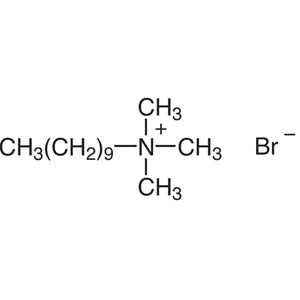
Decyltrimethylammonium Bromide (DTAB), also known as TCI D1467 with CAS number 2082-84-0, is a chemical compound widely used as a phase transfer catalyst in laboratory settings. It plays a crucial role in facilitating reactions between immiscible phases, such as aqueous and organic solvents, by acting as a mediator. This property makes it indispensable in synthetic chemistry, where reactions often require interaction between polar and non-polar environments. DTAB is particularly effective in organic synthesis and catalytic processes due to its ability to enhance reaction efficiency and yield.
DTAB is favored for its stable chemical properties and resistance to degradation under typical laboratory conditions. Its cationic nature allows it to interact with anionic species in solution, enabling the transfer of reactants between different phases. This characteristic ensures consistent performance and reliability in various experimental setups. Additionally, DTAB is non-toxic and easy to handle, making it a preferred choice for both academic and industrial research. Its versatility across a range of chemical applications further solidifies its position as a key reagent in modern laboratory practice.
In Indonesian laboratories, DTAB is commonly used in chemical research and industrial applications. It is frequently found in organic chemistry experiments, catalysis studies, and analytical procedures. Its ability to improve reaction efficiency and simplify complex chemical processes has made it a popular choice among researchers and professionals in both educational and industrial sectors. DTAB’s reliability and effectiveness continue to drive its widespread use in the chemical industry.
- Organic synthesis reactions benefit from DTAB’s ability to mediate between aqueous and organic phases, enhancing reaction rates and product yields.
- Catalytic processes in the laboratory rely on DTAB to facilitate the transfer of reactants between immiscible phases, improving reaction efficiency.
- Analytical chemistry applications use DTAB to aid in the separation and detection of compounds in complex mixtures.
- Industrial chemical processes incorporate DTAB to optimize reaction conditions and reduce energy consumption in phase transfer reactions.
- Environmental studies utilize DTAB to investigate the behavior of surfactants and their impact on phase interactions in various media.
| Brand | TCI |
|---|---|
| CAS number | 2082-84-0 |
| Molecular formula | — |
| Purity | — |
| Category | Chemistry > Synthetic Reagents > Phase Transfer Catalysts |
| Pack sizes | Available in various quantities as per standard supplier offerings |
| Physical form | Solid powder |
| Storage | Store in a cool, dry place away from moisture and direct sunlight |
DTAB should be stored in a cool, dry environment to maintain its chemical stability and prevent degradation. It is recommended to keep the material in a sealed container to avoid exposure to moisture, which can affect its performance. Suitable storage containers include glass or high-density polyethylene (HDPE) bottles, which provide protection against chemical interactions. In laboratory settings, DTAB should be handled with appropriate personal protective equipment (PPE) such as gloves and safety goggles to ensure safe handling. It is important to store DTAB away from incompatible substances to prevent any potential chemical reactions. Regular inspection of storage conditions is advised to maintain the integrity and effectiveness of the material.
—
Produk Terkait
-
ButyltrimethylammoniumBromide TCI B5798
Regular price From Rp 1.298.850,00Regular price -
(3-Bromopropyl)trimethylammoniumBromide TCI B6051
Regular price Rp 1.829.100,00Regular price -
BenzalkoniumChloride(50%inWater)[forBiochemicalResearch] TCI B6063
Regular price From Rp 743.400,00Regular price -
3-[Bis[2-(methacryloyloxy)ethyl](methyl)ammonio]propane-1-sulfonate TCI B6130
Regular price Rp 3.155.250,00Regular price -
BretyliumTosylate TCI B6544
Regular price Rp 5.803.350,00Regular price -
BetaineAnhydrous[forBiochemicalResearch] TCI B6796
Regular price From Rp 610.050,00Regular price -
L-Carnitine TCI C0049
Regular price From Rp 1.140.300,00Regular price -
DL-CarnitineHydrochloride TCI C0050
Regular price From Rp 1.035.300,00Regular price

![Benzalkonium Chloride (50% in Water) [for Biochemical Research] (CAS 63449-41-2) - TCI B6063 - AMI Scientific](http://amiscientific.com/cdn/shop/files/TCI2510B6063.jpg?v=1768815966&width=533)
ammonio]propane-1-sulfonate (CAS 1314713-40-0) - TCI B6130 - AMI Scientific](http://amiscientific.com/cdn/shop/files/TCI2510B6130.jpg?v=1767093213&width=533)
![Betaine Anhydrous [for Biochemical Research] (CAS 107-43-7) - TCI B6796 - AMI Scientific](http://amiscientific.com/cdn/shop/files/TCI2510B6796.jpg?v=1767094237&width=533)