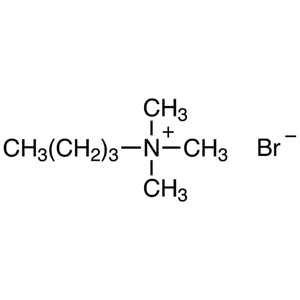
Trimethylstearylammonium Bromide (TCI S0364), with CAS number 1120-02-1, is a chemical compound widely used as a phase transfer catalyst in various chemical reactions. This reagent plays a crucial role in laboratory settings by enabling reactions between immiscible phases, such as water and organic solvents. Its ability to facilitate the transfer of ions or molecules across phase boundaries significantly enhances the efficiency of chemical processes. In synthetic chemistry, it is particularly valuable for reactions that require the interaction of polar and non-polar substances, making it an essential tool for researchers.
One of the key properties that make Trimethylstearylammonium Bromide a preferred choice is its molecular structure, which contains both hydrophobic and hydrophilic groups. This dual nature allows the compound to act as a bridge between polar and non-polar phases, thereby improving the effectiveness of chemical reactions. Additionally, it exhibits stability and resistance to degradation under various laboratory conditions, ensuring consistent performance. These characteristics make it ideal for use in complex chemical syntheses where reliability and efficiency are paramount.
In Indonesian laboratories, Trimethylstearylammonium Bromide is commonly used in research and development settings, particularly in organic synthesis and catalytic processes. Its application is widespread in academic and industrial laboratories, where it supports the advancement of chemical technologies. The compound’s versatility and effectiveness make it a go-to reagent for scientists working on diverse chemical challenges.
TCI brochures (PDF)
- Quaternary Ammonium Salts 2025-11-10 · p. 5
- Colloidal Quantum Dot (QD) Research Reagents 2026-05-21 · p. 9
- Polymer Additives 2026-04-16 · p. 11
Related TCI products
- TCI T2734 1943-11-9 Trimethylnonylammonium Bromide
- TCI T0906 1119-97-7 Tetradecyltrimethylammonium Bromide
- TCI O0163 2083-68-3 n-Octyltrimethylammonium Bromide
- TCI H0534 2650-53-5 Hexyltrimethylammonium Bromide
- TCI H0081 57-09-0 Hexadecyltrimethylammonium Bromide
- TCI D1468 1119-94-4 Dodecyltrimethylammonium Bromide
- Organic synthesis reactions benefit from Trimethylstearylammonium Bromide due to its ability to enhance interfacial interactions between immiscible phases, improving reaction efficiency and yield.
- In aqueous-organic biphasic systems, this catalyst facilitates the transfer of reactants and products across phase boundaries, making it ideal for heterogeneous catalytic processes.
- It is widely used in the preparation of complex organic molecules, where it helps overcome solubility limitations and accelerates reaction rates in multi-phase environments.
- For industrial chemical processes, Trimethylstearylammonium Bromide supports the development of more efficient and sustainable synthesis methods by reducing energy consumption and waste.
- In teaching and research laboratories, it serves as a valuable tool for demonstrating phase transfer mechanisms and catalytic principles in chemical education.
| Brand | TCI |
|---|---|
| CAS number | 1120-02-1 |
| Molecular formula | — |
| Purity | — |
| Category | Chemistry > Synthetic Reagents > Phase Transfer Catalysts |
| Pack sizes | Available in various quantities as per supplier specifications |
| Physical form | Solid powder |
| Storage | Store in a cool, dry place away from moisture and direct sunlight |
Trimethylstearylammonium Bromide should be stored in a cool, dry environment to maintain its chemical stability and effectiveness. It is recommended to keep the compound in airtight containers to prevent exposure to moisture and air, which could affect its performance. Suitable storage conditions include a controlled temperature range between 15°C and 25°C, ensuring the reagent remains in optimal condition for use. General laboratory precautions include handling the material with appropriate personal protective equipment, such as gloves and safety goggles, to minimize direct contact. Proper labeling and storage in designated chemical cabinets are essential to ensure safe handling and prevent accidental exposure. Regular inspection of storage conditions is advised to maintain the integrity of the reagent over time.
—
Product Categories
Produk Terkait
-
TrimethylnonylammoniumBromide TCI T2734
Regular price Rp 1.801.800,00Regular priceRp 1.275.750,00Sale price Rp 1.801.800,00 -
TetradecyltrimethylammoniumBromide TCI T0906
Regular price From Rp 582.750,00Regular priceRp 423.150,00Sale price From Rp 582.750,00 -
n-OctyltrimethylammoniumBromide TCI O0163
Regular price From Rp 1.351.350,00Regular priceRp 960.750,00Sale price From Rp 1.351.350,00 -
HexyltrimethylammoniumBromide TCI H0534
Regular price From Rp 2.411.850,00Regular priceRp 1.702.050,00Sale price From Rp 2.411.850,00 -
HexadecyltrimethylammoniumBromide TCI H0081
Regular price From Rp 530.250,00Regular priceRp 386.400,00Sale price From Rp 530.250,00 -
DodecyltrimethylammoniumBromide TCI D1468
Regular price From Rp 928.200,00Regular priceRp 664.650,00Sale price From Rp 928.200,00 -
DecyltrimethylammoniumBromide TCI D1467
Regular price From Rp 1.087.800,00Regular priceRp 775.950,00Sale price From Rp 1.087.800,00 -
ButyltrimethylammoniumBromide TCI B5798
Regular price From Rp 1.351.350,00Regular priceRp 960.750,00Sale price From Rp 1.351.350,00