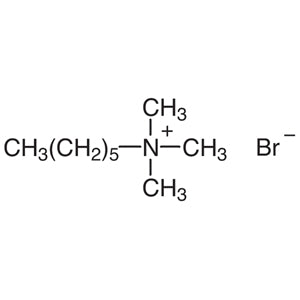
TCI H0534 Hexyltrimethylammonium Bromide is a short-to-medium chain quaternary ammonium salt that functions both as a phase transfer catalyst and as a cationic surfactant in organic synthesis work. Its molecule consists of a positively charged trimethylammonium group bonded to a hexyl chain, with a bromide ion serving as the counter ion. This amphiphilic structure is precisely what allows the compound to carry reactive anions from the aqueous phase into the organic phase, so that reactions which would otherwise proceed slowly because the two reagents sit in different phases can run far more efficiently under milder laboratory conditions.
The properties that make this reagent a preferred choice are its good solubility in both water and polar organic solvents, its stability toward strong bases, and the ease with which it is handled as a solid that can be weighed directly without special equipment. The length of the hexyl chain provides a balance between hydrophilic and lipophilic character, which makes it suitable for liquid-liquid as well as solid-liquid two-phase systems. As a cationic surfactant, the compound also forms micelles above a certain concentration and can modify the surface charge of particles, a property that is exploited in synthesis work.
In Indonesian laboratories, this reagent is typically used in organic synthesis research at universities and in industrial research and development units, where two-phase reaction systems are routine. It is chosen where a reaction needs to be driven under milder conditions rather than through elevated temperature or aggressive solvents, and its handling as a weighable solid suits teaching and research laboratories that do not have specialised dispensing equipment on hand.
TCI brochures (PDF)
- Quaternary Ammonium Salts 2025-11-10 · p. 5
- Colloidal Quantum Dot (QD) Research Reagents 2026-05-21 · p. 9
- Polymer Additives 2026-04-16 · p. 11
Related TCI products
- TCI T2734 1943-11-9 Trimethylnonylammonium Bromide
- TCI T0906 1119-97-7 Tetradecyltrimethylammonium Bromide
- TCI S0364 1120-02-1 Trimethylstearylammonium Bromide
- TCI O0163 2083-68-3 n-Octyltrimethylammonium Bromide
- TCI H0081 57-09-0 Hexadecyltrimethylammonium Bromide
- TCI D1468 1119-94-4 Dodecyltrimethylammonium Bromide
- Phase transfer catalysis in liquid-liquid systems, where the amphiphilic structure ferries reactive anions from the aqueous phase into the organic phase so the reaction proceeds efficiently under milder conditions.
- Phase transfer catalysis in solid-liquid systems, since the balanced hydrophilic and lipophilic character of the hexyl chain suits reactions in which one reagent remains an undissolved solid.
- Base-mediated organic synthesis under two-phase conditions, where the stability of this quaternary ammonium salt toward strong bases allows it to survive the reaction environment intact.
- Micelle-based reaction work, because the compound assembles into micelles above a certain concentration and thereby creates an organised medium for reagents in aqueous systems.
- Surface charge modification of particles in synthesis, exploiting the cationic character of the trimethylammonium head group to alter how particles behave in the reaction mixture.
| Brand | TCI |
|---|---|
| CAS number | 2650-53-5 |
| Molecular formula | — |
| Purity | — |
| Category | Chemistry > Synthetic Reagents > Phase Transfer Catalysts |
| Pack sizes | available in the standard TCI catalogue pack sizes; please confirm the size required when ordering. |
| Physical form | solid, able to be weighed directly without special equipment |
| Storage | keep in a tightly closed container in a cool, dry place |
Store the container tightly closed in a cool, dry place away from moisture, since quaternary ammonium bromide salts are prone to picking up water from humid air, which is a practical concern in the Indonesian climate. Original supplier containers or tightly sealing glass or plastic bottles are appropriate, and the cap should be replaced immediately after weighing. Handle the solid in a well-ventilated area or a fume hood to avoid raising dust, and wear standard laboratory personal protective equipment including a lab coat, safety glasses, and chemical-resistant gloves. Use a clean, dry spatula for each withdrawal to avoid contaminating the bulk material, and keep the compound away from strong oxidising agents. Wash hands thoroughly after handling.
—
Product Categories
Produk Terkait
-
TrimethylnonylammoniumBromide TCI T2734
Regular price Rp 1.801.800,00Regular priceRp 1.275.750,00Sale price Rp 1.801.800,00 -
TetradecyltrimethylammoniumBromide TCI T0906
Regular price From Rp 582.750,00Regular priceRp 423.150,00Sale price From Rp 582.750,00 -
TrimethylstearylammoniumBromide TCI S0364
Regular price Rp 2.013.900,00Regular priceRp 1.423.800,00Sale price Rp 2.013.900,00 -
n-OctyltrimethylammoniumBromide TCI O0163
Regular price From Rp 1.351.350,00Regular priceRp 960.750,00Sale price From Rp 1.351.350,00 -
HexadecyltrimethylammoniumBromide TCI H0081
Regular price From Rp 530.250,00Regular priceRp 386.400,00Sale price From Rp 530.250,00 -
DodecyltrimethylammoniumBromide TCI D1468
Regular price From Rp 928.200,00Regular priceRp 664.650,00Sale price From Rp 928.200,00 -
DecyltrimethylammoniumBromide TCI D1467
Regular price From Rp 1.087.800,00Regular priceRp 775.950,00Sale price From Rp 1.087.800,00 -
ButyltrimethylammoniumBromide TCI B5798
Regular price From Rp 1.351.350,00Regular priceRp 960.750,00Sale price From Rp 1.351.350,00