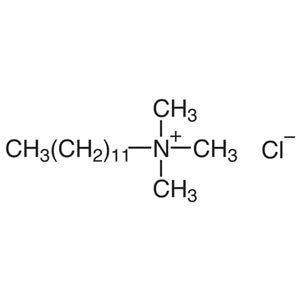
Dodecyltrimethylammonium Chloride (DTAC) is a chemical compound widely used as a phase transfer catalyst in various chemical reactions. It plays a crucial role in laboratory settings by facilitating the transfer of molecules between different phases, particularly between polar and non-polar environments. This property makes it an essential tool for accelerating chemical reactions and improving the efficiency of synthetic processes. DTAC is commonly employed in laboratory experiments where interfacial interactions are required, such as in emulsification, extraction, and polymerization reactions. Its ability to bridge different phases enhances the overall effectiveness of chemical processes and supports a wide range of analytical and synthetic applications.
DTAC is valued for its solubility in both organic solvents and water, which allows it to be versatile in different reaction conditions. Its high ionization potential contributes to its effectiveness in promoting chemical reactions by stabilizing charged intermediates. Additionally, DTAC exhibits good chemical stability and is resistant to degradation, ensuring its long shelf life and consistent performance. These properties make it a preferred choice for researchers and laboratory professionals who require reliable and efficient catalysts for complex chemical processes. Its compatibility with a variety of solvents and reagents further enhances its applicability across different experimental setups.
In Indonesian laboratories, DTAC is extensively used in chemical research, particularly in organic synthesis and analytical chemistry. It is a key component in studies involving phase transfer reactions, where its ability to mediate between different phases is essential. Researchers in Indonesia rely on DTAC for its reliability, efficiency, and adaptability, making it a staple in both academic and industrial laboratory environments. Its widespread use underscores its importance in advancing chemical research and development in the region.
- Organic synthesis reactions benefit from DTAC's ability to facilitate phase transfer, enhancing reaction rates and product yields.
- Analytical chemistry applications utilize DTAC for its solubility properties, aiding in sample preparation and extraction processes.
- Emulsification processes in industrial and research settings rely on DTAC to stabilize oil-water interfaces and improve mixing efficiency.
- Polymerization reactions often incorporate DTAC to promote interfacial interactions and control reaction dynamics.
- Extraction techniques in environmental and pharmaceutical research use DTAC to enhance the transfer of analytes between phases for accurate detection and quantification.
| Brand | TCI |
|---|---|
| CAS number | 112-00-5 |
| Molecular formula | — |
| Purity | — |
| Category | Chemistry > Synthetic Reagents > Phase Transfer Catalysts |
| Pack sizes | Available in various quantities as per standard laboratory supply standards |
| Physical form | Solid powder |
| Storage | Store in a cool, dry place away from moisture and direct sunlight |
DTAC should be stored in a cool, dry environment to maintain its chemical stability and prevent degradation. It is recommended to use airtight containers to protect it from moisture and humidity, which can affect its performance. Since it is a solid powder, it should be handled with care to avoid inhalation or skin contact. Laboratory personnel should wear appropriate personal protective equipment, such as gloves and safety goggles, when working with DTAC. Proper ventilation is also essential to ensure safe handling and minimize exposure risks. DTAC is generally stable under normal storage conditions and does not require refrigeration, making it suitable for long-term storage in standard laboratory settings.
—
Produk Terkait
-
ButyltrimethylammoniumBromide TCI B5798
Regular price From Rp 1.298.850,00Regular price -
(3-Bromopropyl)trimethylammoniumBromide TCI B6051
Regular price Rp 1.829.100,00Regular price -
BenzalkoniumChloride(50%inWater)[forBiochemicalResearch] TCI B6063
Regular price From Rp 743.400,00Regular price -
3-[Bis[2-(methacryloyloxy)ethyl](methyl)ammonio]propane-1-sulfonate TCI B6130
Regular price Rp 3.155.250,00Regular price -
BretyliumTosylate TCI B6544
Regular price Rp 5.803.350,00Regular price -
BetaineAnhydrous[forBiochemicalResearch] TCI B6796
Regular price From Rp 610.050,00Regular price -
L-Carnitine TCI C0049
Regular price From Rp 1.140.300,00Regular price -
DL-CarnitineHydrochloride TCI C0050
Regular price From Rp 1.035.300,00Regular price

![Benzalkonium Chloride (50% in Water) [for Biochemical Research] (CAS 63449-41-2) - TCI B6063 - AMI Scientific](http://amiscientific.com/cdn/shop/files/TCI2510B6063.jpg?v=1768815966&width=533)
ammonio]propane-1-sulfonate (CAS 1314713-40-0) - TCI B6130 - AMI Scientific](http://amiscientific.com/cdn/shop/files/TCI2510B6130.jpg?v=1767093213&width=533)
![Betaine Anhydrous [for Biochemical Research] (CAS 107-43-7) - TCI B6796 - AMI Scientific](http://amiscientific.com/cdn/shop/files/TCI2510B6796.jpg?v=1767094237&width=533)