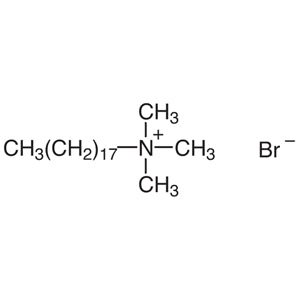
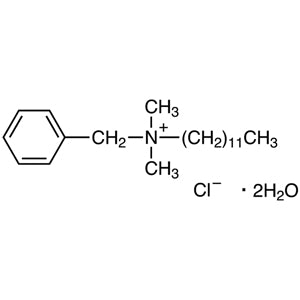
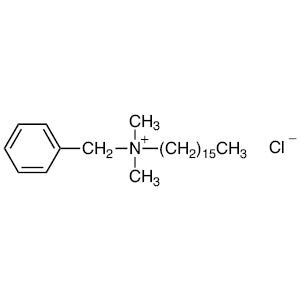
Benzyldimethylstearylammonium Chloride (BDMA) is a chemical compound widely used in laboratory settings for polymer and material science applications. As a cationic surfactant, it plays a crucial role in modifying the surface properties and structural stability of polymers. This compound is commonly employed as an additive during polymer synthesis to enhance the performance of final materials. Its unique molecular structure, consisting of an amine group and a long hydrocarbon chain, allows it to interact effectively with various polymer matrices.
BDMA is preferred due to its ability to improve solubility and intermolecular interactions, which are essential for achieving desired material properties. Its cationic nature enables it to adsorb onto negatively charged surfaces, making it highly effective in surface modification processes. This characteristic is particularly valuable in applications requiring enhanced adhesion, reduced friction, and improved mechanical properties. The compound’s versatility makes it a key reagent in both academic and industrial research environments.
In Indonesian laboratories, BDMA is extensively used in material and polymer research for various purposes, including composite development, surface coating, and physical property modification. Its relevance in the rapidly growing field of material technology and industrial chemistry makes it an essential component for researchers aiming to innovate and improve material performance. The compound’s application is broad, supporting both fundamental and applied research in the chemical sciences.
TCI brochures (PDF)
- Quaternary Ammonium Salts 2025-11-10 · p. 4
- Polymer Additives 2026-04-16 · p. 12
Related TCI products
- TCI S0364 1120-02-1 Trimethylstearylammonium Bromide
- TCI S0087 112-03-8 Trimethylstearylammonium Chloride
- TCI A0208 139-08-2 Benzyldimethyltetradecylammonium Chloride
- TCI B2171 147228-80-6 Benzyldodecyldimethylammonium Chloride Dihydrate
- TCI B0237 122-18-9 Benzylcetyldimethylammonium Chloride
- TCI B0044 121-54-0 Benzethonium Chloride
- Surface modification research benefits from BDMA’s ability to enhance adhesion and reduce surface friction, making it ideal for polymer coating and composite development.
- Polymer additive testing utilizes BDMA to improve the stability and performance of synthetic polymers, supporting both academic and industrial applications.
- Material science experiments leverage BDMA’s cationic properties to modify surface interactions, aiding in the development of advanced functional materials.
- Surface coating development relies on BDMA’s surfactant properties to create durable and functional coatings on various substrates.
- Mechanical property enhancement studies use BDMA to improve the tensile strength and durability of polymer-based materials.
| Brand | TCI |
|---|---|
| CAS number | 122-19-0 |
| Molecular formula | — |
| Purity | — |
| Category | Materials Science > Polymer/Macromolecule Reagents > Polymer Additives |
| Pack sizes | Available in various quantities as per supplier specifications |
| Physical form | Solid powder |
| Storage | Store in a cool, dry place away from moisture and direct sunlight |
BDMA should be stored in a cool, dry environment to maintain its chemical integrity and prevent degradation. It is recommended to keep the compound in a sealed container to avoid exposure to moisture and air, which can affect its performance. Proper ventilation is essential when handling BDMA to minimize inhalation risks. Laboratory personnel should wear appropriate personal protective equipment, such as gloves and safety goggles, when working with this compound. Due to its surfactant nature, BDMA may cause irritation if it comes into contact with skin or eyes, so careful handling is necessary. Storage should be in a location that is inaccessible to children and unauthorized personnel to ensure safety compliance.
—
Product Categories
Produk Terkait
-
TrimethylstearylammoniumBromide TCI S0364
Regular price Rp 2.013.900,00Regular priceRp 1.423.800,00Sale price Rp 2.013.900,00 -
TrimethylstearylammoniumChloride TCI S0087
Regular price From Rp 1.060.500,00Regular priceRp 757.050,00Sale price From Rp 1.060.500,00 -
BenzyldimethyltetradecylammoniumChloride TCI A0208
Regular price From Rp 662.550,00Regular priceRp 478.800,00Sale price From Rp 662.550,00 -
BenzyldodecyldimethylammoniumChlorideDihydrate TCI B2171
Regular price Rp 1.881.600,00Regular priceRp 1.331.400,00Sale price Rp 1.881.600,00 -
BenzylcetyldimethylammoniumChloride TCI B0237
Regular price From Rp 955.500,00Regular priceRp 683.550,00Sale price From Rp 955.500,00 -
BenzethoniumChloride TCI B0044
Regular price From Rp 689.850,00Regular priceRp 497.700,00Sale price From Rp 689.850,00 -
TrimethyltetradecylammoniumChloride TCI T0926
Regular price From Rp 1.008.000,00Regular priceRp 720.300,00Sale price From Rp 1.008.000,00 -
n-OctyltrimethylammoniumChloride TCI O0178
Regular price From Rp 1.220.100,00Regular priceRp 868.350,00Sale price From Rp 1.220.100,00