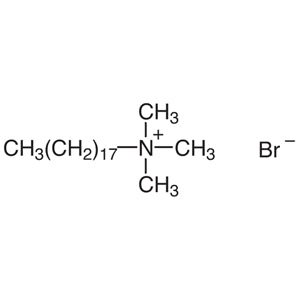
Trimethylstearylammonium Chloride from TCI, also known as octadecyltrimethylammonium chloride, is a quaternary ammonium salt that acts as a cationic surfactant. In the catalogue it is listed among the colloidal quantum dot research reagents. Each molecule has a positively charged trimethylammonium head group and a long octadecyl tail. In the laboratory, the compound serves as a structure-directing agent, a colloidal stabilizer, a phase-transfer agent, and a surface modifier in nanomaterial synthesis and formulation work.
Researchers choose this compound because its positive charge is permanent and does not depend on pH. As a result, its electrostatic interaction with negatively charged surfaces stays reliable across a wide range of reaction conditions. The long C18 tail is strongly hydrophobic and helps micelles form. That behaviour matters when templating pores in mesoporous silica and when stabilizing nanocrystals and quantum dots. Three pack sizes (25 g, 100 g, and 500 g) cover needs from early exploratory research up to laboratory-scale material production, so groups can scale up without changing reagent source.
In Indonesia, this reagent is relevant to materials science and nanotechnology laboratories at universities and research institutions, for example in quantum dot synthesis and studies of nanostructured materials. Research groups working on mesoporous materials, colloidal nanocrystals, and surface-modified particles can use it as a consistent cationic surfactant in their experimental protocols. Its role as a template and stabilizer makes it useful in thesis research, funded projects, and method development in materials chemistry laboratories.
TCI brochures (PDF)
- Quaternary Ammonium Salts 2025-11-10 · p. 4
- Colloidal Quantum Dot (QD) Research Reagents 2026-05-21 · p. 10
- Polymer Additives 2026-04-16 · p. 11
Related TCI products
- TCI S0364 1120-02-1 Trimethylstearylammonium Bromide
- TCI T0926 4574-04-3 Trimethyltetradecylammonium Chloride
- TCI O0178 10108-86-8 n-Octyltrimethylammonium Chloride
- TCI H0082 112-02-7 Hexadecyltrimethylammonium Chloride
- TCI D1306 10108-87-9 Decyltrimethylammonium Chloride
- TCI D1016 112-00-5 Dodecyltrimethylammonium Chloride
- Mesoporous silica templating: the long C18 tail drives micelle formation, which provides the template around which ordered pores form during silica synthesis.
- Quantum dot stabilization: the cationic head group and hydrophobic tail help keep colloidal quantum dots dispersed and stable during synthesis and post-synthetic processing.
- Nanocrystal synthesis as a structure-directing agent: its surfactant behaviour helps guide the growth and organization of nanomaterials in solution-based preparation routes.
- Phase-transfer processes: as a quaternary ammonium salt, it can help move charged species or particles between aqueous and organic phases in synthesis and formulation work.
- Surface modification of negatively charged materials: its permanent, pH-independent positive charge allows reliable electrostatic binding to anionic surfaces to change their interfacial properties.
| Brand | TCI (product code S0087) |
|---|---|
| CAS number | 112-03-8 |
| Molecular formula | — |
| Purity | — |
| Category | Materials Science > Electronic Materials > Colloidal Quantum Dot (QD) Research Reagents |
| Pack sizes | 25 g, 100 g, 500 g |
| Physical form | — |
| Storage | follow the conditions on the TCI product label and Safety Data Sheet |
- Chemical class: quaternary ammonium salt, cationic surfactant
Keep this reagent in its original, tightly closed container in a cool, dry, well-ventilated area, away from moisture, direct sunlight, and incompatible materials such as strong oxidizing agents. Reseal the container promptly after each use to protect product quality. Handle the material with standard laboratory personal protective equipment, including gloves, safety glasses, and a lab coat. Avoid creating or breathing dust, and prevent contact with skin and eyes. Because cationic surfactants can irritate tissue, work in a fume hood or a well-ventilated area when weighing. Always check the TCI Safety Data Sheet for detailed hazard, storage, and disposal information, and dispose of waste in line with local regulations.
—
Produk Terkait
-
TrimethylstearylammoniumBromide TCI S0364
Regular price Rp 2.013.900,00Regular priceRp 1.423.800,00Sale price Rp 2.013.900,00 -
TrimethyltetradecylammoniumChloride TCI T0926
Regular price From Rp 1.008.000,00Regular priceRp 720.300,00Sale price From Rp 1.008.000,00 -
n-OctyltrimethylammoniumChloride TCI O0178
Regular price From Rp 1.220.100,00Regular priceRp 868.350,00Sale price From Rp 1.220.100,00 -
HexadecyltrimethylammoniumChloride TCI H0082
Regular price From Rp 928.200,00Regular priceRp 664.650,00Sale price From Rp 928.200,00 -
DecyltrimethylammoniumChloride TCI D1306
Regular price Rp 2.757.300,00Regular priceRp 1.943.550,00Sale price Rp 2.757.300,00 -
DodecyltrimethylammoniumChloride TCI D1016
Regular price From Rp 980.700,00Regular priceRp 701.400,00Sale price From Rp 980.700,00 -
BenzyldimethylstearylammoniumChloride TCI B1297
Regular price From Rp 955.500,00Regular priceRp 683.550,00Sale price From Rp 955.500,00 -
TrimethylnonylammoniumBromide TCI T2734
Regular price Rp 1.801.800,00Regular priceRp 1.275.750,00Sale price Rp 1.801.800,00