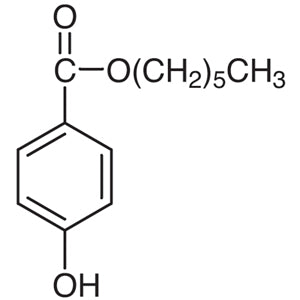
Hexyl 4-Hydroxybenzoate is the hexyl ester of 4-hydroxybenzoic acid and occupies a bridging position within the paraben homologous series, sitting between medium-chain esters such as butyl and longer-chain esters such as heptyl or nonyl. In the laboratory it serves as an analytical reference material, as a test compound in antimicrobial research, and as a non-heterocyclic building block for organic synthesis. Its availability completes the homologous collection researchers need when they wish to map how physicochemical properties and biological activity shift incrementally with the addition of each successive methylene group.
The principal characteristic of this ester is a lipophilicity distinctly higher than that of methyl, ethyl, or butyl paraben, yet not as extreme as that of the nine-carbon homologue. This combination yields a compound that remains dissolvable in common organic solvents while already showing a strong tendency to partition into the non-polar phase. The phenolic hydroxyl group at the para position provides a chromophore for ultraviolet detection and simultaneously acts as a reactive site for selective etherification or acylation, while the ester group can be hydrolysed or transesterified as the synthetic route requires.
In Indonesian laboratories, this material is typically encountered in analytical chemistry and formulation research groups, in university and institutional research units running preservative and antimicrobial studies, and in synthesis laboratories preparing substituted benzoate derivatives. It is generally purchased in small research quantities alongside other members of the paraben series, so that a complete homologous set is on hand for comparative work, method development, and the construction of calibration or reference series.
Related TCI products
- TCI A3639 63435-16-5 Methyl 4-Amino-3-hydroxybenzoate
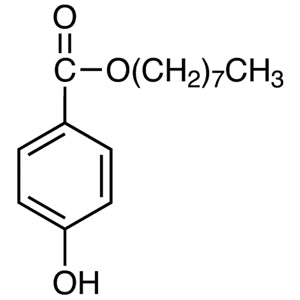
- TCI O0443 1219-38-1 n-Octyl 4-Hydroxybenzoate
- TCI M3513 3964-57-6 Methyl 3-Chloro-4-hydroxybenzoate
- TCI M3498 536-25-4 Methyl 3-Amino-4-hydroxybenzoate
- TCI M2796 1882-72-0 Methyl 2-Amino-5-hydroxybenzoate
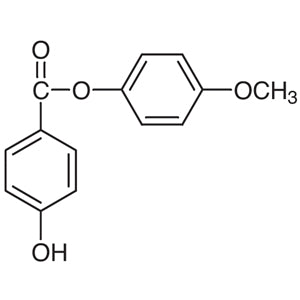
- TCI H0825 50687-62-2 4-Methoxyphenyl 4-Hydroxybenzoate
- Analytical reference standard — the defined structure and ultraviolet-active phenolic chromophore make it well suited for preparing comparison solutions and identifying paraben peaks in chromatographic separations.
- Antimicrobial screening studies — as a test compound within the paraben homologous series, it allows researchers to relate antimicrobial response directly to increasing alkyl chain length under identical assay conditions.
- Non-heterocyclic building block for organic synthesis — the free phenolic hydroxyl and the ester function provide two independently addressable handles for selective etherification, acylation, hydrolysis, or transesterification steps.
- Structure–activity relationship mapping — its intermediate chain length fills the gap between short and long homologues, giving a continuous data series for correlating lipophilicity with observed biological effect.
- Partitioning and solubility investigations — its markedly non-polar character combined with retained solubility in common organic solvents suits studies of phase distribution behaviour and solvent system development.
| Brand | TCI |
|---|---|
| CAS number | 1083-27-8 |
| Molecular formula | — |
| Purity | — |
| Category | Chemistry > Building Blocks > Non-Heterocyclic Building Blocks |
| Pack sizes | available in research-scale laboratory pack sizes; please refer to the current catalogue listing for the options offered |
| Physical form | — |
| Storage | keep in the tightly closed original container, protected from light and stored according to the manufacturer's label instructions |
- Product code: H0213
Store the container tightly closed in a cool, dry place away from direct sunlight and sources of heat or ignition, following the storage conditions stated on the manufacturer's label. Amber glass or the original supplier container is preferred, as it limits light exposure and prevents the moisture ingress that can promote ester hydrolysis. Handle the material in a well-ventilated area or a fume hood, using standard personal protective equipment including a laboratory coat, safety glasses, and chemical-resistant gloves. Avoid generating dust, avoid contact with skin and eyes, and weigh the compound on clean, dry equipment. Keep it separated from strong bases, strong acids, and strong oxidising agents, all of which may attack the ester linkage or the phenolic hydroxyl group. Consult the manufacturer's safety data sheet before first use and dispose of residues in accordance with applicable laboratory waste procedures.
—
Produk Terkait
-
Methyl4-Amino-3-hydroxybenzoate TCI A3639
Regular price From Rp 2.041.200,00Regular price -
n-Octyl4-Hydroxybenzoate TCI O0443
Regular price Rp 1.724.100,00Regular price -
Methyl3-Chloro-4-hydroxybenzoate TCI M3513
Regular price From Rp 1.458.450,00Regular price -
Methyl3-Amino-4-hydroxybenzoate TCI M3498
Regular price From Rp 1.378.650,00Regular price -
Methyl2-Amino-5-hydroxybenzoate TCI M2796
Regular price From Rp 717.150,00Regular price -
4-Methoxyphenyl4-Hydroxybenzoate TCI H0825
Regular price From Rp 4.531.800,00Regular price -
2-Hydroxyethyl4-Hydroxybenzoate TCI H0698
Regular price Rp 1.829.100,00Regular price -
2-Ethylhexyl4-Hydroxybenzoate TCI H0506
Regular price From Rp 823.200,00Regular price