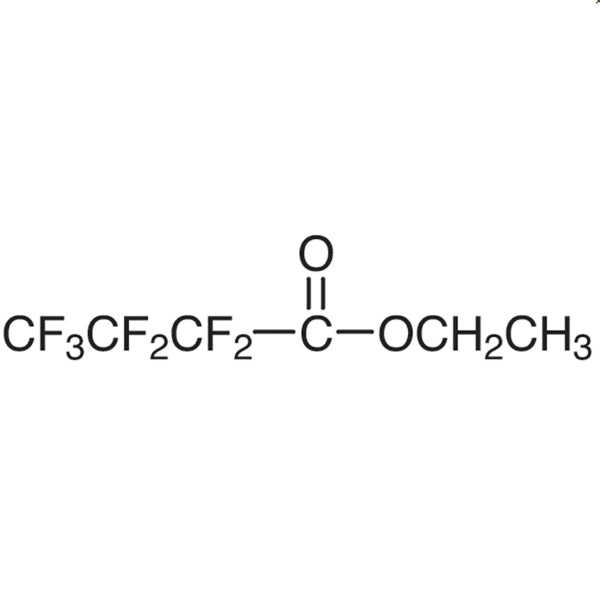
Ethyl Heptafluorobutyrate is the ethyl ester of heptafluorobutyric acid, a compound that carries a three-carbon perfluorinated chain in which every hydrogen atom has been replaced by fluorine. The presence of this perfluoroalkyl group gives the molecule electronic behaviour that differs sharply from that of an ordinary ester, and it is this difference that places the compound in its own category as a fluorinated building block. In the laboratory, the material is used to introduce a perfluoropropyl fragment into target molecules, most often in the synthesis of fluorinated heterocyclic compounds and in analytical derivatisation work.
The property that makes this reagent a preferred choice is the strong electron-withdrawing effect of the heptafluoropropyl chain, which renders the ester carbonyl carbon far more electrophilic than that of a conventional aliphatic ester. As a consequence, the compound reacts rapidly with nucleophiles such as enolates, amines, and organometallic reagents. Claisen condensation with methyl ketones, for example, delivers fluorinated 1,3-diketones that can subsequently be cyclised into fluorine-substituted pyrazoles and pyrimidines. The embedded fluorinated fragment also raises the metabolic stability and lipophilicity of the resulting compounds, two attributes of considerable value in medicinal chemistry programmes.
In Indonesian laboratories, this building block is typically found in university research groups and institutional synthesis facilities working on fluorinated heterocycles, in pharmaceutical discovery work where fluorine substitution is used to tune a candidate molecule, and in analytical laboratories that prepare derivatives before chromatographic measurement. Because it is a specialty reagent rather than a bulk solvent, it is normally ordered in small research quantities and kept under controlled conditions until the specific synthetic step that requires it.
- Synthesis of fluorinated heterocycles — the activated ester reacts with enolates to give fluorinated 1,3-diketones that cyclise cleanly into pyrazole and pyrimidine ring systems bearing fluorine substituents.
- Claisen condensation with methyl ketones — the highly electrophilic carbonyl carbon accepts enolate attack far more readily than ordinary aliphatic esters, allowing condensation to proceed quickly under mild laboratory conditions.
- Introduction of perfluoropropyl fragments — the reagent transfers a complete three-carbon perfluorinated chain into a target molecule in a single step, avoiding multi-stage fluorination sequences entirely.
- Analytical derivatisation work — the compound converts nucleophilic functional groups into fluorinated derivatives, a common preparation step before instrumental analysis of samples in research and quality laboratories.
- Medicinal chemistry building block applications — the embedded fluorinated fragment increases metabolic stability and lipophilicity of the product, properties routinely sought when optimising candidate molecules during drug discovery.
| Brand | TCI |
|---|---|
| CAS number | 356-27-4 |
| Molecular formula | — |
| Purity | — |
| Category | Chemistry > Building Blocks > Fluorinated Building Blocks |
| Pack sizes | available in standard TCI research pack sizes; please confirm the packaging option required when ordering |
| Physical form | — |
| Storage | store according to the conditions stated on the manufacturer's label and safety data sheet |
- Product code: H0594
- Chemical name: Ethyl Heptafluorobutyrate
Store the container tightly closed in a cool, dry, well-ventilated area away from direct sunlight, heat sources, and incompatible materials, following the conditions given on the manufacturer's label and safety data sheet. Keep the reagent in its original supplier container or in a compatible tightly sealed glass vessel, as the ester is moisture-sensitive in the presence of nucleophiles and reacts readily with amines and organometallic reagents. Handle it inside a fume hood using appropriate gloves, safety goggles, and a laboratory coat. Transfer quantities carefully, close the container immediately after use, and keep it separated from bases and strong nucleophiles during storage. Consult the safety data sheet before first use and before any waste disposal step.
—
Produk Terkait
-
MethylHeptafluorobutyrate TCI H1033
Regular price From Rp 1.035.300,00Regular price -
2,2,3,3,4,4,4-Heptafluoro-1-butanol TCI H0548
Regular price From Rp 1.353.450,00Regular price -
HeptafluorobutyrylChloride[forHeptafluorobutyration] TCI H0508
Regular price From Rp 1.485.750,00Regular price -
Ethyl4,4,4-Trifluorobut-2-ynoate TCI E1495
Regular price Rp 6.651.750,00Regular price -
Ethyl4,4,4-Trifluorobutyrate TCI E0830
Regular price From Rp 848.400,00Regular price -
HeptafluorobutyricAnhydride TCI H0337
Regular price Rp 2.279.550,00Regular price -
HeptafluorobutyricAcid TCI H0024
Regular price From Rp 2.545.200,00Regular price -
4,4,4-TrifluorobutyricAcid TCI T2670
Regular price From Rp 848.400,00Regular price


![Heptafluorobutyryl Chloride [for Heptafluorobutyration] (CAS 375-16-6) - TCI H0508 - AMI Scientific](http://amiscientific.com/cdn/shop/files/TCI2510H0508.jpg?v=1768360590&width=533)