


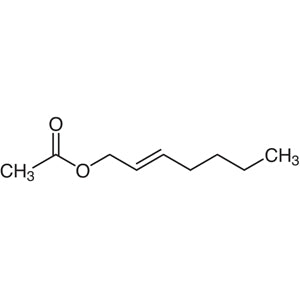
TCI H0849 6-Heptenyl Acetate is the acetate ester of 6-hepten-1-ol, a seven-carbon chain compound carrying a terminal double bond at one end and an acetate ester group at the other. It belongs to the family of non-heterocyclic building blocks and is valuable because it combines a terminal alkene that is reactive toward metal catalysis with a hydroxyl group already protected as an ester. In the laboratory, this compound is widely used as a substrate in metathesis, hydroformylation, and hydrofunctionalization reactions, as well as an intermediate in the synthesis of insect pheromones and aroma compounds.
The property that makes it a preferred choice is the clean division of labour between the two ends of the molecule. The sterically unhindered terminal alkene is an ideal substrate for ruthenium catalysts in both cross metathesis and ring-closing metathesis, and equally suitable for hydroboration, epoxidation, dihydroxylation, and thiol-ene radical addition. The acetate group, meanwhile, is stable under many neutral reaction conditions, yet is readily hydrolysed with mild base or reduced to liberate the primary alcohol whenever that free hydroxyl is required.
Because it is a liquid at room temperature and soluble in common organic solvents, the material is straightforward to handle in Indonesian laboratories. It is typically measured out by syringe or pipette for small-scale reactions in academic organic synthesis groups, fragrance and flavour research units, and agricultural research programmes working on pheromone-based pest monitoring. Its role is generally that of a starting material or intermediate rather than an end product, feeding into multi-step routes.
- Olefin metathesis substrate — the unhindered terminal alkene reacts cleanly with ruthenium catalysts in cross metathesis and ring-closing metathesis, giving predictable chain extension or macrocycle formation.
- Insect pheromone synthesis — the seven-carbon chain with terminal unsaturation and a masked alcohol maps directly onto many acetate-type pheromone structures used in agricultural pest monitoring work.
- Hydroformylation studies — the terminal double bond accepts carbon monoxide and hydrogen under transition metal catalysis, extending the chain by one carbon while the acetate group remains untouched.
- Thiol-ene and radical addition chemistry — the terminal alkene is a reliable acceptor for thiyl radicals, making the compound a convenient model substrate for click-type conjugation and polymer functionalization experiments.
- Aroma and fragrance compound preparation — it serves as an intermediate in building ester-bearing volatile molecules, with the acetate function retained in the product or removed by mild hydrolysis.
| Brand | TCI (Tokyo Chemical Industry) |
|---|---|
| CAS number | 5048-30-6 |
| Molecular formula | — |
| Purity | — |
| Category | Chemistry > Building Blocks > Non-Heterocyclic Building Blocks |
| Pack sizes | supplied in standard TCI research-scale packaging; please confirm the available pack size when ordering |
| Physical form | liquid at room temperature, soluble in common organic solvents |
| Storage | keep in a cool, tightly closed container away from light and heat |
- Catalogue number: H0849
Store the container tightly closed in a cool, well-ventilated area away from direct sunlight, heat sources, and ignition sources. Amber glass bottles with solvent-resistant caps are appropriate, as the terminal alkene may be sensitive to prolonged exposure to light and air; keeping the headspace small or blanketing with inert gas after each withdrawal helps preserve quality over repeated use. Handle inside a fume hood, wearing safety goggles, a laboratory coat, and chemically resistant gloves. Transfer the liquid by syringe or pipette rather than pouring, and keep it separate from strong oxidizing agents and strong bases, which can attack either the alkene or the ester function. Always consult the manufacturer's safety data sheet before first use and dispose of residues through the laboratory's organic waste stream.
—
Produk Terkait
-
trans-2-HeptenylAcetate TCI A1145
Regular price Rp 2.174.550,00Regular price -
ButylAcetate[forSpectrophotometry] TCI A0228
Regular price Rp 1.538.250,00Regular price -
VinylAcetateMonomer(stabilizedwithHQ) TCI A0045
Regular price Rp 477.750,00Regular price -
PropylAcetate TCI A0044
Regular price From Rp 477.750,00Regular price -
PhenylAcetate TCI A0043
Regular price Rp 452.550,00Regular price -
n-OctylAcetate TCI A0042
Regular price From Rp 505.050,00Regular price -
NonylAcetate TCI A0041
Regular price From Rp 505.050,00Regular price -
4-NitrophenylAcetate TCI A0040
Regular price From Rp 3.896.550,00Regular price
![123-86-4 Butyl Acetate [for Spectrophotometry] - AMI Scientific](http://amiscientific.com/cdn/shop/files/TCI2510A0228.jpg?v=1767078302&width=533)


