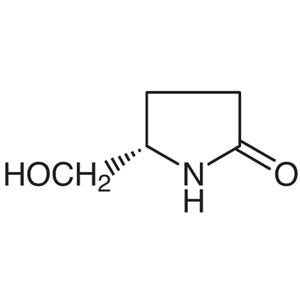
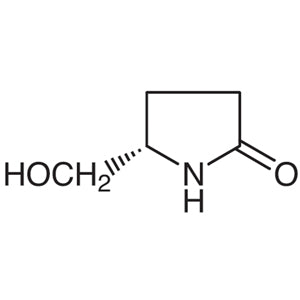
TCI H1241, CAS 66673-40-3, is (R)-5-(Hydroxymethyl)-2-pyrrolidinone, a chiral organic compound that serves as a fundamental building block in asymmetric synthesis. Its structure combines a five-membered lactam ring (2-pyrrolidinone) with a hydroxymethyl group at the 5-position, presenting two distinct reactive sites within a single compact molecule. In organic chemistry research laboratories, a compound of this type becomes a starting point for researchers who want to construct complex molecules with controlled stereochemical configuration, particularly in drug discovery programmes and chiral catalyst development work.
The principal characteristic that makes this material a preferred choice is its stereochemical purity. The clearly defined (R) configuration allows researchers to carry chirality information from the starting material through to the final product without requiring expensive and material-wasteful racemic resolution steps. The primary hydroxyl group on the side chain is readily derivatised through esterification, etherification, tosylation, or oxidation, while the lactam nitrogen can be alkylated or protected according to the requirements of the synthetic route. This combination of two orthogonal reactive points is precisely what gives the compound its high degree of flexibility in multi-step synthetic planning.
In Indonesian laboratories, materials of this type are generally used within university research groups, chemistry postgraduate programmes, and pharmaceutical research and development divisions working on stereoselective synthesis. The compound is typically ordered in research-scale quantities for route exploration, method development, and the preparation of intermediates that will be carried forward into subsequent reaction steps. Its role is as a chiral starting material whose configuration is retained throughout the synthetic sequence being developed.
- Asymmetric synthesis route development — the defined (R) configuration lets researchers establish stereochemistry at the outset rather than relying on downstream resolution of racemic mixtures.
- Chiral building block for drug discovery — the pyrrolidinone core appears widely in bioactive scaffolds, making this a practical entry point for constructing stereochemically defined candidate molecules.
- Chiral catalyst and ligand preparation — both the hydroxyl group and the lactam nitrogen can be modified to build ligand frameworks that transfer chirality in catalytic transformations.
- Selective derivatisation studies — the primary hydroxyl undergoes esterification, etherification, tosylation, or oxidation, allowing systematic comparison of reaction conditions on a single well-defined substrate.
- Protecting group strategy work — the lactam nitrogen can be alkylated or protected independently of the side chain, supporting orthogonal protection schemes in multi-step synthetic sequences.
| Brand | TCI |
|---|---|
| CAS number | 66673-40-3 |
| Molecular formula | — |
| Purity | — |
| Category | Chemistry > Asymmetric Synthesis > Chiral Building Blocks |
| Pack sizes | available in standard research-scale packaging; please confirm the currently available sizes when ordering |
| Physical form | — |
| Storage | store according to the conditions stated on the manufacturer's label and safety data sheet |
- Chemical name: (R)-5-(Hydroxymethyl)-2-pyrrolidinone
- Catalogue code: H1241
Store the container tightly closed in a cool, dry, well-ventilated area away from direct sunlight and sources of heat or ignition, following the conditions stated on the manufacturer's label and safety data sheet. Keep the material in its original supplier container, or in a chemically compatible, clearly labelled closed container if transfer is necessary, and minimise exposure to atmospheric moisture during weighing. Handle in a fume hood using appropriate personal protective equipment, including gloves, safety goggles, and a laboratory coat. Avoid contact with skin and eyes and avoid inhalation of dust. Review the safety data sheet before first use, and dispose of residues and contaminated materials through the laboratory's chemical waste procedures.
—
Produk Terkait
-
(S)-5-(Hydroxymethyl)-2-pyrrolidinone TCI H0867
Regular price From Rp 1.298.850,00Regular price -
(2R,3R,5S,6S)-5,6-Bis(hydroxymethyl)-2,3-dimethoxy-2,3-dimethyl-1,4-dioxane TCI B3695
Regular price Rp 1.220.100,00Regular price -
(2S,4R)-1-(tert-Butoxycarbonyl)-4-hydroxy-2-(hydroxymethyl)pyrrolidine TCI B3662
Regular price From Rp 1.273.650,00Regular price -
tert-Butyl(S)-4-(Hydroxymethyl)-2,2-dimethyloxazolidine-3-carboxylate TCI B5657
Regular price From Rp 3.260.250,00Regular price -
(S)-1-(tert-Butoxycarbonyl)-3-pyrrolidinol TCI B3055
Regular price From Rp 530.250,00Regular price -
(R)-1-(tert-Butoxycarbonyl)-3-pyrrolidinol TCI B3054
Regular price From Rp 1.803.900,00Regular price -
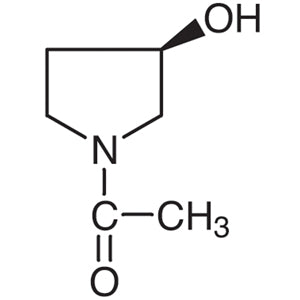
(R)-1-Acetyl-3-pyrrolidinol TCI A2049
Regular price Rp 3.155.250,00Regular price -
(S)-3-Pyrrolidinol TCI P1667
Regular price From Rp 2.491.650,00Regular price